
TAUD Criticises Appeal Verdict for Soldiers Involved in Acid Attack on Andrie Yunus
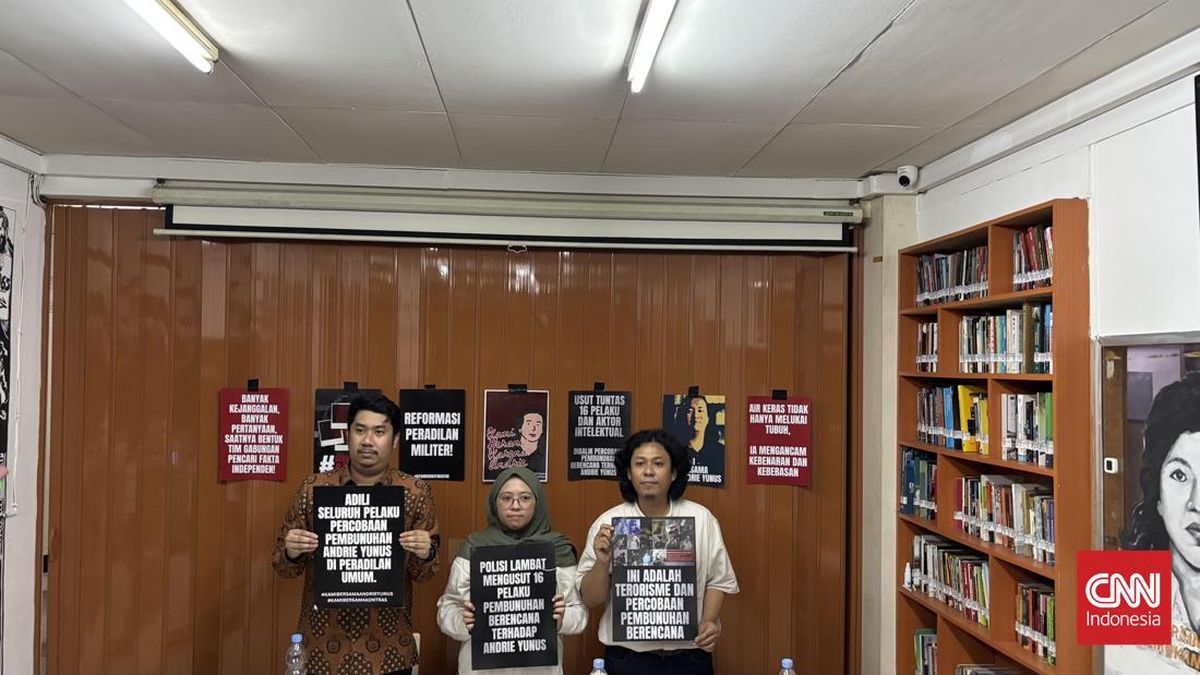
The Military High Court has overturned the dismissal penalty against members of the TNI Strategic Intelligence Agency (BAIS) who were defendants in the acid attack on Andrie Yunus, the External Co-ordinator of the Commission for the Disappeared and Victims of Violence (KontraS). This appellate court decision modifies the ruling of Military Court II-0BB Jakarta (No: 70-K/PM II-08/AL/2026) dated 10 June 2026.
Responding to this, the Advocacy for Democracy (TAUD) team, which has been representing Andrie, stated that the appeal verdict proves a miscarriage of justice. They asserted that the decision to annul the dismissal of the two defendants and the imposition of light prison sentences further demonstrates military impunity through the military justice system.
“The verdict’s wording creates uncertainty and serious questions regarding the status of the additional penalty of dismissal from military service,” said Jane Rosalina Rumpia from KontraS, part of TAUD, in a press statement on Friday (4/9). Jane noted that the verdict appeared irregular and unusual, as it modified the primary sentence without clarifying whether the additional penalty of dismissal from military service, imposed at the first instance, had also been modified or remained in effect.
According to the group, this ambiguity reasonably creates the impression that the dismissal of Defendants I Edi Sudarko and II Budhi Hariyanto Widhi has been annulled. “The ambiguity in the verdict reinforces public suspicion that the military court serves as an infrastructure for impunity and a venue to protect fellow soldiers,” Jane added. She noted this aligns with TAUD’s initial suspicions, drawing parallels to previous military court cases, such as the 1997-1998 abduction of pro-democracy activists involving the Kopassus ‘Tim Mawar’.
Jane stated that the military court still relies on regulations dating back to the New Order era and fails to prioritise the victim’s perspective. She argued that the appeal verdict failed to consider the significant harm suffered by the victim, including permanent damage to his eyesight and approximately 20 per cent skin burns.
Regarding military court reform, Jane argued that the ruling underscores the necessity of reforming the military court system to align with modern criminal law, victim protection principles, and standards of fair justice. Furthermore, the change in the ruling by the Military High Court II Jakarta suggests a sentencing construction that favours the defendants, while the trial was conducted behind closed doors, potentially ignoring relevant evidence and facts.
Jane stated that such conditions prevent a complete search for material truth. This legal construction not only risks damaging the dignity of judicial power but also erodes the principles of a state based on law, which should guarantee legal certainty, transparency, and justice. She questioned the competence of the appellate judges in applying sentencing systems to perpetrators who are state officials with access to intelligence authority.
In cases allegedly involving state actors, Jane argued that the position and capacity of the perpetrators should be a serious factor in determining the severity of the sentence. Instead of increasing accountability, the appeal verdict reduced the punishment, including removing the additional penalty of dismissal for the two defendants.
According to Jane, this issue is inseparable from the structural problems of a military court system that is incompatible with the modern criminal justice system. The existence of a military court that lacks compatibility with modern standards tends to ignore the principles of scientific crime investigation, where evidence must be scientifically verifiable and accountable. Consequently, the involvement of other actors and their relevance to scientific evidence remains unrevealed, causing the legal process to appear limited only to the four defendants.
Regarding the limitations of the cassation process, Jane noted that the subsequent legal mechanism has limitations in reopening facts and evidence. This is because the jurisdiction of the Supreme Court (MA) is limited to ‘judex juris’, meaning its authority is restricted from re-examining facts. Even when objections regarding evidence are raised, Supreme Court justices often defer to the findings of the previous courts (Dilmil II-08 Jakarta and Dilmilti II Jakarta).
“This legal process reinforces the impression that the military court process, from the first instance to the appeal, is merely cosmetic without ever achieving justice for the victim, even indicating a miscarriage of justice,” said Jane. In light of these issues, TAUD is urging the Supreme Court and the Judicial Commission (KY) to transparently follow up on the victim’s complaint regarding alleged ethical violations by the judges of Military Court II-08 Jakarta and to suspend the heads of both the Military Court II-08 Jakarta and Military High Court II Jakarta over allegations of decisions that ignore principles of ethics, independence, impartiality, and integrity.
Source: jawawa.id (https://jawawa.id/newsitem/taud-criticises-appeal-verdict-for-soldiers-involved-in-acid-attack-on-andrie-yunus-1788530405)
Originally published by CNN Indonesia (https://www.cnnindonesia.com/nasional/20260904190415-12-1400212/taud-kritik-putusan-banding-prajurit-penyiram-keras-ke-andrie-yunus), translated from Indonesian