
Task Force Head Ensures Downstream Projects Have Strong Planning Foundation
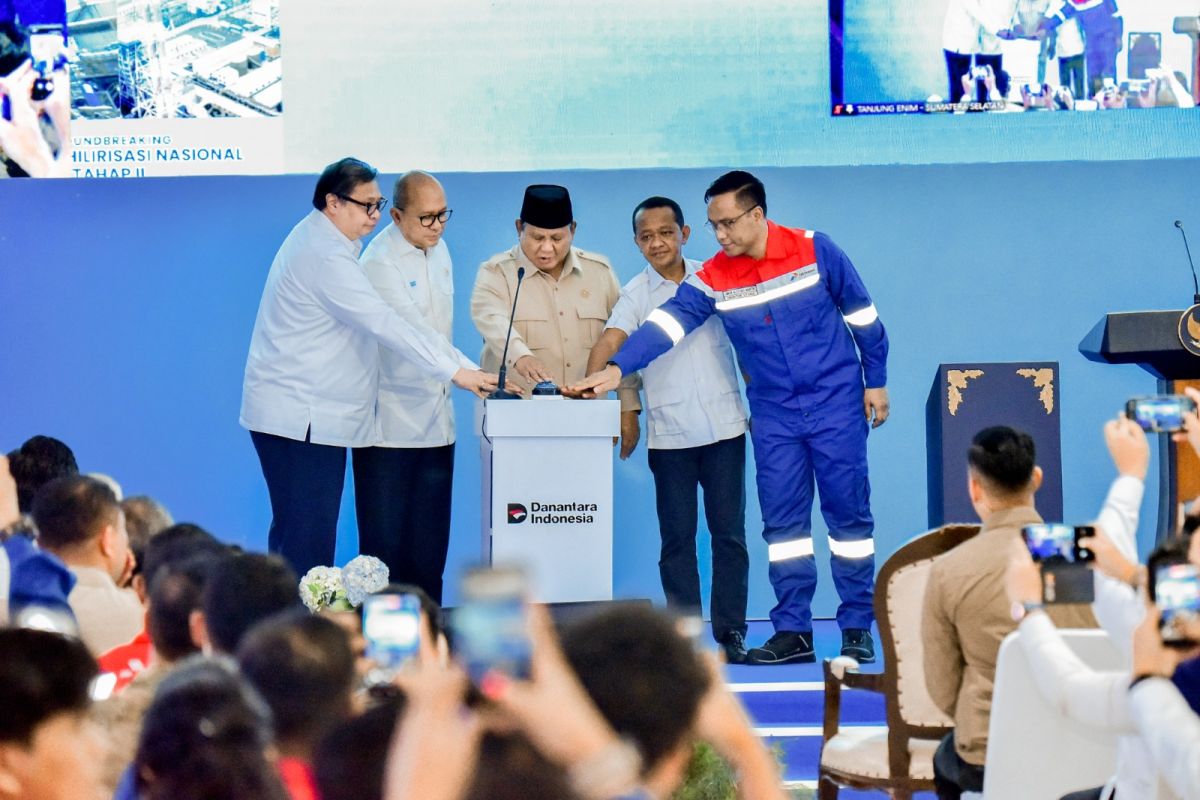
The feasibility study (FS) prepared by the Task Force serves as a crucial foundation to ensure that every downstream project operates with thorough calculations, is on target, and provides maximum benefits for the state and the Indonesian people.
Jakarta (ANTARA) - The Head of the Task Force for Accelerating Downstream Processing and National Energy Resilience, who is also the Minister of Energy and Mineral Resources (ESDM) Bahlil Lahadalia, has assured that downstream projects possess a strong planning foundation.
According to him, in his statement in Jakarta on Thursday, the laying of the first stone or groundbreaking for strategic downstream projects is a concrete follow-up to the feasibility study (FS) compiled by the Downstream Task Force.
Once all studies and FS preparations are completed by the Downstream Task Force, the next stage is executed by the Nusantara Future Power Investment Management Agency (Danantara) to be realised as national strategic investment projects.
The groundbreaking for Phase I and Phase II projects marks that the work of the Downstream Task Force has entered the actual implementation phase on the ground.
Bahlil stated that the downstream projects that have undergone groundbreaking in Phases I and II demonstrate that the Downstream Task Force’s efforts do not stop at the study stage but are immediately followed up into real projects that provide economic impacts for society.
“The FS prepared by the Task Force is an important foundation so that every downstream project runs with mature calculations, is on target, and provides maximum benefits for the state and the Indonesian people,” said Bahlil after the Groundbreaking Ceremony for Phase II Downstream Projects by President Prabowo Subianto at the Cilacap Refinery, Central Java, on Wednesday (29/4/2026).
According to Bahlil, the Downstream Task Force is tasked with ensuring that downstream projects have a strong planning foundation, while the subsequent execution and investment stages are handled by Danantara to make implementation faster and more measurable.
“Once the FS is complete, those projects enter the implementation stage and it becomes Danantara’s task to ensure investments proceed, projects are realised, and their benefits are felt by society,” he emphasised.
According to Bahlil, President Prabowo’s directives are very clear that downstream processing must become a strategic instrument to strengthen national energy resilience, increase the added value of natural resources, and reduce dependence on imports.
“We must no longer merely be exporters of raw materials. Downstream processing must be a tool to strengthen energy sovereignty, increase state revenues, create jobs, and ensure that Indonesia’s natural wealth is truly enjoyed by the Indonesian people,” he stressed.
From the downstream projects that have undergone groundbreaking in Phases I and II, the majority are strategic projects in the ESDM sector, ranging from alumina and bauxite smelters in Mempawah, bioavtur and bioethanol production facilities, gasoline refinery construction, fuel storage facilities, dimethyl ether (DME) projects, to nickel, carbon steel, Buton asphalt, copper, gold, and palm biodiesel downstreaming.
During the inauguration, President Prabowo emphasised that a nation aspiring to advance must dare to master and process its own resources, rather than just selling raw materials.
“We do not want to just sell raw materials. We want to process their derivatives in Indonesia so that the added value is enjoyed by the Indonesian people,” the President explained.
The President also specifically directed the downstream team and Danantara to continuously evaluate projects objectively with the best technological approaches and efficient calculations.
“So, brothers in the downstream team and Danantara, continue to study the technology. Look at it mathematically, mathematically, mathematically,” the President urged.
Meanwhile, the Chief Executive Officer (CEO) of Danantara, Rosan Roeslani, stated that the implementation of all national downstream projects will strengthen energy resilience while driving large-scale job creation.
“We always coordinate with Mr Bahlil as the Minister of ESDM and Head of the Task Force to review downstream projects that we will indeed implement soon for value addition, industry creation, and job creation,” he explained.
The first phase groundbreaking on 6 February 2026 included ESDM sector projects such as alumina smelters into aluminium and bauxite into smelter-grade alumina in Mempawah; bioavtur production facilities from used cooking oil in Cilacap; and bioethanol production facilities in Banyuwangi.
Meanwhile, for the second phase, strategic ESDM sector projects include the construction of gasoline refinery facilities in Cilacap and Dumai; operational fuel storage tanks in Palaran, Biak, and Maumere; coal processing into DME in Tanjung Enim; stainless steel manufacturing from nickel in Morowali; carbon steel slab production from local iron ore in Cilegon; development of the Buton asphalt ecosystem; copper and gold downstreaming in Gresik; and palm oil processing into downstream oleofood products and biodiesel in Sei Mangkei.
Specifically for the construction of gasoline refinery facilities in Cilacap and Dumai, this project is targeted to strengthen national energy self-sufficiency and reduce petrol imports by around 10 per cent of the national volume, with a production capacity of 153,000 kilolitres per year.
Meanwhile, the DME project in Tanjung Enim is a strategic step to support LPG import substitution, given that around 80 per cent of national LPG needs are still met through imports.
With the running of these projects, the government reaffirms its commitment to accelerating the transformation of a downstream-based economy, strengthening national industrialisation, and realising energy sovereignty as the foundation towards a more independent and prosperous Indonesia.