
Task Force and Technical Verification Accelerate Designation of Customary Forests
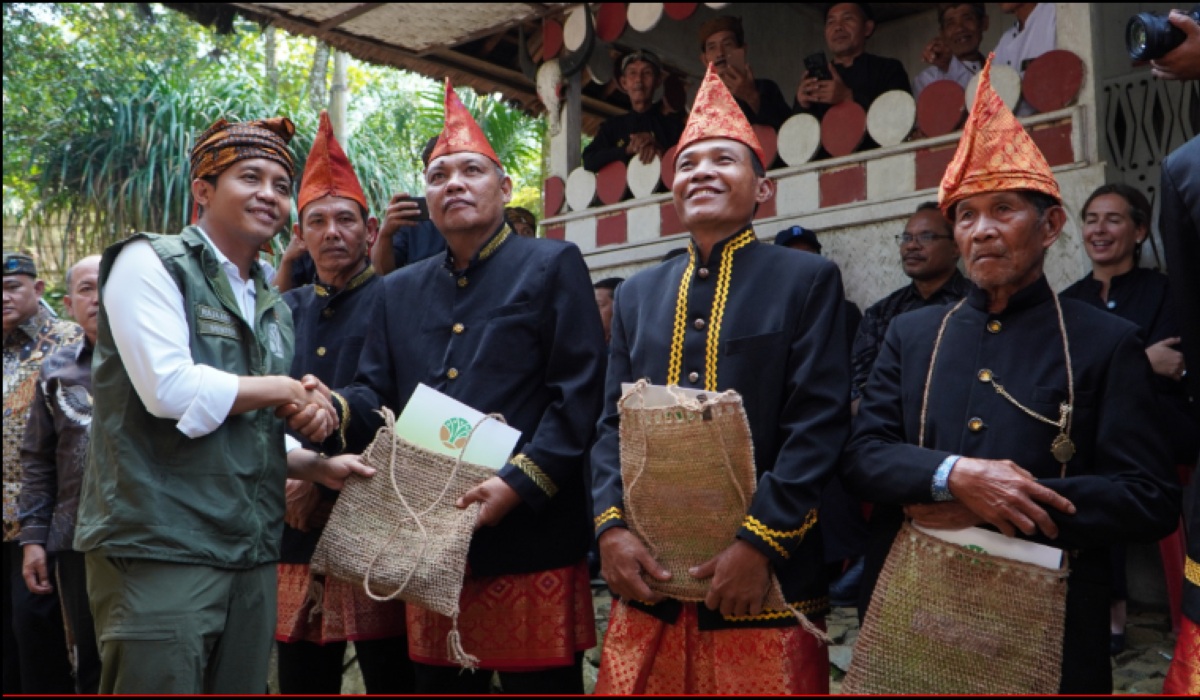
Indonesia’s customary forests are spread across major forest regions, including Sumatra, Kalimantan, and Papua. According to data from the Ministry of Forestry, as of December 2025, there were 174 customary forests covering a total area of approximately 368,877 hectares. The existence of customary forests is not only important from an ecological perspective. For indigenous peoples, the forest is a source of life, a cultural space, and a place to preserve traditional knowledge passed down through generations. Therefore, the recognition and protection of customary forests is a crucial part of efforts to maintain ecosystem sustainability and local wisdom. The establishment of a Task Force for the Acceleration of Customary Forest Designation and the implementation of technical verification for customary forest applications are among the government’s steps to strengthen this protection. This policy is also linked to the government’s target of designating 1.4 million hectares of customary forests by 2029, in line with the expansion of the Social Forestry programme. The protection of genetic resources and local wisdom also has a legal basis. Indonesia has ratified the Nagoya Protocol, implemented through Law Number 11 of 2013 concerning Access to Genetic Resources and the Fair and Equitable Sharing of Benefits. The traditional knowledge of indigenous peoples, including that related to customary forests, is an important part of this protection framework. The recognition of customary forests is a form of respect for indigenous peoples who have long acted as forest guardians. Minister of Forestry Raja Juli Antoni referred to indigenous peoples as the government’s foremost partners in protecting the forests. “We must ensure that forest governance is not only oriented towards physical protection but also social justice. Indigenous peoples are the government’s foremost partners in protecting the forest, the best forest guardian,” said Raja Juli Antoni before the delegation of the 21st session of the United Nations Forum on Forests (UNFF21) at the UN Headquarters in New York on 11 May 2026. According to him, the empowerment of indigenous peoples, women, and youth is key to creating sustainable livelihoods while maintaining ecosystem sustainability. The Chair of the Malinau Customary Forest Designation Verification Team and a political ecology and environmental policy expert from IPB University, Soeryo Adiwibowo, explained that technical verification aims to obtain field facts. The process is carried out to ensure the existence of the customary forest and its compliance with statutory criteria. “One example of such criteria is that the community must still be a cohesive social unit. So we conduct interviews and observations of that community,” said Soeryo, who is familiarly called Bowo. The availability of verifiers is becoming increasingly important as the target for customary forest designation area increases over the next five years. In practice, the verification team is divided into an Object Team and a Subject Team. The Object Team goes directly to the forest location to be verified, while the Subject Team interviews customary leaders, village heads, and customary officials. The team also observes territorial boundaries using maps, GPS, drones, and direct checks inside the forest. During the verification of customary forests in Malinau Regency, North Kalimantan, the Subject Team held focus group discussions with the Abai Sembuak, Punan Adiu, and Punan Long Ranau Indigenous Law Communities. “We collected primary and secondary data from three villages, namely Abai Sembuak Warod, Punan Long Adiu, and Punan Long Ranau in Malinau Regency, last May,” Bowo explained. During the process, the team found that knowledge regarding the boundaries of customary forest areas is mostly held by the older generation. Meanwhile, some young people do not know the detailed boundaries of the customary territory. Therefore, in addition to interviews, the team also directly checked the territorial boundaries according to maps that had been agreed upon based on the regent’s decree when each Indigenous Law Community was designated. Before obtaining a designation decree from the Ministry of Forestry, a customary forest proposal must undergo technical verification. To accelerate this process, the Ministry of Forestry formed a Task Force for the Acceleration of Customary Forest Status Designation. The task force was established based on Minister of Forestry Decree Number 144 of 2025 and updated through Minister of Forestry Decree Number 121 of 2026. The task force’s work is supported by the United Nations Development Programme (UNDP) and the Government of Norway as part of the effort to accelerate customary forest designation. UNDP National Project Manager for the Indonesian Indigenous Law Community Project, M. Yayat Afianto, stated that the Indonesian government made an international commitment at the Wildlife Global Summit in Rio de Janeiro on 4 November 2025. In this commitment, Indonesia set a target to recognise 1.4 million hectares of new customary forests during the 2025-2029 period. According to Yayat, UNDP is working with the Government of Norway to support the achievement of this target through two main activities: capacity building for new verifiers and the implementation of technical verification in the field. “Capacity building activities are needed to increase the number of field verifiers, and verifiers can work properly according to the standards set by the Indonesian government. We are also facilitating the preparation of a syllabus and guidelines for implementing the technical verification,” said Yayat. The Technical Verification Team, also called the Integrated Team, works to verify object and subject data in the field. The team goes directly to meet the community and measures the boundaries of the proposed customary forests. To maintain transparency and scientific credibility, the leadership of the Integrated Team comes from academia. The existence of the Task Force and the Integrated Team for Customary Forest Technical Verification is a continuation of Constitutional Court Decision Number 35.