
Taruna Ikrar Pushes BPOM to Integrate into National Health Architecture
Indonesia’s health transformation is entering an increasingly integrated phase. Data, technology, regulation, drug safety, family health, and future therapeutic innovations are all being placed within a single policy ecosystem.
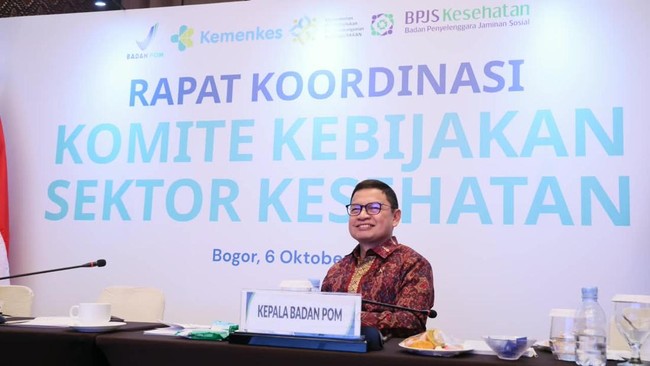
This vision was evident during the third-quarter coordination meeting of the Health Sector Policy Committee (KKSK) held at the Novotel Bogor Golf Resort and Convention Centre on Tuesday (6/1/2026). The meeting brought together Minister of Health Budi Gunadi Sadikin, Minister of Population and Family Development/Head of BKKBN Wihaji, Deputy Minister Ratu Ayu Isyana Bagoes Oka, and leaders from various related institutions.
As the host, the Head of the Indonesian Food and Drug Authority (BPOM), Prof. Taruna Ikrar, presented several strategic BPOM agendas to the KKSK forum. Also in attendance were the President Director of BPJS Kesehatan, Prihati Pujiwaskito, the Executive Head of Insurance, Guarantee, and Pension Fund Supervision of the OJK, Ogi Prastomiyono, and the Chairperson of the Indonesian Health Council, Arianti Anaya.
For Taruna, the KKSK is more than just an inter-agency coordination space; it is a meeting point for various agendas that determine how the national health system operates in a more unified manner. One of the most concrete examples is the integration of drug supervision data. BPOM has provided 11 Application Programming Interfaces (APIs) to SATUSEHAT Logistics, including integrated drug distribution supervision data ranging from the upstream supply to healthcare facilities.
This step was further reinforced in the KKSK conclusions. The use of SATUSEHAT Logistics was agreed upon for monitoring specific medicines, with the Ministry of Health and BPOM playing vital roles in its implementation. Consequently, the digitalisation of supervision is moving from concept to concrete working mechanisms. Drug distribution data will no longer operate in isolation; information from the supply chain can now become part of a more integrated supervision system.
Beyond drug data, the KKSK agenda also addressed the public issue of kratom. Prof. Taruna Ikrar revealed that the KKSK approved a follow-up plan for the use of kratom as a raw material and extract, based on benefit and risk assessments. The agreed steps include clinical trials to examine several indications, including analgesic effects, while also investigating opiate content. BPOM, through its Deputy for the Supervision of Traditional Medicine, Health Supplements, and Cosmetics, will work alongside the Ministry of Health on this follow-up.
This approach places kratom within a scientific framework based on benefits and risks. Simultaneously, BPOM is expanding its focus to future health technologies. BPOM and the Ministry of Health are continuing to coordinate regarding Advanced Therapy Medicinal Products (ATMP), including regulations and policies to strengthen the supervision of ATMP products and processing facilities, as well as the implementation of cell-based and/or stem cell therapies within Special Economic Zones.
Furthermore, BPOM and BPJS Kesehatan have discussed the need for data flows from BPOM to BPJS to obtain membership information from business groups under BPOM’s supervision. Meanwhile, BPOM and the Ministry of Health have agreed on a pilot project simulating capitation financing for natural medicine at community health centres (Puskesmas) and primary clinics in the Special Region of Yogyakarta.
The mapping of facilities, products, and financing schemes will serve as the basis for determining next steps. This series of agendas demonstrates a significant shift: drug and food supervision is increasingly being positioned as part of the health ecosystem, rather than working in separate sectoral silos.
This synergy is further strengthened through cooperation between BPOM and the Ministry of Population and Family Development/BKKBN. During the KKSK forum, both agencies signed a Memorandum of Understanding to synchronise drug and food supervision programmes with family development, population, and family planning programmes. Two primary focuses were identified: first, education on preventing the misuse of certain drugs (OOT), particularly among adolescents; and second, quality control of family planning services.
To ensure service quality, BPOM has socialised the Joint Decree on the Quality Control of Family Planning Services to all technical implementation units. Follow-up actions are directed towards strengthening central-regional coordination and the supervision of contraceptive storage and distribution according to Good Drug Distribution Practices (CDOB), prioritised based on BKKBN mapping.
With this approach, drug quality does not end when the product leaves the production facility; supervision continues through storage, distribution, and until it reaches the public. If all these agendas are linked, BPOM’s position within the KKSK appears increasingly broad, covering drug supervision data, SATUSEHAT Logistics integration, drug misuse prevention, kratom studies, natural medicines, cell-based therapies, and family planning quality.
All these efforts converge on a single interest: ensuring that the health transformation operates on a foundation of data, science, regulation, and public protection. The KKSK conclusions also emphasised the importance of ensuring that various decisions are actively followed up. Outstanding plans will be discussed periodically at the technical and ministerial leadership levels to ensure that the forum moves beyond an exchange of ideas into concrete implementation.
Source: jawawa.id (https://jawawa.id/newsitem/taruna-ikrar-pushes-bpom-to-integrate-into-national-health-architecture-1791359649)
Originally published by CNBC Indonesia (https://www.cnbcindonesia.com/lifestyle/20261007134319-33-774081/taruna-ikrar-dorong-bpom-masuk-ke-arsitektur-kesehatan-nasional), translated from Indonesian