
Target to Complete Repairs of Damaged Schools by 2028, 71,000 Schools to Be Revitalised This Year
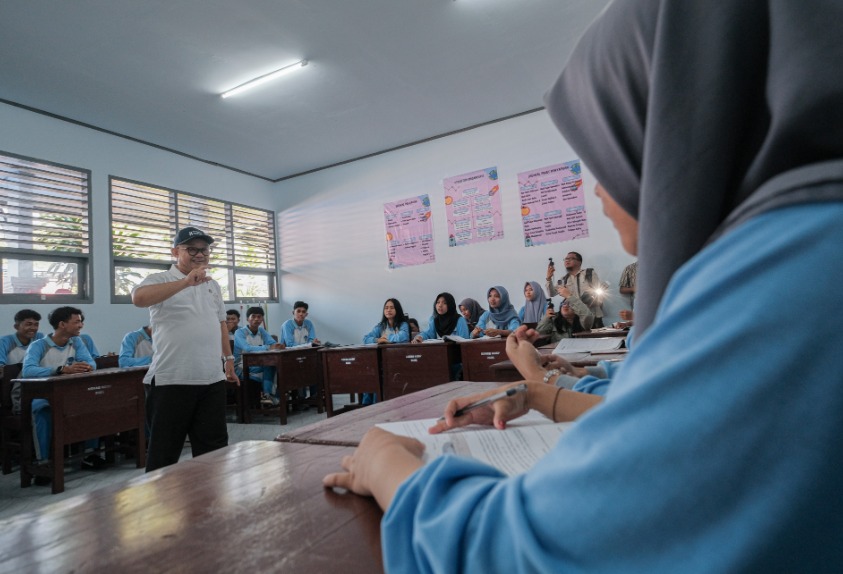
The government’s efforts to build more equitable education infrastructure across the archipelago are becoming increasingly evident through a massive programme to revitalise facilities and infrastructure. Deputy Minister of Primary and Secondary Education, Fajar Riza Ul Haq, inaugurated the revitalisation of educational units in Tabanan Regency on Thursday as part of his official visit to Bali.
For 2026, the government has prepared a state budget allocation to continue the revitalisation of approximately 11,744 educational units. Additionally, following the directive of President Prabowo Subianto, a minimum of 60,000 additional educational units are targeted to receive revitalisation. Consequently, at least 71,000 educational units will receive support from this programme in 2026.
“Since the New Order era built SD Inpres, there has never been another massive school construction or repair initiative except in the era of Mr Prabowo,” Fajar said in his address to hundreds of teachers, regional leaders, and education stakeholders in attendance.
Fajar stressed that the government is targeting that by 2028, there will be no more severely damaged schools in Indonesia, whether at the primary, junior secondary, senior secondary, Madrasah Aliyah, or vocational school levels.
In addition to accelerating school revitalisation, the government is also promoting a digital learning transformation. In 2025, the government has distributed 288,000 Interactive Flat Panel units to educational units across Indonesia and is targeting an increase to 800,000 units in 2026.
The government’s commitment to accelerating the handling of damaged schools was also demonstrated through a direct response to conditions on the ground. Before attending the revitalisation inauguration, Deputy Minister Fajar Riza Ul Haq inspected SD Negeri 3 Sembung Gede, whose building had been demolished after collapsing and endangering the safety of the school community.
As a result of this condition, students are temporarily undergoing lessons in emergency rooms, including the school library. Responding to the situation, Fajar instructed his staff to prioritise the school in the 2026 revitalisation programme. This step demonstrates the government’s rapid response to the needs of schools identified directly in the field.
“Earlier, before going on stage, I told the Deputy Regent that this school would immediately be placed on the priority list,” Fajar said.
During the event, Deputy Minister Fajar also conducted a symbolic signing of the revitalisation representing 22 beneficiaries from the early childhood education, primary, junior secondary, and Community Learning Activity Centre levels. The Tabanan Regency Government also reported that this year, 62 schools in the region received school repair assistance.
Tabanan Deputy Regent I Made Dirga stated that school revitalisation holds a much larger significance than merely the physical construction of buildings.
“School revitalisation is not merely the construction or repair of buildings, but a long-term investment in creating a safe, comfortable, inclusive, and inspiring learning environment for students,” he said.
According to him, education is a civilisational investment that will determine the quality of future generations. Therefore, the Tabanan Regency Government continues to place education as a regional development priority through improving the quality of educational facilities and infrastructure, strengthening teacher and education personnel capacity, developing literacy and numeracy, utilising digital technology, and strengthening culture-based education and local wisdom.
The tangible impact of the revitalisation was heard directly from the testimony of the Head of SMP Negeri 2 Kediri, Ni Luh Putu Septawati. Before receiving assistance, two of her classrooms were severely damaged for three consecutive years. The damage, which initially occurred in the steel frame, continued to spread until the classroom roof was no longer safe to use.
“After waiting for three years with damage that continued to worsen, our school finally received the revitalisation programme,” Septawati said emotionally. Now the two classrooms are fully functional and in very good condition, boosting teacher motivation and student confidence in learning.
Echoing this sentiment, the Head of SD Negeri 3 Marga, I Nyoman Adi Saputra, said that revitalisation is a programme highly anticipated by many educational units in the regions.
“Revitalisation is not just building repairs, but it restores the hopes of students and teachers. Better classrooms bring a more comfortable learning atmosphere, while a good school environment fosters enthusiasm for learning and teaching,” he said.
Concluding the event, Fajar also emphasised that education development is not only carried out through physical infrastructure improvements but also through strengthening teacher quality and transforming learning. According to him, the government continues to strive to strengthen teacher competence so that they are able to utilise various technological support systems and deliver higher quality learning for students.
Fajar invited regional governments, educational units, and all stakeholders to continue strengthening collaboration in overseeing various priority education programmes. Through the acceleration of school revitalisation, digital learning transformation, and strengthening teacher competence, the government hopes that all Indonesian children can learn in a safe, comfortable, and quality environment as part of the effort to realise quality education for all.
Source: jawawa.id (https://jawawa.id/newsitem/target-to-complete-repairs-of-damaged-schools-by-2028-71-000-schools-to-be-revitalised-this-year-1780649479)
Originally published by Media Indonesia (https://mediaindonesia.com/humaniora/897335/target-tuntaskan-perbaikan-sekolah-rusak-di-2028-tahun-ini-71-ribu-sekolah-akan-direvitalisasi), translated from Indonesian