
Target for Passing the Asset Forfeiture Bill and a Test of Parliamentary Leadership
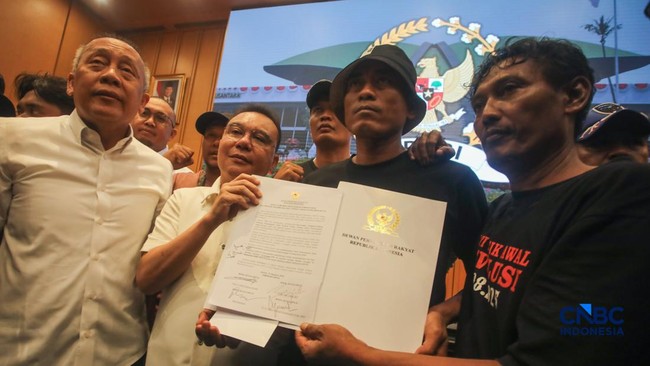
Demonstrations are part of democracy. Through demonstrations, the public conveys its anxieties, demands, and corrections to those in power. However, the quality of democracy is not determined solely by the people’s freedom to speak. Democracy is also determined by the willingness of state institutions to listen and translate aspirations into action.
This was evident when the public conveyed its demands in front of the Senayan Parliament Complex in Jakarta on 27 August 2026. One of the aspirations that resurfaced was the acceleration of the passage of the Asset Forfeiture Bill. This demand is not merely a technical legislative matter, but a reflection of public anxiety over corruption, economic crime, and the difficulty of returning stolen state assets.
In this situation, the DPR leadership showed a response worthy of appreciation. Deputy Speaker of the House of Representatives from the Gerindra Party faction, Prof. Sufmi Dasco Ahmad, received public representatives, listened directly to their aspirations, and provided certainty regarding follow-up actions.
Prof. Dasco stated that the Asset Forfeiture Bill is targeted to be decided in a plenary session no later than 15 December 2026. This commitment was conveyed to representatives of the Pati Bersatu Community Alliance who were present at parliament. The DPR will also provide a copy of the plenary minutes as a reference and a form of accountability to the public.
Moreover, Prof. Dasco stated the DPR leadership’s readiness to resign if the commitment is not completed on time. This statement is certainly not a small matter. Amid a political tendency often filled with promises without measurable standards, the courage to set a deadline creates a standard of accountability that the public can test.
This is where Prof. Dasco’s leadership in the DPR deserves appreciation. He has shown that a parliamentary leader is not only responsible for managing meetings or maintaining communication between factions. A parliamentary leader must also be able to serve as a bridge between voices on the street and decisions in the chamber.
Such leadership can be called responsive leadership. Power does not wait for public anxiety to develop into distrust, but seeks to capture the message, open dialogue, and devise a path to resolution. Criticism is not treated as hostility, but as important information for improving institutional performance.
Demonstrations often occur not only because the public disagrees with the government or the DPR. Demonstrations also emerge when the public feels that formal channels are not fast, open, or effective enough. Therefore, the DPR leadership’s willingness to receive public representatives carries greater meaning than a ceremonial meeting. The meeting becomes a mechanism for rebuilding trust.
The DPR’s response shows that stability and openness need not be opposed. Parliament can maintain political order while providing space for criticism. Aspirations can be conveyed peacefully, while the DPR provides clear, measurable, and monitorable answers.
The Asset Forfeiture Bill itself has travelled a long road. DPR records show that initial studies were conducted by PPATK together with the government from 2008 to 2012. After more than a decade, the bill has now entered the 2026 Priority National Legislation Programme. The length of the process explains why the public no longer merely needs support in the form of statements, but certainty regarding its completion.
Its urgency is evident from the scale of losses due to corruption. The KPK recorded state losses from corruption cases during 2019-2023 at approximately Rp336.53 trillion. Meanwhile, state financial recovery recorded by the KPK in the first half of 2025 reached Rp452.88 billion.
The two figures come from different periods and scopes, so they cannot be compared directly. However, the data still illustrates the magnitude of the challenge in returning the proceeds of crime to the state.
The DPR’s commitment must therefore be directed not only at meeting the passage target, but also at producing a law that is effective, fair, and not easily abused. Speed is important, but legal quality must still be maintained.
The DPR needs to ensure that the asset forfeiture mechanism is equipped with clear standards of proof, judicial oversight, objection mechanisms, and protection for third parties acting in good faith. The state must have the power to pursue the proceeds of crime, but citizens must also be protected from possible arbitrary actions.
Its deliberation needs to involve the KPK, PPATK, the Attorney General’s Office, the Police, academics, advocates, civil society organisations, and victim groups. Public participation must not be carried out merely to fulfil procedure. Public input must be visibly reflected in changes and improvements to the articles.
The management of seized assets must also be transparent. The public needs to know which assets have been seized, their value, how they are managed, the results of auctions, and the benefits returned to the state. Success in seizing assets must not be followed by new problems in their storage or utilisation.
The commitment of Prof. Dasco and the DPR leadership provides a lesson that demonstrations need not end as an exchange of slogans between the public and the state. Demonstrations can be the beginning of dialogue, and dialogue can produce a concrete legislative agenda.
However, the work is not finished. The 15 December 2026 deadline has now become an institutional promise that the public will monitor. That is precisely where the important value of the commitment lies: the DPR is willing to open itself to being judged on results.
Appreciation for the DPR leadership does not mean reducing the public’s critical function. On the contrary, appreciation should be given when state institutions show a responsive attitude.