
Tanimbar Regency and BRIN intensify seaweed cultivation education
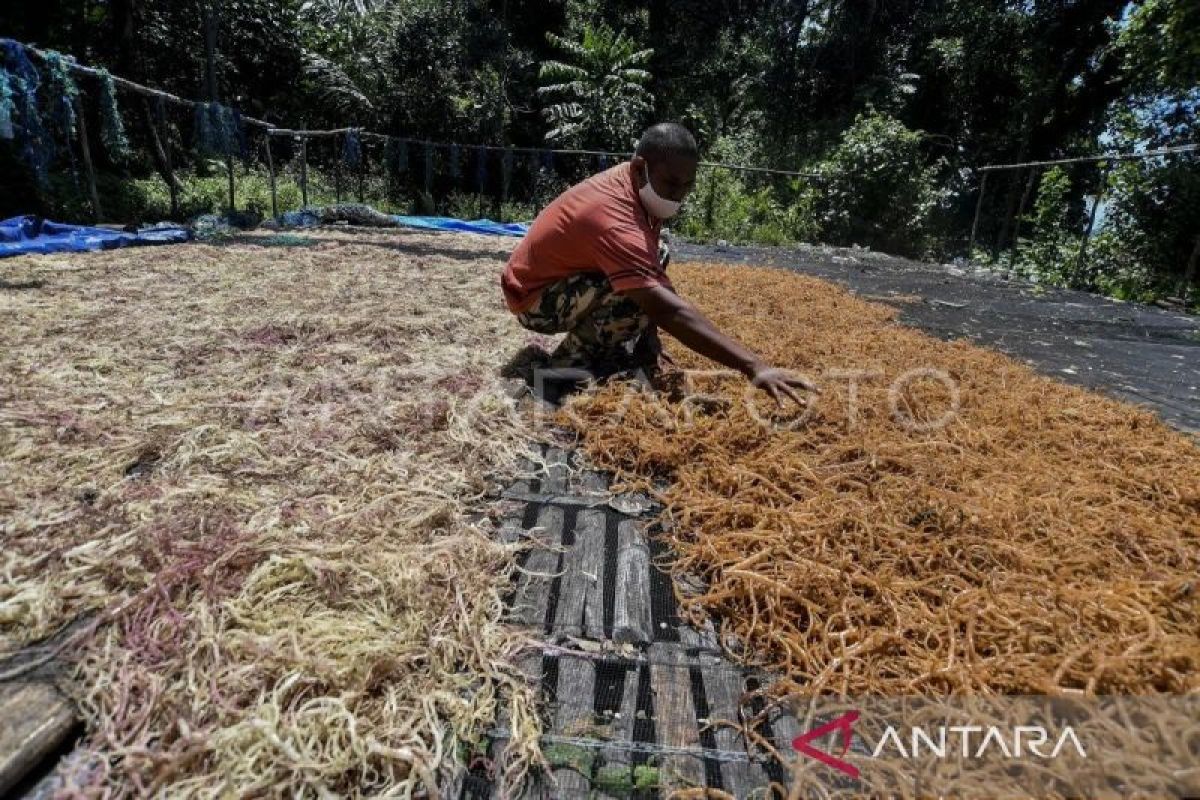
The government of the Tanimbar Islands Regency (KKT) in Maluku, together with the National Research and Innovation Agency (BRIN), is intensifying education for seaweed farmers to boost the productivity of a commodity that has declined by around 50 percent in recent years.
Head of the Tanimbar Islands Regency Fisheries Office, Poly Matitaputty, said strengthening the capacity of farmers is important so that the problems affecting production can be addressed through cultivation approaches suited to local water conditions.
According to him, farmers need assistance covering site selection, use of seedlings, planting patterns, maintenance, and post-harvest handling of seaweed.
“This education and capacity strengthening is important so that farmers can understand the factors affecting productivity and adapt cultivation techniques to environmental conditions,” he said.
He said the production decline was one of the issues discussed with BRIN and farming communities in the villages of East Lamdesar, West Lamdesar, Kelaan, and Keliobar.
Matitaputty explained a number of obstacles faced in recent years, including limited quality seedlings, seasonal changes, water temperature and conditions, maintenance techniques, planting patterns, and disease outbreaks.
Therefore, developing seaweed cultivation cannot rely solely on farmers’ habits or experience, but needs to be supported by research-based knowledge that can be adapted to the characteristics of the Tanimbar island region.
In the activity, the BRIN team explained that successful seaweed cultivation begins with site selection and continues through to harvest and post-harvest stages.
One aspect of particular concern is seed quality. Farmers are encouraged to select seedlings from healthy plants that show good growth, no signs of disease or damage, and are able to adapt to local water conditions.
In addition to seedlings, planting times also need to be adjusted to seasonal conditions. Changes in temperature, currents, water conditions, and seasonal patterns can affect growth while increasing the risk of cultivation failure.
For this reason, a seasonal calendar approach is considered important to develop so that farmers can determine planting and seed collection times based on environmental conditions.
Matitaputty said the synergy with BRIN is expected not to stop at educational activities, but to bring about changes in community cultivation practices so that Tanimbar seaweed productivity rises again and farming businesses can operate sustainably.
The capacity strengthening is also part of efforts to promote seaweed as a fisheries commodity capable of providing economic value for coastal communities in the Tanimbar Islands Regency.