
Take Note! Indonesia's 4 New Policies to Protect Airlines from Rising Avtur Prices
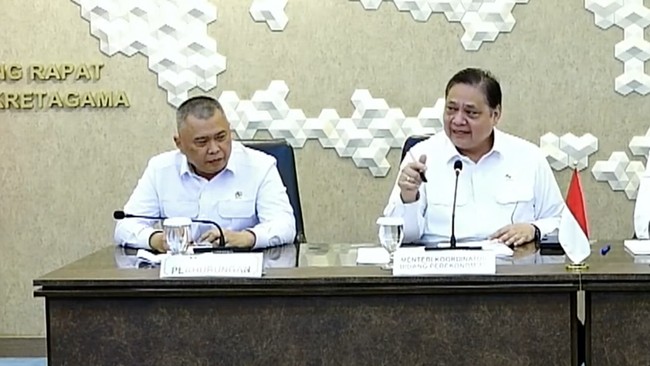
Jakarta, CNBC Indonesia - The government has issued the latest policies to anticipate the rise in oil prices, particularly aviation fuel or avtur. Coordinating Minister for the Economy Airlangga explained that on 31 March 2026, the government and Pertamina had decided not to raise Pertalite and diesel prices until December this year, with the condition that global oil prices do not exceed US$97 per barrel. Avtur is a non-subsidised fuel type, with prices following market developments. According to him, many countries have already raised prices, such as Thailand and the Philippines. Therefore, following directives from President Prabowo Subianto, the government is taking action to make adjustments. ‘And of course, if we do not adjust, various other airlines could take advantage of the price differences,’ said Airlangga during a press conference at his office on Monday (6 April 2026). From his notes, the avtur price at Soekarno-Hatta Airport as of 1 April has reached US$23,551 per litre, up around 72.45% from the previous month. This aircraft fuel price contributes 40% to aircraft operating costs. ‘Therefore, the government is preparing strategic mitigation steps so that ticket prices remain affordable for the public,’ he said. On the same occasion, Finance Minister Purbaya Yudhi Sadewa emphasised that the government has a buffer in the form of a Budget Surplus Balance (SAL) of US$420 trillion if global oil prices become uncontrollable. ‘If it’s desperate, it can be used, but it feels far from that, because the chance of staying above US$100 per barrel (global oil price) for a prolonged period is small, looking at the politics in the US like what,’ he said. ‘I want to emphasise, no need to worry, no need to speculate that I’m running out of money,’ he added. Here are the policies taken by the government: 1. Increasing Fuel Surcharge This is an additional fee charged by transportation companies to customers to cover fluctuating fuel cost increases. Airlangga explained that the increase is set at 38%. This policy is prepared for a period of two months. ‘The fuel surcharge is adjusted again to 38%, where this is the same for jets and propellers. Previously, jets were only 10% and propellers 25%, now everything is adjusted to 38%,’ said Airlangga. 2. Government-Borne VAT Incentive for Airplane Tickets On that occasion, Airlangga also explained that the government is providing incentives to maintain the ticket price burden component. Namely, by covering the VAT cost for economy-class commercial domestic air transport tickets. It is hoped that with this policy, the rise in airplane ticket prices can be kept to around 9% - 13%. ‘The first is VAT borne by the government (VAT DTP) of 11%, for scheduled commercial air transport tickets domestically in economy class,’ said Airlangga. This policy is also prepared only for a two-month period. According to his calculations, the total subsidy value provided for this policy reaches US$1.3 trillion per month, or US$2.6 trillion for two months. ‘The fuel surcharge and VAT DTP policies will be implemented according to the previously announced package programme, namely for two months, so we will continue to evaluate whether geopolitics or the war in the Middle East is still ongoing,’ he said. 3. Payment Relaxation from Pertamina Furthermore, Airlangga said that PT Pertamina (Persero) is also providing payment relaxation. Although the payment mechanism will then be explained with terms and conditions on a business-to-business basis. 4. Reduction of Import Duties on Aircraft Spare Parts The government is also providing ease with incentives to reduce import duties on aircraft spare parts to 0%. ‘So spare parts are given 0% import duty, so it is hoped that this can also reduce the operating costs of airlines,’ said Airlangga. From his notes, the import duty revenue from spare parts last year reached Rp500 billion. Airlangga also hopes that with this policy, it will strengthen the competitiveness of the aircraft repair industry. The estimate calculated by his side is an increase in this industry of up to US$700 per year and adding contribution to GDP up to US$1.49 billion, as well as job creation. ‘This step is followed up with the issuance of technical regulations in this case both ministerial regulations for finance and industry,’ he explained.
Source: jawawa.id (https://jawawa.id/newsitem/take-note-indonesias-4-new-policies-to-protect-airlines-from-rising-avtur-prices-1775631151)
Originally published by CNBC Indonesia (https://www.cnbcindonesia.com/news/20260406163836-4-724295/simak-4-kebijakan-baru-ri-lindungi-maskapai-dari-kenaikan-harga-avtur), translated from Indonesian