
Take Note, Azerbaijan: From Indonesia to Iran, Regimes That Ban the Hijab Are Bound to Fall!
JAKARTA — The Azerbaijani government’s decision to ban the hijab in schools has prompted comparisons with similar policies under Indonesia’s New Order. Policies of this kind, which were also once imposed in Turkey and Iran, have invariably led to a resurgence of Muslim communities and the political downfall of regimes that banned the hijab.
“Remember, we experienced the same thing in 1982,” Instagram user nenna_nakki wrote in the comments on Republika’s account. “It happened in the 1980s… Indonesia managed to get through it,” wrote another user, whose account is 734tiya.
The ban on the hijab in state schools in the 1980s was a stark contradiction of religious freedom in Indonesia. The issuance of Decree No. 052/C/Kep/D.82 on 17 March 1982 by Darji Darmodiharjo, the Director General of Primary and Secondary Education, was not merely a technical matter concerning school uniforms; it marked the culmination of structural tensions between the state and a burgeoning Islamic identity.
These tensions were rooted in the global geopolitical landscape, which spilled into domestic affairs. At the time, Iran’s 1979 Revolution stirred religious and political awareness among students in Indonesia. The sentiment spread from female students active at the Salman Mosque on the Bandung Institute of Technology campus to universities across the country.
The government viewed the growing trend of wearing the hijab not merely as a religious practice but as a manifestation of rising Islamic political awareness—and as a genuine threat to national stability.
In Soeharto’s political thinking, which held that “stability is a prerequisite for development”, conspicuous religious expression was often suspected of fostering radicalism. Fears of an “Islamic state” agenda or the infiltration of extremist ideology made the government wary of religious symbols in public spaces, including educational institutions.
Decree No. 052/C/Kep/D.82 was the legal instrument for enforcing a policy of compulsory uniformity. By defining the “national uniform” without including the option of a hijab, the government effectively made the garment impermissible in state schools. The logic was starkly binary: a schoolgirl had to choose between loyalty to the state’s uniform rules and obedience to religious law.
As a result, state schools, which should have served as inclusive institutions for all citizens, became spaces of segregation. Girls who insisted on wearing the hijab were treated as defying state authority. This created systemic trauma and widened the divide between Muslim communities and the government in power.
Ironically, restrictions on religious expression strengthened cohesion among Muslims. Pressure from the authorities prompted advocacy movements demanding Muslim girls’ basic rights. The ban became part of the collective memory underpinning calls to protect freedom of religious expression in education.
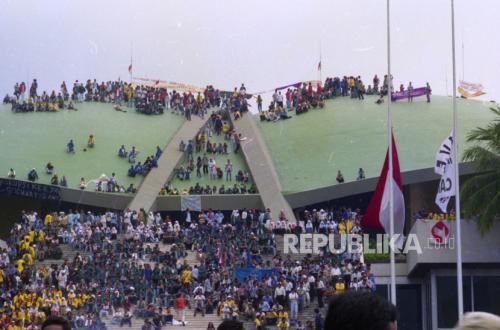
After haunting Muslim schoolgirls for more than a decade, the New Order regime was eventually forced to loosen its grip amid growing demands for democratisation and the government’s need to reconnect with Muslim communities.
The legal reversal began when the Department of Education and Culture, under Minister Fuad Hassan, issued Decree No. 100/C/Kep/D/1991. The regulation formally allowed female students to wear Muslim clothing, including the hijab, in state schools.
The 1991 decree did not emerge overnight. It was an administrative response to mounting pressure from religious organisations and community leaders, as well as growing public awareness of human rights. The government recognised that banning the hijab was no longer a strategic way to maintain stability; instead, it was undermining the government’s legitimacy in the eyes of Muslims.
The decree marked a fundamental shift in the New Order’s political thinking. Whereas in the early 1980s the state had viewed the hijab as a threat to national stability, by the 1990s the government had begun to adopt a policy of “accommodation”. This is often interpreted as Soeharto’s effort to realign his politics with an Islamic community that was gaining intellectual and social influence.
The decision amounted to legal recognition that religious expression in schools was not subversive. With the hijab permitted, state schools could once again be inclusive institutions where religious identity coexisted with national education standards.
After the fall of the New Order, freedom of expression in educational settings was further strengthened through higher-level regulations, including the amended 1945 Constitution, which guarantees everyone the freedom to embrace a religion and worship according to their beliefs.
History shows, the article argues, that consistent public aspirations grounded in conviction can ultimately carry more weight than authoritarian policies designed to impose restrictions.
The fall of the Shah’s regime in Iran…
Source: jawawa.id (https://jawawa.id/newsitem/take-note-azerbaijan-from-indonesia-to-iran-regimes-that-ban-the-hijab-are-bound-to-fall-1792029087)
Originally published by Republika (https://analisis.republika.co.id/berita/tmxbcn393/catat-azerbaijan-dari-indonesia-sampai-iran-rezim-pelarang-hijab-pasti-tumbang), translated from Indonesian