
Take a Look! How Bank Indonesia's Scheme Caps Dollar Purchases at US$25,000
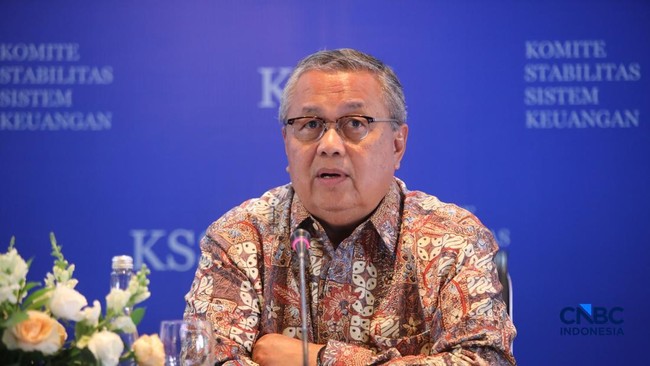
Jakarta, CNBC Indonesia — Bank Indonesia (BI) continues to calibrate policy in the foreign exchange market as a mitigation measure to safeguard Rupiah stability amid the high dynamics of global financial markets. The latest policy framework is formalised in Regulation of Members of the Board of Governors (PADG) No. 7 of 2026, issued on 26 March 2026. Its main focus is to ensure domestic foreign exchange supply for the real economy while dampening speculative risk that could exert undue pressure on Rupiah movements.
Under the policy, BI reduces the threshold for dollar purchases from US$100,000 per market participant per month to US$50,000 per market participant per month, with a further adjustment to US$25,000 per market participant per month.
Historically, adjusting the threshold for the obligation to submit underlying documentation for foreign exchange transactions is not a new move for the central bank. A similar policy was implemented in 2015 when domestic financial markets faced a sharp shock from the Taper Tantrum. At that time, the threshold for cash purchases of foreign exchange against the Rupiah was drastically cut from US$100,000 to just US$25,000 per market participant per month. That tactical move proved fruitful, with Rupiah’s exchange rate tending to remain stable over a relatively long period. This stability persisted at least until the market faced a weakening trend around 2022, when the threshold was restored to the US$100,000 level.
Director of the Financial Market Development Department at Bank Indonesia, Ruth, explained that the tightening currently in place is not a form of foreign exchange control, but a disciplined reporting of underlying transactions. “We are not restricting the purchase of the United States dollar. You can buy as much as you want, but please ensure there is an underlying transaction, so it is not speculative,” Ruth said.
Through this disciplinary approach, monetary authorities set a new rule for the spot market by cutting the threshold for purchases without supporting documents to US$50,000 per month per participant, effective from 1 April 2026. As an additional proactive step, Bank Indonesia has again revised the scheme, lowering the threshold to US$25,000 at the start of June 2026.
As a balancing catalyst to the tightening in the cash market, this policy strategically broadens the room for manoeuvre for market participants in hedging or derivative instruments. The threshold for derivative transactions without an underlying, including selling forwards and swaps, was significantly raised to US$10 million per transaction. The policy aims to encourage businesses to manage exchange-rate risk using derivative instruments rather than having to hoard foreign currency in cash, mirroring advanced financial markets where derivatives dominate over the spot.
In addition, the rule introduces an exemption from the prohibition on non-deliverable forward (NDF) transactions in overseas markets, specifically for selling positions, which began implementation on 4 May 2026. This facility is granted exclusively to 14 major dealer banks to curb expectations of Rupiah weakness.
This pillar of stability is also supported by the expansion of the Local Currency Transaction (LCT) facility, which enables direct bilateral settlement without USD conversion. On the efficiency of the scheme, Ruth added: “When bilateral transactions can be conducted directly in the domestic currency, the economy will run much more efficiently and we will not always have to use the United States dollar first.” Data shows that by April 2026, the volume of LCT settlements had reached US$22.61 billion.