
‘Tabola Bale’ at WCCE 2026: Teuku Riefky Wants Creators to Prosper
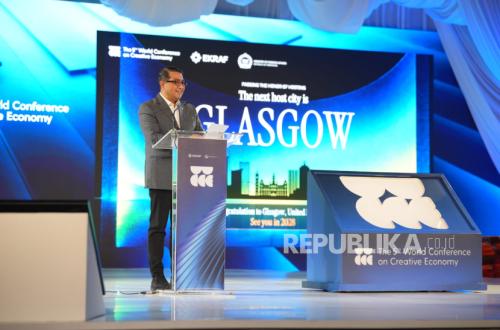
JAKARTA — The song “Tabola Bale” rang out from the stage at the World Conference on Creative Economy (WCCE) 2026. International guests were seen swaying to its rhythm. Popularised by Silet Open Up with Jacson Zeran, Juan Reza and Diva Aurel, the song has taken music from eastern Indonesia beyond geographical boundaries and reached a wide audience.
But behind the event’s exuberance lies a fundamental question: how much of the economic value ultimately returns to the creators who made it? That question was a recurring theme at WCCE 2026, held at the Hotel Indonesia Kempinski in Jakarta.
Over three days, from Wednesday to Friday (21–23 October), the global creative economy conference brought together governments, industry players, academics and delegates from various countries.
Creative Economy Minister Teuku Riefky Harsya stressed that industry growth must not be measured solely by investment, exports or the number of jobs. Creators must receive a greater share of the value they generate.
“Growth alone is not enough. Our ambition is for creators to capture more value from what they create and build sustainable livelihoods from their creativity,” Teuku Riefky said at the closing of WCCE on Friday (23 October).
The statement is particularly relevant to the current development of Indonesia’s creative economy. In 2025, the sector grew by 6.8 per cent, employed 27.4 million people, attracted investment of US$11.3 billion (about Rp204.46 trillion) and generated exports worth US$31.9 billion (about Rp577 trillion).
These figures demonstrate the creative economy’s significant role in the national economy. The challenge ahead is to ensure that opportunities and economic value are not concentrated among certain businesses, but also reach creators, small businesses, young talent and regions with creative potential.
For Teuku Riefky, promoting creative works alone is not enough to advance the industry. The creative ecosystem needs intellectual property protection, access to finance, digital infrastructure, talent development and routes connecting creative works with markets. Without these, creativity risks remaining untapped potential while the people behind it struggle to build businesses and sustainable livelihoods.
To strengthen this foundation, the Ministry of Creative Economy launched three strategic initiatives during WCCE 2026: the Creative Economy Data Model (CEDM), the Indonesia Creative Economy Outlook 2026–2027, and Ekraf Academy, a platform for developing creative-economy talent. The government hopes these measures will have a long-term impact on industry participants.
CEDM was developed with the World Intellectual Property Organization (WIPO) to map the creative economy ecosystem more comprehensively. The model covers three interconnected dimensions: Environment for Creativity, Resources for Creativity and Creative Value.
The first dimension maps the conditions that enable creativity to flourish, including intellectual property protection, governance and socio-cultural factors. The second examines the resources required, from talent and infrastructure to financing and market access. The third measures the value generated through the creation of intellectual property, socio-economic contributions and creative soft power—the influence arising from cultural strength and creativity.
“Through this collaborative initiative, we want to ensure that knowledge and data can be translated into concrete action to develop Indonesia’s creative economy,” Teuku Riefky said.
The Indonesia Creative Economy Outlook 2026–2027, meanwhile, provides a strategic overview of the sector’s performance, opportunities, regional potential and national development priorities. The publication is titled “Creative Economy Transformation: Digitalization, AI, and an Intellectual Property-Based Economy”, with a particular focus on digital transformation, artificial intelligence (AI) and strengthening an economy based on intellectual property.
Through Ekraf Academy, the government is preparing in-person, online and hybrid learning, built around three main pillars: creative leadership, creative talent and creative entrepreneurship.
The three pillars are intended to strengthen creative ecosystem leadership in the regions, improve workforce skills and help businesses develop and reach global markets. The programme is designed to address the challenges facing the creative industries today.
On the final day of WCCE 2026, the Ministry of Creative Economy signed partnerships with 30 Indonesian universities. The collaboration is expected to strengthen ties between education and research and industry needs, enabling knowledge generated on campus to be developed into innovations and products with commercial potential.
Globally, strengthening the ecosystem was among the key issues underpinning the Jakarta Vision on Creative Economy. The document produced at WCCE 2026 was formally adopted at the conference’s ministerial meeting, attended by countries including Russia, Ukraine and Iran.
Teuku Riefky hopes the document will provide a basis for strengthening the creative economy’s position on the international development agenda. The government also wants to encourage future resolutions at the United Nations General Assembly.
“We hope these ideas and commitments can shape future resolutions at the UN General Assembly, giving the creative economy a stronger voice in global development,” he said.
Source: jawawa.id (https://jawawa.id/newsitem/tabola-bale-at-wcce-2026-teuku-riefky-wants-creators-to-prosper-1792936275)
Originally published by Republika (https://ameera.republika.co.id/berita/tngdcu370/tabola-bale-di-wcce-2026-teuku-riefky-ingin-kreator-sejahtera), translated from Indonesian