
Synergy Needed: Deputy Speaker Reveals Inclusive Education Remains Far from Expectations
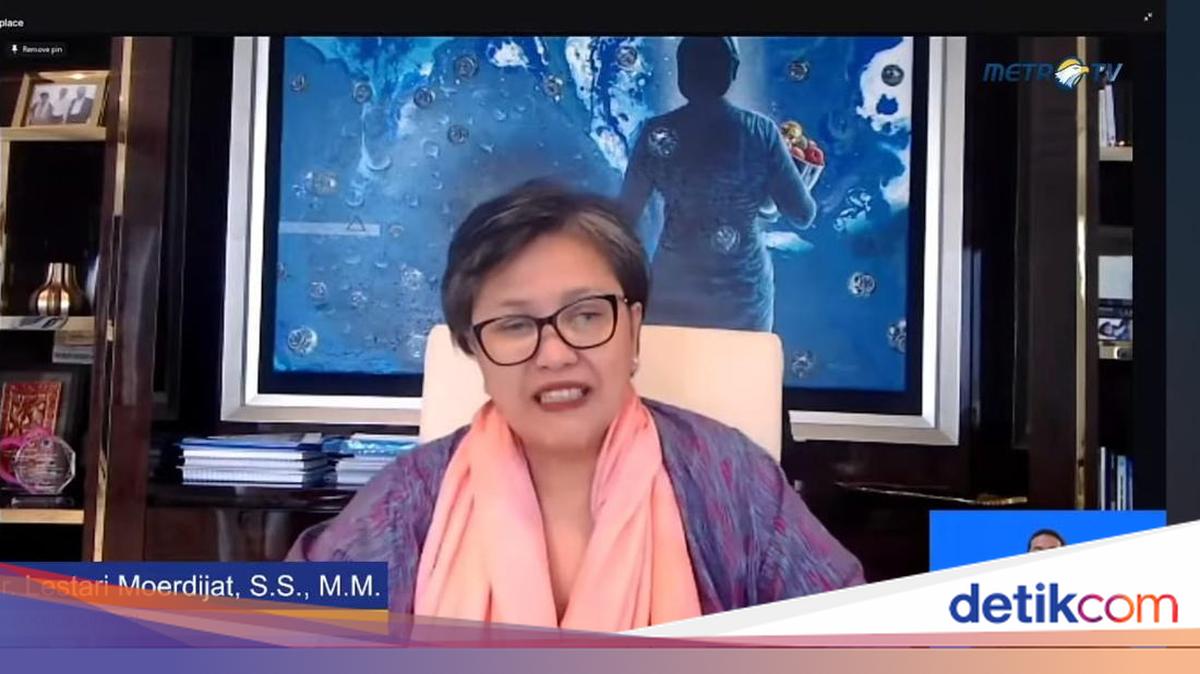
Deputy Speaker of the People’s Consultative Assembly (MPR) Lestari Moerdijat has said that an inclusive and affordable education system for every citizen remains far from expectations. She stressed that synergy among all relevant parties is urgently needed to realise this goal.
“In essence, we have a Constitution and a number of policies that support inclusive education, but its implementation must still be a concern for all parties,” Lestari said in a written statement on Wednesday (1/7/2026).
She made the remarks while opening an online discussion themed “Creating an Inclusive and Affordable Education System for Indonesia’s Generation,” organised by the Denpasar 12 Discussion Forum.
According to Lestari, Article 31, paragraphs 1 and 2 of the 1945 Constitution explicitly guarantee education as the right of every citizen and the government’s obligation to fund it.
“However, is the current education budget entirely for the education sector, does it reach vulnerable groups, and is the financing scheme applied appropriate?” Lestari questioned.
Lestari, who is also a member of House of Representatives (DPR) Commission X, expressed hope that the ongoing deliberation of the National Education System Bill (Sisdiknas) could become a momentum to improve policies capable of addressing a number of existing problems.
The senior member of the NasDem Party argued that inclusive education is not merely an effort to open doors for all citizens. More than that, it must be strived for so that no Indonesian child is left behind in education, as part of realising social justice for all Indonesian people as mandated by Pancasila.
Director of Learning and Student Affairs at the Directorate General of Higher Education, Ministry of Higher Education, Science, and Technology, Beny Bandanadjaja, opined that the ministry is continuously striving to realise inclusive and affordable education, as part of carrying out the mandate of Article 31 of the 1945 Constitution, which obliges the state to organise an education system capable of enlightening the nation.
According to Beny, universities are continuously striving to be part of the solution to overcome various problems in different regions. On the occasion, Beny explained that based on information from the new student admissions committee in 2025, 17,000 prospective students did not re-register for various reasons, not solely due to financial issues.
Meanwhile, this year’s new student admissions process is still ongoing and will end in late July 2026. To open the widest possible access, Beny said public universities also apply a levelling system for single tuition fees (UKT) based on the financial capability of the prospective student’s family.
Dean of the Faculty of Postgraduate Education and Head of the Master of Education Study Programme at Pelita Harapan University (UPH), Niko Sudibjo, argued that every discussion regarding inclusive education is inseparable from the issue of cost. Yet, according to him, there are other perspectives that can be pursued to make education more inclusive and easily accessible to the public, namely through more flexible university management.
According to Niko, the current education system is somewhat rigid, resulting in a gap between the needs of people’s lives and the educational structure applied.
Flexibility in university management could be realised by implementing a hybrid learning system to overcome geographical constraints. The learning system could be carried out in stages, along with financing flexibility to reduce the financial burden.
On the other hand, education observer Totok Amin Soefijanto argued that the phenomenon of prospective students passing but not re-registering is caused by several factors. These include high single tuition fees (UKT), mismatched study programmes, and negative verification of the Smart Indonesia Card (KIP) for College.
Based on his records, in 2022, there were 151,500 applicants for KIP Kuliah, and in 2025, there were 255,500 applicants. However, on average, only 50% of applicants had their KIP Kuliah applications accepted, most of whom came from the decile 1-4 community groups (very poor and poor).
“The state must be present to facilitate access to education for every citizen as mandated by Article 31 of the 1945 Constitution,” said Totok.
To facilitate access to education, Totok suggested the implementation of a partial KIP Kuliah with a tiered assistance scheme, transparency in the application of UKT, the use of accurate National Socio-Economic Single Data (DTSEN), and mentoring for prospective students to audit the reasons for withdrawal, as well as assistance channels before the registration period closes.
Totok also added that if access to education is determined by the ability to pay, the aspiration to achieve a Golden Indonesia 2045 will be difficult to realise.
Education policy observer Indra Charismiadji argued that the problem of prospective students not re-registering because they cannot afford UKT reflects a phenomenon of a higher education middle-income trap, as the state is not carrying out the mandate of Article 31, paragraph 5 of the 1945 Constitution. Currently, universities only function as learning institutions, whereas the constitution mandates that they become research centres.
“If the current conditions continue, it will be difficult for the public to access education,” said Indra.
Meanwhile, GEDSI Specialist and Safeguarding expert Pujiaryati Anggiasari argued that inclusive education is critically needed for persons with disabilities. According to her, currently, only about 4% of persons with disabilities can access formal education.
This figure illustrates how difficult it is for persons with disabilities to obtain an education. It is not solely a matter of UKT, but also the hidden costs that must be borne, such as the need for assistive devices, companions, and supporting facilities and infrastructure, not to mention the need for teaching materials in alternative formats that burden persons with disabilities.
“The obstacles faced by persons with disabilities in trying to access education are very real,” Anggiasari stressed.
On the occasion, Senior Journalist Saur Hutabarat emphasised that enlightening the life of the nation is the responsibility of the state.