
Syailendra Capital explores institutional investor participation in gold ETF
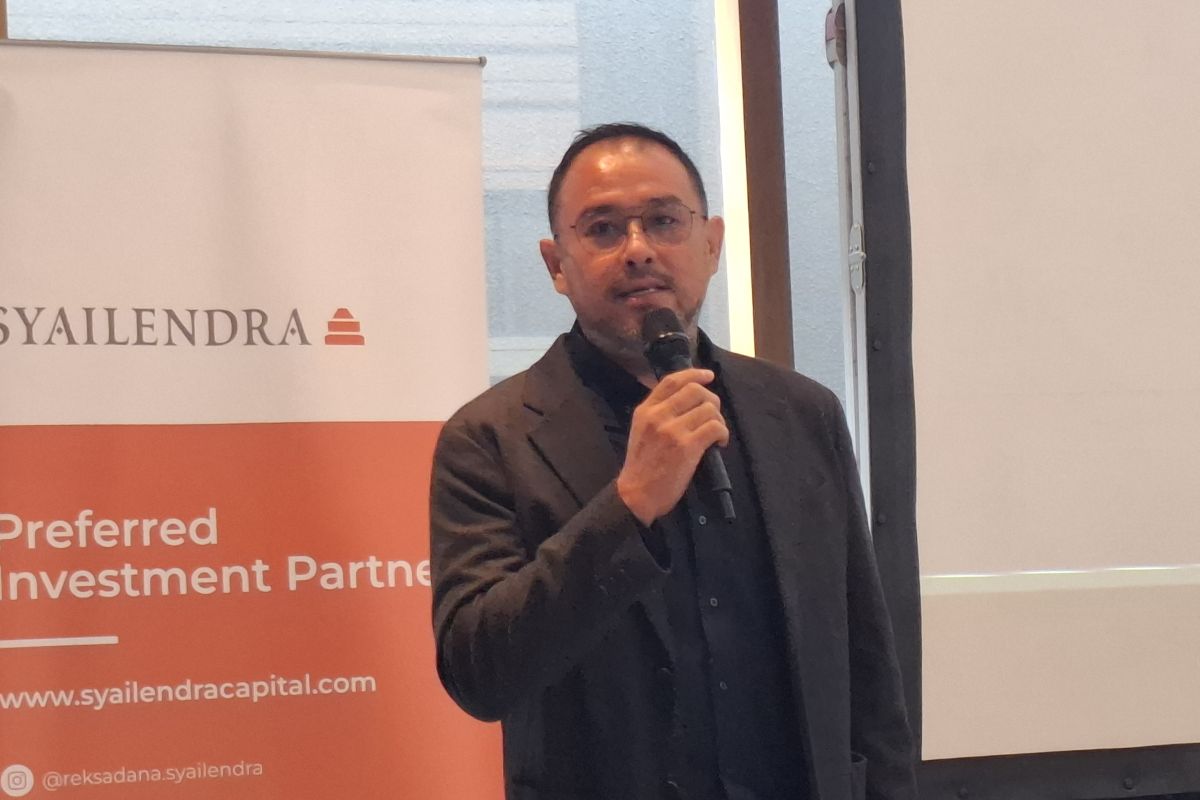
Jakarta (ANTARA) - Investment management firm PT Syailendra Capital is exploring the participation of institutional investors in gold exchange-traded fund (ETF) instruments through meetings with several insurance companies and pension funds.
Agustinus Candra, Group Head of Operations at Syailendra Capital, stated that the company has conducted roadshows to these institutional investor groups over the past two weeks.
“We have conducted roadshows over the last two weeks to several insurance companies and pension funds,” Candra said during the Syailendra Media Talks titled “Gold 360°: One Asset, Four Perspectives” in Jakarta on Monday.
This exploration comes at a time when investors in the Syailendra Sharia Gold ETF (XSGO) are currently comprised entirely of retail clients. Based on data from the Indonesian Central Securities Depository (KSEI) gathered by Syailendra, Candra noted that approximately 400 investors hold the product, with no institutional investors yet involved.
“If we pull the data from KSEI, it turns out there are approximately 400 people who have purchased it. And those are all retail clients. There are no institutional players yet,” he said.
Candra mentioned that several insurance companies met by Syailendra essentially have no restrictions on investing in gold ETFs. However, he noted that these companies still require internal regulations to accommodate Electronic Gold Receipts (EGR) within their investment policies.
“From the perspective of insurance companies, there are no restrictions; they are free to invest if they wish. But if asked why they haven’t invested yet, it seems they need a derivative of internal regulations,” he explained.
He explained that EGR has already been classified as a Security, whereas for the insurance companies met by Syailendra, its inclusion still needs to be accommodated within internal provisions regarding investment portfolios.
Similarly, for pension funds, Candra noted that their investment regulations still need to accommodate EGR as a Security.
“It is the same for pension funds, but for pension funds, it is more about the overarching regulations needing to record that EGR is a security,” he stated.
In addition to insurance companies and pension funds, Syailendra is approaching social security institutions and foundations as part of its outreach to institutional investor groups.
The development of gold ETFs in Indonesia is underpinned by Financial Services Authority (OJK) Regulation Number 2 of 2026, which has been in effect since 23 February 2026. The OJK issued this regulation to strengthen the national economy, support accelerated market deepening, and provide a legal basis for the development of gold-based investment products.
The OJK, together with Self-Regulatory Organisations (SRO), launched gold ETFs on 10 August 2026 as one of the rapid steps within eight integrated market deepening action plans. The government expects these instruments to expand the investor base, increase instrument diversity, enhance liquidity, and strengthen market governance.
Previously, OJK Deputy Commissioner for Licensing and Supervision of Capital Market Investment Management and Securities, Eddy Manindo Harahap, mentioned that seven investment managers have applied for gold ETF licences. Of that number, six have received effective statements, and five products were launched on 10 August 2026.
The OJK has not yet set targets for the assets under management (AUM) or transaction value of gold ETFs, as the instrument is still in its early stages of development. The OJK stated that initial progress will be monitored based on industry readiness and investor response.
More broadly, the OJK noted that the number of Single Investor Identifications (SID) in the capital market reached 30.27 million, growing by 48.67 per cent annually as of 7 August 2026. Notably, 78 per cent of investors are under the age of 40. During the same period, the net asset value of mutual funds was recorded at Rp667 trillion, while the industry’s assets under management (AUM) stood at Rp1,026 trillion.