
Swimming in Profits, TINS's Earnings Soar 595% to Rp1.5 Trillion
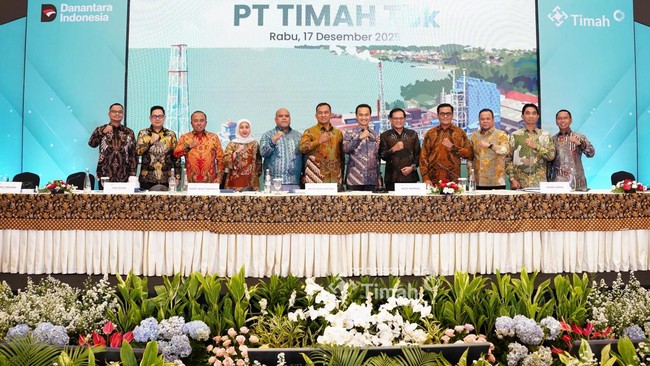
Jakarta, CNBC Indonesia - The state-owned mining issuer, PT Timah (Persero) Tbk (TINS), recorded a net profit of Rp1.5 trillion in the first quarter of 2026. This achievement exceeded the company’s set target of Rp252 billion by 595%.
This performance was driven by significant production increases, operational optimisation, and sustainable improvements in corporate governance.
Based on the consolidated financial report as of 31 March 2026, TINS recorded revenue of Rp5.47 trillion, a 160.5% jump from Rp2.10 trillion in the same period the previous year. This rise aligned with increased sales volumes and average selling prices for tin metal.
Additionally, the company’s operating profit reached Rp1.88 trillion, a sharp increase from Rp148 billion in the first quarter of 2025. Meanwhile, EBITDA was recorded at Rp2.1 trillion, up more than 450% year-on-year from Rp348 billion.
The company’s asset value in the first quarter of 2026 rose 11.62% to Rp15.23 trillion from Rp13.64 trillion at the end of 2025. Liabilities stood at Rp5.27 trillion, up 1% from Rp5.23 trillion at the end of 2025.
Equity position was Rp9.96 trillion, an 18.4% increase from Rp8.41 trillion at the end of 2025, in line with the booking of first-quarter 2026 profits.
The company’s financial performance showed strong results, evident from key financial ratios including a Quick Ratio of 105.1%, Current Ratio of 276.1%, Debt to Asset Ratio of 6.9%, and Debt to Equity Ratio of 10.6%.
PT Timah (Persero) Tbk’s President Director, Restu Widiyantoro, stated that this positive performance resulted from consistent efficiency and optimisation strategies across all business lines.
“In the first quarter of 2026, the company booked solid financial performance, supported by significant operational achievements and consistent sustainable optimisation strategies across all business lines. Thus, the company was able to exceed the set profit target,” he said in an official statement on Friday (1/5/2026).
On the operational side, the company recorded a surge in tin ore production to 6,312 tonnes of Sn, a 96% increase from 3,225 tonnes of Sn in the same period the previous year. This increase was driven by additional operating units, including Production Suction Ships (KIP), Production Suction Pontoons (PIP), and onshore partnership mines.
Additionally, production growth was supported by the operation of the Singkep 1 Dredger Ship, improved supervision and security of Mining Business Licence Areas (WIUP) and production areas, as well as support from a Task Force (Satgas) from the Government placed at the company.
In the first quarter of 2026, the company continued various efforts to enhance operational performance and production. In onshore mining, the company added operating units and strengthened exploration activities through pilot drilling to ensure more precise excavation directions aligned with the established Work Plan blocks.
Meanwhile, in offshore mining, the company operated one Dredger Ship (KK) unit and continued to optimise Production Suction Ship (KIP) performance. Performance improvements were also supported by optimising KIP processing residue facilities to increase processing effectiveness, as well as boosting productivity of Production Suction Pontoons (PIP).
Tin metal production rose 82% to 5,630 metric tonnes of Sn compared to 3,095 metric tonnes of Sn in the same period the previous year. Tin metal sales increased 113% to 6,009 metric tonnes from 2,824 tonnes in the prior year’s period.
The average selling price of tin metal was USD49,221 per metric tonne, up 51% from USD32,495 per metric tonne the previous year.
In the first quarter of 2026, the company’s tin metal sales were dominated by exports at 97%, with domestic sales at 3%. The main export destinations included China at 48%; India at 11%; South Korea at 10%; Italy at 6%; Singapore at 5%; and the Netherlands at 4%.
Looking ahead, management is optimistic that the positive performance trend will continue. Production increases, optimisation of onshore and offshore mining, and strengthened operational governance are expected to be key factors in maintaining sustainable growth.
On the external side, the strengthening global tin price trend amid tight supply is also a positive catalyst for the company’s performance.