
Swift Response as Indonesian Volcanoes Erupt: Public Works Minister Activates Task Force
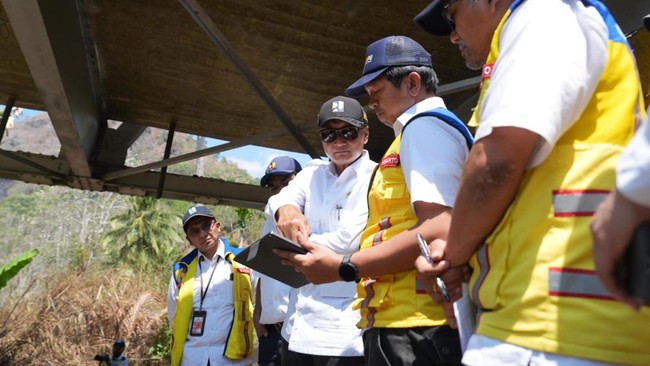
Jakarta, CNBC Indonesia – The eruption of Mount Anak Krakatau and increased activity at several volcanoes across Indonesia have once again drawn the government’s attention. Minister of Public Works Dody Hanggodo expressed his sympathy for affected communities and those living in disaster-prone areas.
“I share the sorrow of our brothers and sisters struck by calamity in various regions. Conditions certainly differ, but for us at the Public Works Ministry what matters is being able to respond quickly according to needs on the ground. I have already instructed my staff to be on standby and to move, particularly to help maintain access and basic services for the public,” Dody said in a written statement on Monday (7/9/2026).
Indonesia is endowed with highly diverse landscapes and abundant natural resources. On the other hand, this geographical and geological setting also exposes various regions to different disaster risks, ranging from earthquakes, floods, landslides and drought to volcanic eruptions. Readiness and the ability to respond swiftly are therefore essential so that people’s needs can be addressed immediately.
The Public Works Ministry previously faced this situation when handling disasters in Aceh, North Sumatra and West Sumatra. At that time, a task force was formed to unify the handling of various infrastructure needs, from the emergency response phase through to rehabilitation and reconstruction.
“In a disaster situation, we cannot work as business as usual. Conditions change rapidly, and needs on the ground arrive all at once. There may be severed roads, damaged bridges, water needs, and public facilities that must be dealt with immediately. So individual units cannot each work on their own. Everything must be consolidated immediately according to conditions in the field,” he said.
An evaluation found that the task force working model was able to accelerate coordination and decision-making. The need for such a model has grown as disasters have occurred in various regions beyond Sumatra, including East Nusa Tenggara, alongside increased volcanic activity in a number of areas.
On this basis, Dody decided to expand the task force’s remit into the Disaster Emergency Response and Infrastructure Rehabilitation Task Force for the Public Works Sector, covering the whole of Indonesia.
“Initially we formed this task force to help handle the disaster response in Aceh, North Sumatra and West Sumatra. After evaluation, its working model proved quite helpful. Meanwhile, disasters certainly do not occur only in Sumatra. That is why I decided to widen its scope, so that when needs arise in other regions, we already have teams and mechanisms ready to deploy,” he said.
The task force will serve as the coordination hub within the Public Works Ministry to consolidate needs on the ground, technical units, personnel, equipment and other support required. Dody also asked that the chain of coordination be made as short as possible so that field responses can be carried out more quickly.
“I have asked for coordination to be kept as brief as possible. As soon as reports come in from the field, it must immediately be clear what is most urgent, who is handling it, where the equipment and support come from, and then the team moves. In a disaster situation, time means everything to the public,” he explained.
Institutionally, the task force’s substance, structure, duties and working mechanisms have been prepared. The draft Minister of Public Works Decree that will provide the formal basis for the task force’s establishment is currently going through a circulation process before being finalised. The task force will be chaired by the Head of the Regional Infrastructure Development Agency (BPIW) of the Public Works Ministry, Adenan Rasyid, involving relevant organisational and technical units according to needs in each affected region.
In parallel, the Public Works Ministry has prepared coordination and operational readiness so that urgent handling needs can be responded to immediately.
In its implementation, the task force will function as the traffic controller for disaster-related infrastructure handling within the Public Works Ministry, so that needs for roads and bridges, water resources, drinking water and sanitation, buildings, and public facilities can all be handled under a single coordination.
“When people are struck by disaster, we cannot spend too long calculating. If access must be opened, we open it. If water is needed, we provide it. If there is infrastructure that must be dealt with immediately, the technical teams must move in. That is why we have prepared this task force, so that all of Public Works’ capacity can move and work together more quickly,” Dody asserted.
The Public Works Ministry will also continue to coordinate with BNPB, regional governments, ministries and agencies, and other relevant parties in accordance with their respective authorities.
Going forward, the task force will continue to be evaluated as the basis for developing a more permanent institutional arrangement, so that coordination, control and response to disaster-related infrastructure damage can be carried out more rapidly and in an integrated manner.