
Sweeping Away Plecostomus Fish: The Dilemma of an Economically Valuable Pest
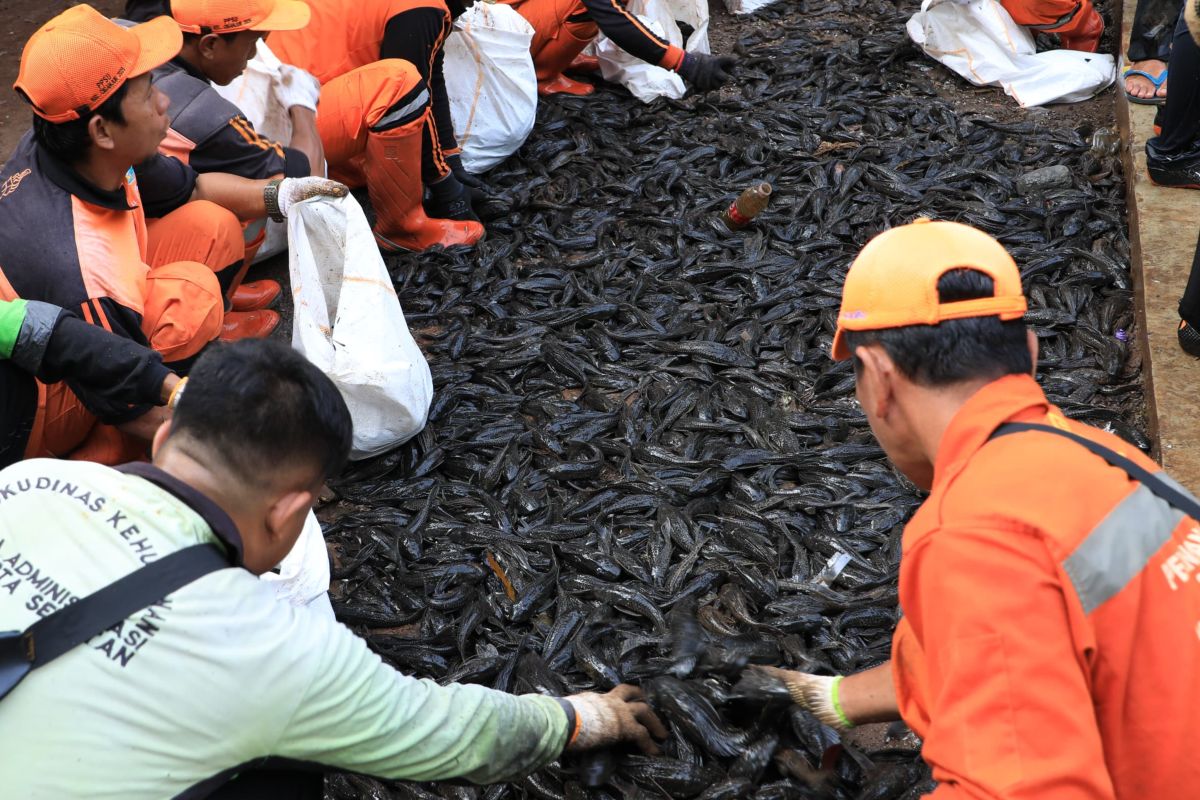
The flow of the Ciliwung River in the Kalibata area, South Jakarta, tells a story of residents who depend on a fish long regarded as a pest: the plecostomus. For some, this fish poses a threat to the ecosystem. However, for fishermen like Ajum (39), the plecostomus is an irreplaceable source of livelihood. Ajum and other fishermen’s income heavily relies on the river’s water conditions. When the water flow is stable, catches can be quite promising. But when floods arrive, earnings are swept away. “If the water is good, it can reach 20-30 kilograms. But during floods, at most 10 kilos. Sometimes we hold off because it’s risky,” said Ajum when met on the banks of the Ciliwung in Jakarta. Under normal conditions, he can catch around 15 kg of plecostomus per day. However, when the water rises and the current becomes stronger, catches drop significantly. The current price of plecostomus ranges from Rp15,000 to Rp18,000 per kg. Though it seems promising, fishermen’s income remains uncertain. “If it’s a bad day, it’s just enough for transport costs. A day can cost Rp100,000 to Rp150,000,” he said. To catch the fish, Ajum must navigate the river for five to six hours. He starts his activity from afternoon to night, using a tyre as a flotation aid to follow the current. The job is not without risks. Strong currents, drifting logs, and the need for peak physical condition are daily challenges. Yet behind these risks lies the need to make a living. The caught fish are then sold to collectors to be processed into various food products like cilok, nuggets, otak-otak, and crackers. It is at this point that the dilemma arises. On one hand, the plecostomus is seen as damaging to the ecosystem. This fish is said to damage embankments and eat other fish and their eggs, so its presence is considered to disrupt ecological balance. However, on the other hand, the existence of this fish supports the economy for some residents. Ajum is aware of this awkward position. He does not reject cleaning efforts but also sees that total eradication is not easy. “It’s good to clean it because it’s a pest. But it won’t be completely gone. Even those used to catching it can’t clean them all,” he said. According to him, the plecostomus has a very rapid reproduction rate. In one spawning, a single parent can produce hundreds or even thousands of offspring. “It reproduces quickly; one can become thousands if they hatch,” said Ajum. This makes the plecostomus population persist even if caught in large numbers. Ajum even likens eradication efforts to controlling mosquitoes. “Like mosquitoes, you exterminate them and they come back,” he said. Nevertheless, he still sees the importance of keeping the river clean. According to him, dead plecostomus that are not collected can pollute the water. “The important thing is to keep the environment clean, but this fish also has economic benefits,” he said. A similar view comes from environmental activist Arief Kamarudin. He considers the government’s steps to clean plecostomus as a positive action to maintain ecological balance. “The government’s movement is very good and positive. It proves concern for the ecosystem, and I fully support it,” said Arief. He explained that the plecostomus is an invasive species that can disrupt the balance of aquatic environments if not controlled. “Not just plecostomus, all invasive things in an ecosystem will definitely disrupt the balance,” he stated. However, Arief also reminded that environmental issues cannot be simplified to just one factor. Besides invasive fish, Jakarta’s rivers also face rubbish and waste problems. “The problem isn’t just one. There’s rubbish, waste, and invasive fish. All of that must be addressed one by one,” he said. According to him, cleaning plecostomus remains important even if the rubbish issue is not fully resolved. “If taken, the numbers will decrease. But all problems must be solved together,” he said. He emphasised the importance of public education as a long-term solution, especially in addressing recurring rubbish issues. “For rubbish, it has to start from the root. We need education because humans are the ones throwing it away. If not changed, it will keep repeating,” he said. Amid these various efforts, the Ciliwung River remains a living space for many people. For Ajum, every flowing current brings hope as well as uncertainty. On one side, there is the push to clean the river for a better environment. On the other, there are lives dependent on the fish that is to be eliminated. This dilemma illustrates a simple reality: environmental and economic issues often go hand in hand, intersect, and do not always have easy answers. Amid the Ciliwung’s currents, the plecostomus is not just a pest. It also becomes part of the story of survival. The DKI Jakarta Provincial Government will evaluate the handling of plecostomus in the capital region to ensure it does not violate animal welfare principles. The follow-up to the catches involves killing the fish and burying them hygienically at designated locations. This step is taken so that the fish do not return to the waters, are not traded, and can be utilised as natural compost. Deputy Governor of DKI Rano Karno proposed to his team to handle plecostomus like in Brazil, by processing it into charcoal. The DKI Provincial Government reminds the public not to use plecostomus as food ingredients due to the health risks it poses because of re
Source: jawawa.id (https://jawawa.id/newsitem/sweeping-away-plecostomus-fish-the-dilemma-of-an-economically-valuable-pest-1776855139)
Originally published by Antara (Indonesian) (https://www.antaranews.com/berita/5536900/menyapu-ikan-sapu-sapu-dilema-sang-hama-bernilai-ekonomi), translated from Indonesian