
Sweden Strengthens Power Supply for Strategic Investment in Batam
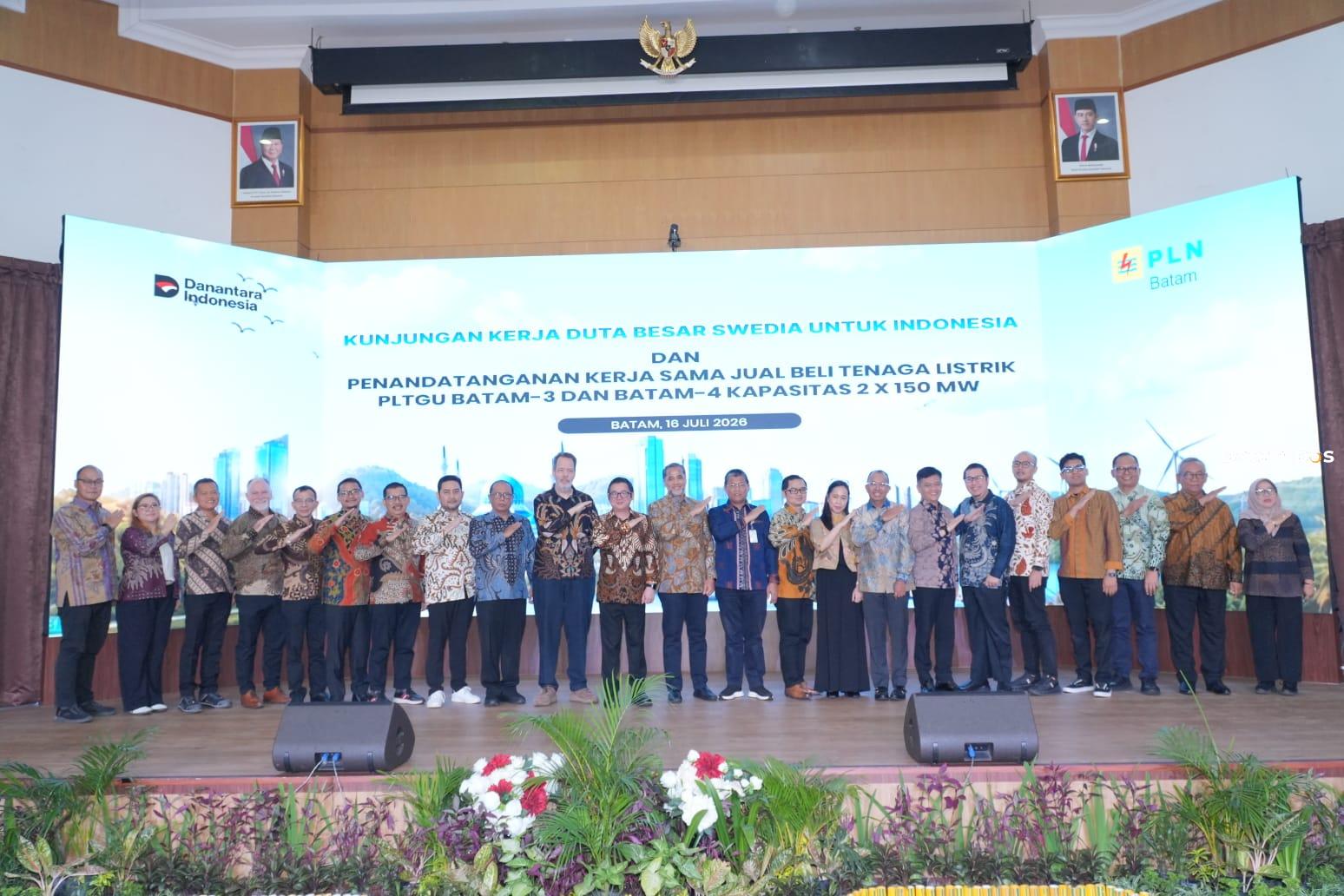
The Swedish government is strengthening its support for energy development in Batam through a partnership to build power plants expected to support the growth of investment, industry, and the digital economy in the city. The commitment was marked by a visit from the Swedish Ambassador to Indonesia, Daniel Blockert, to PT PLN Batam, where he witnessed the signing of a Power Purchase Agreement (PJBTL) for the Batam-3 and Batam-4 Gas and Steam Power Plants (PLTGU) with a combined capacity of 2 x 150 megawatts (MW) between PT PLN Batam and PT Dalle Energy Batam. The event was also attended by representatives from Danantara Asset Management, BP Batam, the Batam City Government, Medco Power Indonesia, and Siemens Energy Indonesia.
In his remarks, Ambassador Daniel Blockert stated that the partnership marks a significant milestone in strengthening Batam’s energy security while supporting sustainable industrial growth. “This collaboration reflects a commitment to strengthening Batam’s energy resilience. Sweden views the partnership with Indonesia as a very important relationship, particularly through the Sweden–Indonesia Sustainability Partnership,” he said. According to Blockert, Sweden encourages collaboration between government, industry players, and technology providers to accelerate the energy transition. He explained that the project utilises SGT-800 gas turbine technology from Siemens Energy, manufactured in Finspång, Sweden. Beyond improving electricity supply reliability, the technology is considered capable of using low-emission fuels such as green hydrogen and green ammonia, aligning with efforts to develop a low-carbon industrial area in Batam. Blockert also invited PT PLN Batam to participate in an official visit by the Crown Princess of Sweden to Indonesia and the Sweden–Indonesia Sustainability Partnership Conference scheduled for September 2026.
Representing the Batam City Government, Regional Secretary Firmansyah expressed appreciation for the Swedish government’s support in strengthening Batam’s energy sector. He noted that the additional 300 MW generation capacity would enhance the reliability of electricity supply, which is a primary requirement for industrial and investment zones. “Reliable electricity is the main foundation for maintaining an investment climate. This additional supply will support the acceleration of development and economic growth in Batam,” he said. PT PLN Batam President Director Kwin Fo stated that electricity demand in Batam continues to rise with the growth of industrial estates, data centres, and the digital economy. He added that PLN Batam is continuously strengthening the electricity system, from generation and transmission to distribution and customer service. “Batam is in a very strategic position. The growth of industry, investment, digital zones, and data centres requires a reliable, efficient, and sustainable electricity supply,” he said, adding that the construction of PLTGU Batam-3 and Batam-4 is a crucial part of maintaining power adequacy and improving the reliability of Batam’s electricity system.
Meanwhile, PT Dalle Energy Batam President Director Imron Gazali said the project is a continuation of Medco Power’s partnership with PLN Batam, which has been established for more than two decades. He stated that the construction of PLTGU Batam-3 and Batam-4 represents the company’s commitment to meeting Batam’s growing energy needs while enhancing the competitiveness of the investment area. During his working visit, the Swedish Ambassador also inspected the operational 120 MW Tanjung Uncang PLTGU, including its control room. The visit then continued to the Engineering, Procurement, and Construction (EPC) project site in Kabil to observe the progress of the PLTGU Batam-1 and Batam-2, each with a capacity of 150 MW.