
Swapping Debt for the Future of Education
Reviving the debt-for-education swap does not imply that Indonesia is failing to meet its debt obligations. The resignation of Perry Warjiyo as Governor of Bank Indonesia on 26 July occurs at a time when the Indonesian economy is facing significant pressure. The Rupiah has weakened, breaching the range of Rp18,000 per US dollar, while interest burdens on the 2026 State Budget are estimated to reach approximately Rp600 trillion. Such obligations, combined with rising borrowing costs and a weakening currency, potentially constrain the government’s ability to fund priority programmes.
While Indonesia’s debt ratio remains within macroeconomically controllable limits, fiscal sustainability cannot be measured by the debt-to-GDP ratio alone. The scale of interest, maturity dates, currency composition, and the quality of debt utilisation also determine the remaining fiscal space for education, health, and social protection. This context makes the discussions at the Transforming Education Summit+4 (TES+4) at UNESCO Headquarters in Paris on 10 July highly relevant for Indonesia. The forum presented an uncomfortable warning: the global education crisis is being exacerbated by a financing crisis.
UNESCO noted that 113 countries, representing a population of 6.1 billion, spend more on debt servicing than on education. Furthermore, international aid for education is projected to decline by up to 30 per cent between 2023 and 2027. Meanwhile, low- and lower-middle-income countries face an annual education financing gap of approximately US$97 billion.
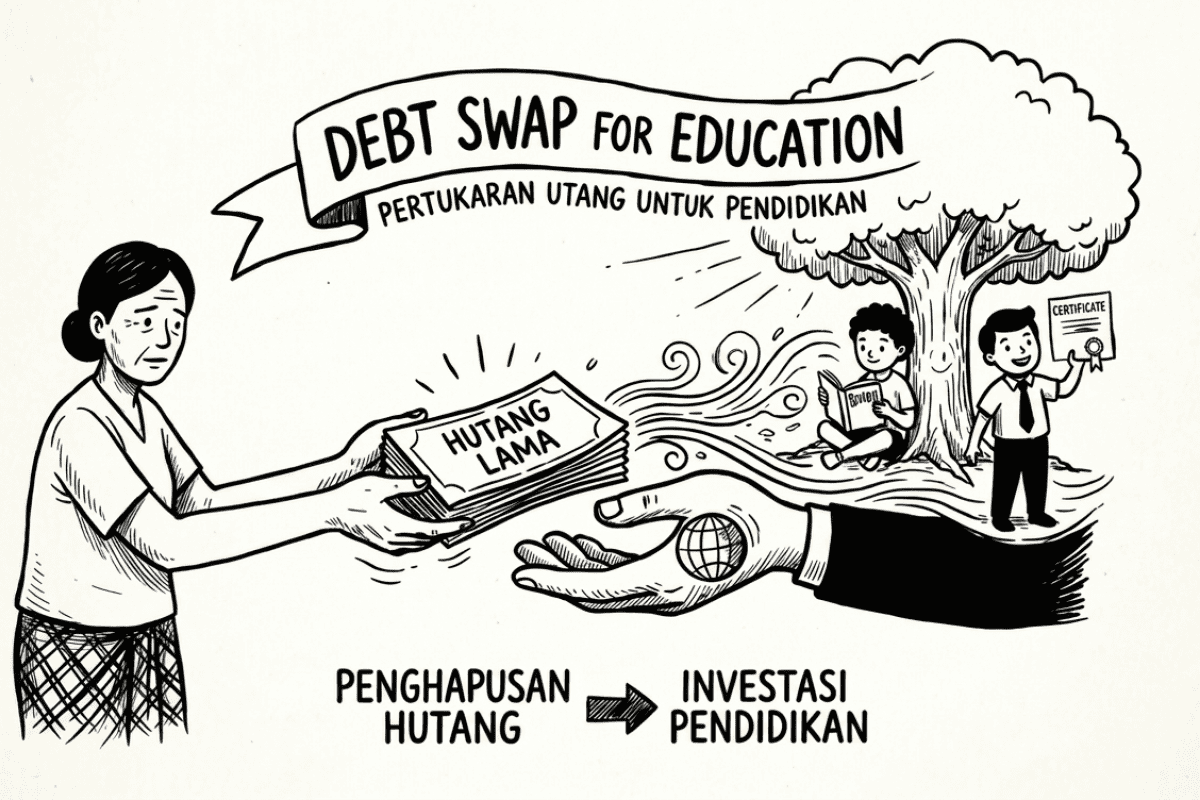
These figures demonstrate that educational transformation cannot rely solely on curriculum changes, digitalisation, or artificial intelligence. These initiatives require competent teachers, adequate schools, electricity, internet access, books, laboratories, and sustainable budgets. Consequently, one of the key ideas reintroduced at TES+4 is the debt-for-education swap mechanism. Under this scheme, creditor nations cancel part of their receivables on the condition that the debtor nation allocates domestic currency funds to agreed-upon education programmes.
Indonesia is not a newcomer to debt-swap diplomacy. Germany was one of Indonesia’s early partners, driven by Bappenas in the implementation of debt-for-development swaps. A December 2002 agreement cancelled German receivables worth 25.6 million euros, in exchange for which Indonesia provided Rupiah funds equivalent to 12.8 million euros for teacher training and the development of equipment for 511 learning resource centres across 17 provinces. A subsequent agreement in November 2004 cancelled approximately 23 million euros of debt and interest, with Indonesia providing Rupiah funds equivalent to 11.5 million euros to build 100 junior high schools in ten remote provinces in eastern Indonesia. Similar schemes were utilised for school rehabilitation following earthquakes in Yogyakarta and Central Java, as well as for Indonesia–Germany scholarship programmes.