
Swa Katon Asri Farmers' Group Uses Used Water Gallons as Rice Planting Media
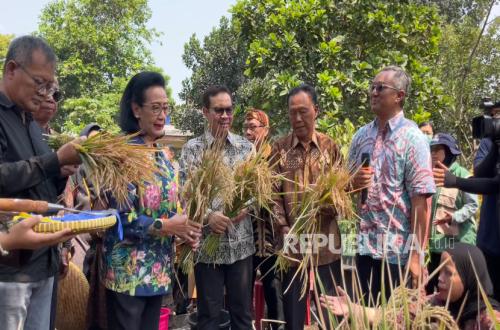
Limited urban land is no longer an obstacle to agricultural productivity. This has been demonstrated by the Swa Katon Asri Farmers’ Group (Poktan), which recently celebrated its first harvest of cultivated crops.
Rather than using vast tracts of land, the crops were grown using recycled materials, specifically empty mineral water gallons. This use of discarded gallons serves as a creative and efficient solution for narrow residential yards while acting as a practical method for managing plastic waste.
The Vice Chairperson of the Regional Representative Council (DPD RI), Gusti Kanjeng Ratu (GKR) Hemas, emphasised the importance of maintaining harmony and strengthening food security starting from the smallest unit of society: the family and the home garden. She made these remarks while attending the first integrated rice harvest at the Swa Katon Asri Farmers’ Group in Wirobrajan, Yogyakarta.
In her speech, GKR Hemas praised this urban farming innovation that utilises limited land, such as planting rice in used gallons. According to her, this creative step proves that urban land constraints are not a barrier to achieving food independence.
“Food security begins with a family. By utilising narrow yards or limited media such as gallons, communities can meet their own food needs while encouraging the active participation of the elderly,” said GKR Hemas on Friday (25/09/2026).
Based on on-site calculations, rice production in gallons is capable of producing an average of 44 stalks, with an estimated conversion rate of up to 7 tonnes per hectare. This yield is even higher than the average production in conventional paddy fields, which typically ranges between 5 to 6 tonnes per hectare.
This community empowerment does not only focus on food crops like rice or vegetables but can also be integrated with livestock sectors within the home garden. Residents can raise several laying hens or maintain fish ponds around their homes to create a complete, self-sufficient food ecosystem.
The founder of Joglo Tani Indonesia, Teo Suprapto, explained that even small plots of land, measuring approximately 1 metre, can still be maximised to meet daily household needs.