
Suwung Landfill in Bali Not to Be Closed, But Waste Disposal Method Will Change
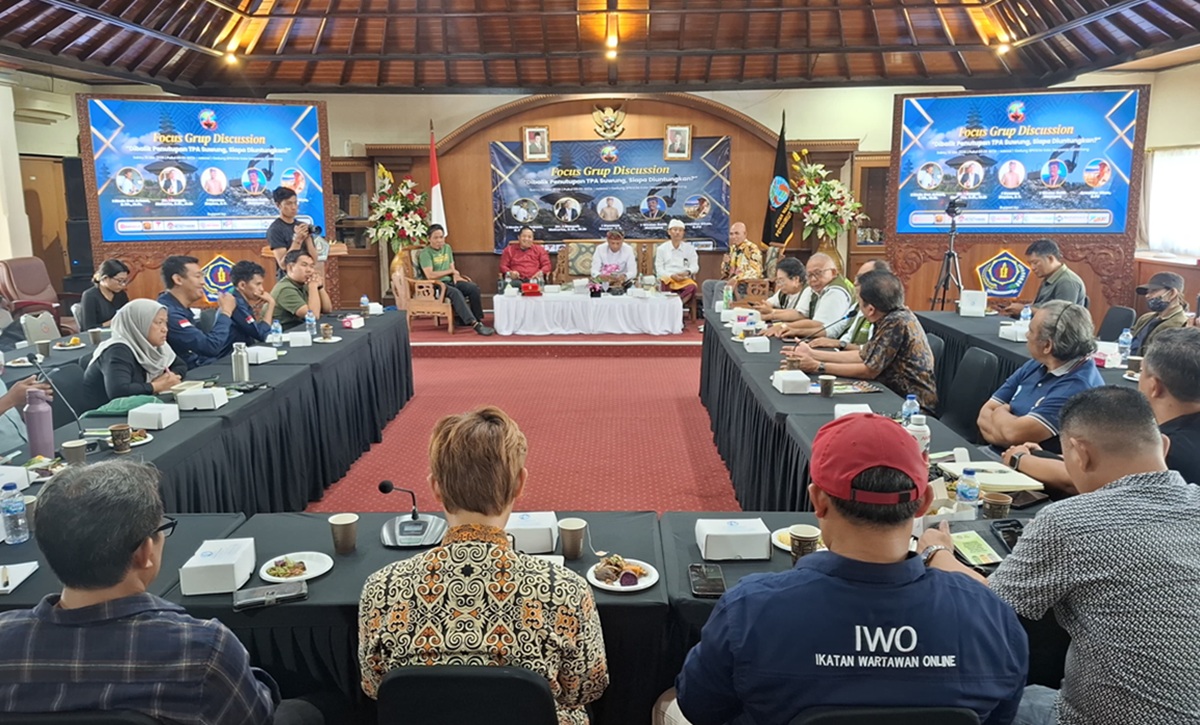
A public discussion organized by the Bali Online Journalists Association (IWO) with the theme “Closure of Suwung Landfill, Who Benefits?” successfully clarified misinformation circulating in the community. The issue regarding the total closure of the Suwung landfill was corrected by experts who affirmed that the policy being implemented is actually a change in waste management methods.
Academic from Warmadewa University, DR. I Nengah Muliarta, explained that the narrative about the closure of the Suwung landfill circulating in mass media and social media is incorrect. According to him, the Suwung landfill is not being closed, but rather its method is being changed.
“There are many narratives being built incorrectly, by both mainstream and social media. That the Suwung landfill is being closed. In fact, what is being closed is the method, the open dumping method. Because this is a mandate of the law,” said Muliarta.
He requested that this wording be corrected so that the public in Bali does not panic. The condition of the Suwung landfill, which is around 40 years old, can no longer accommodate waste if it continues to use the open dumping method. Therefore, the government encourages the community to focus on TPS3R and manage organic waste independently from the source.
“The prohibition of disposing of waste at the Suwung landfill without massive education, without massive socialization, without infrastructure, without human resources, without funding is meaningless. The people of Bali must continue to be educated to manage their own waste, sort it properly, and so on,” added Muliarta.
One of the discussion participants, Agung Yuda, assessed that local governments have been too slow to respond since the enactment of the law prohibiting open dumping in 2008. “This means that for 11 years, local governments did nothing, or rather, they were asleep. They only started moving when the deadline for open dumping was approaching,” he criticized.
Regarding future solutions, Chairman of Commission III of the Bali Regional People’s Representative Council (DPRD), I Nyoman Suyasa, explained that the closure of the old method is a necessity because of its emergency status. The government is now encouraging long-term projects for Waste-to-Energy Plants (PLTSa) in Bali.
“So, who benefits? The answer is the community and the tourism sector,” said Suyasa. According to him, if the PLTSa operates fully, air pollution, sea pollution, and the risk of disease will be eliminated, thus increasing land value, hotel growth, and tourist comfort.
The Head of the Forestry and Environment Agency (KLH) of Bali Province, I Made Dwi Arbani, presented data that currently there are 343 districts/cities and provinces in Indonesia that have been sanctioned by the central government due to stalled waste management systems.
“The ‘collect-transport-dispose’ system is no longer sufficient. We must enforce Law No. 18 of 2008 concerning 3R (Reduce, Reuse, Recycle),” said Dwi Arbani. He also emphasized the clear regulations regarding the division of authority. “The responsibility for this waste problem lies with the Regents and Mayors, not with the Governor.”
Tough criticism from the perspective of community behavior was also conveyed by a practitioner of independent waste management, I Wayan Balik Mustiana. He highlighted people’s mindset who often shirk responsibility after paying cleanliness fees.
Through a village-based management system based on Tri Hita Karana, Wayan Balik proved that 80% of waste can actually be resolved at the village level, considering that 60-70% of household waste is organic waste that can be composted independently. (Z-2)
The importance of waste processing facilities, such as TPS 3R (Waste Processing Place for Reduce, Reuse, Recycle), which should be supported by facilities to distribute the resulting compost.
KLH/BPLH together with the Bali Provincial Government reiterate the steps to stop the practice of open dumping.
The Minister of Environment and Forestry, Hanif Faisol Nurofiq, instructed the closure of open dumping practices at landfills throughout Indonesia. See the target reduction and PSEL solutions in South Kalimantan.
Reviewing the Leuwigajah landfill explosion tragedy in 2005 and the Bantargebang landslide in 2026 as an emergency alarm for the failure of waste management systems in Indonesia.
A member of the DKI Jakarta DPRD, Josephine Simanjuntak, urged the DKI Jakarta Provincial Government to increase community participation in overcoming this problem.
The Governor of DKI Jakarta, Pramono Anung, claimed to have followed the directions of the Ministry of Environment to stop one area of open dumping after the TPST Bantargebang, West Java.