
Sustainable landscape management seen as solution to food, energy and climate challenges
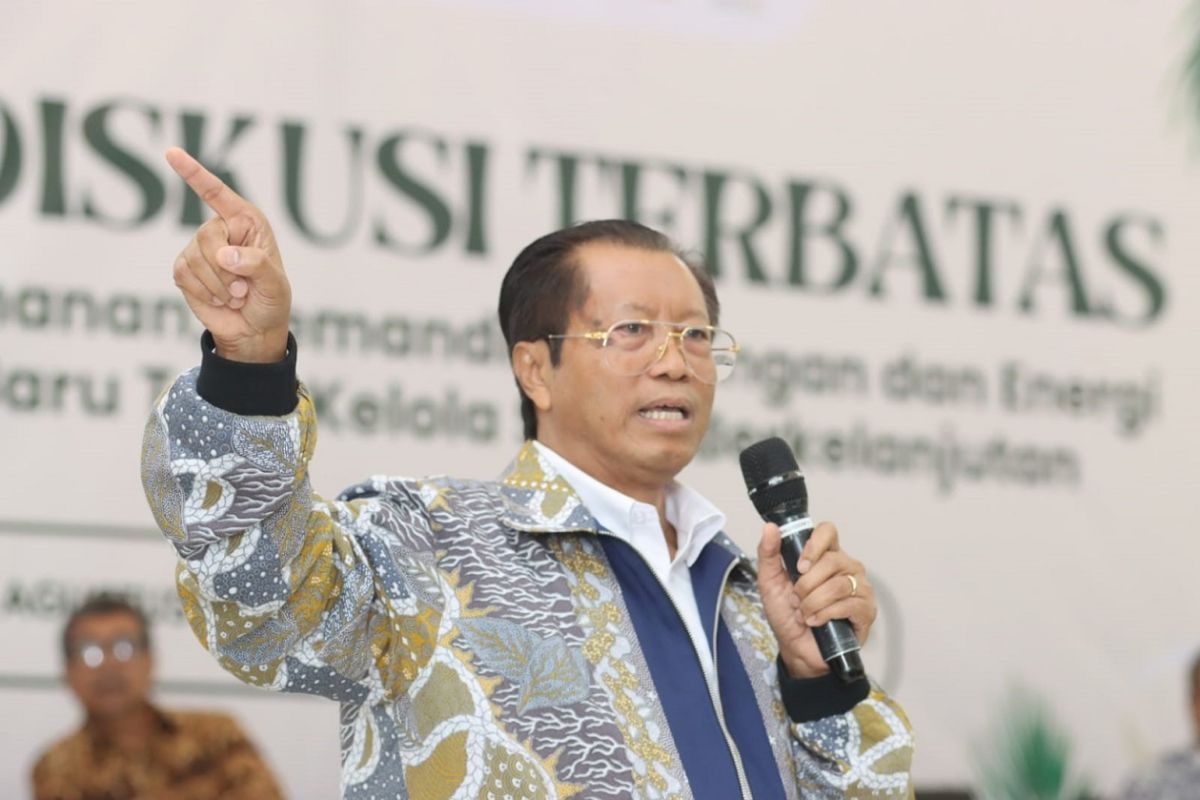
Certainty in spatial planning and sustainable landscape governance is considered the solution to overcoming the three geopolitical and economic challenges facing Indonesia: food security, energy independence and climate resilience.
Petrus Gunarso, founder of the Panca Palma Tropika Indonesia Foundation, stressed that the root of Indonesia’s ecological and national development challenges cannot be resolved through separate sectoral approaches, but must be viewed as a single landscape unit.
“Our approach must shift. Today’s problem is not merely about oil palm plantations, but rather about holistic and integrated landscape governance,” he said in a statement in Jakarta on Monday.
According to him, sustainable landscape governance must integrate all spatial elements proportionally and with legal certainty, encompassing conservation areas, production forests, oil palm plantations, food agriculture, and rivers and watersheds.
“The designation of ecosystem protection area proportions must be clear and protected. There is also a need to optimise sustainable forestry sector cultivation,” said Petrus at the Limited Discussion Forum themed “Building Resilience, Food and Energy Independence Through a New Nexus of Sustainable Palm Oil Governance”.
Regarding oil palm plantations, he continued, there needs to be precise certainty on the area of national strategic commodities. Protection and improvement of food land productivity based on the strength of 7 million hectares of national rice fields must also be addressed.
Petrus said that spatial planning for settlements growing alongside demographic dynamics, supported by planned road and bridge networks, is also part of the strategy being pursued.
He added that spatial certainty is an absolute prerequisite for implementing measurable and efficient climate action.
When space is certain, he continued, conservation can be carried out, carbon sequestration potential can be accurately calculated, biodiversity can be protected, climate resilience can be built, and the palm oil industry can make a real contribution to national food and energy sovereignty.
At the event organised by Rumah Sawit Indonesia at IPB University in Bogor, Petrus emphasised that integration between these components requires cross-sectoral commitment.
“All strategic functions, from spatial planning, biodiversity conservation, carbon accounting, to palm oil transformation, can only be carried out if the landscape is managed within a single governance framework that is certain, inclusive and sustainable,” he said.