
Sustainable Empowerment Programmes Create Long-Term Social Impact
A company’s role in development is no longer measured solely by its economic contribution, but also by the social and environmental impact it creates for the community. Various companies are therefore developing social responsibility programmes that are not merely oriented towards temporary aid, but also encourage self-reliance and sustainability for beneficiaries.
This approach has become increasingly relevant amid the need to strengthen the community’s economy, enhance the quality of human resources, and support sustainable environmental conservation. Through its Social and Environmental Responsibility (TJSL) programme, PT Pupuk Kalimantan Timur (Pupuk Kaltim) runs various initiatives focused on community empowerment, strengthening the local economy, education, health, and environmental conservation.
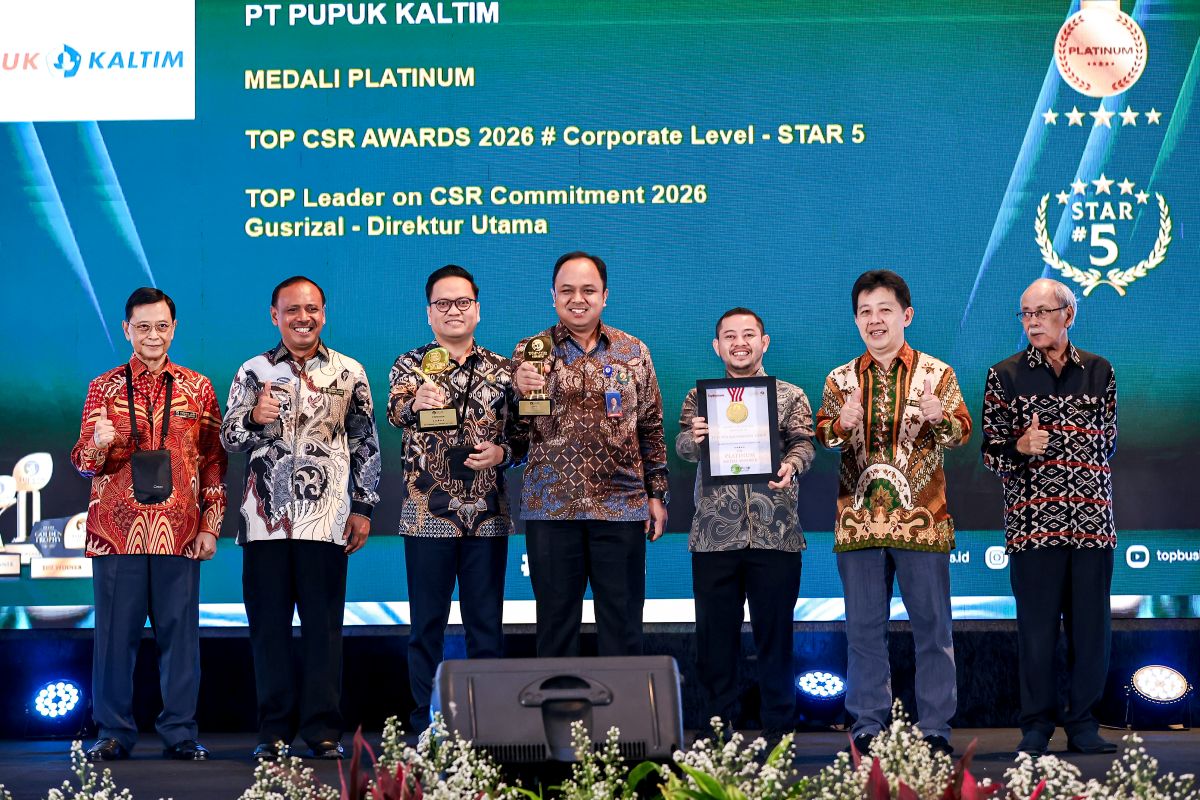
For the implementation of this programme, the company won three awards at the TOP CSR Awards 2026: the TOP CSR Awards 2026 Star 5 predicate, a Platinum Medal, and the TOP Leader on CSR Commitment 2026 award given to Pupuk Kaltim President Director Gusrizal. The Star 5 predicate is the highest category in the TOP CSR Awards assessment, given to companies with CSR systems, policies, and implementations deemed highly excellent. The Platinum Medal is awarded to companies capable of consistently maintaining this predicate over several years of the awards.
Pupuk Kaltim Corporate Secretary Anggono Wijaya stated that the awards reflect the company’s commitment to implementing TJSL programmes in a measurable and sustainable manner. “For Pupuk Kaltim, TJSL is not merely a corporate obligation. It is an integral part of our sustainability strategy to create added value for the community, the environment, and the company collectively,” Anggono said.
According to him, various programmes run by the company are designed to support food security, community economic empowerment, strengthening of MSMEs, education, health, environmental management, and increasing human resource capacity. All programmes are aligned with Environmental, Social, and Governance (ESG) principles, ISO 26000 Social Responsibility, and the Creating Shared Value (CSV) approach.
“Programme initiatives are designed with a long-term approach and based on community needs. The goal is not only to solve existing social issues but also to create self-reliance and sustainability for beneficiaries,” Anggono continued.
One of the company’s flagship programmes is the Koperasi Bina Sukses Bontang, which focuses on strengthening the capacity of local MSMEs. The programme assists business actors in expanding promotional access, building partnership networks, and improving product marketing. By 2025, the production capacity of assisted MSMEs reached 468 CBM per container and successfully penetrated export markets in 12 countries.
In the field of women’s empowerment, the company developed the PKT Serasi Programme, which encourages the creation of processed products with economic added value while strengthening women’s roles in improving family welfare. Pupuk Kaltim also runs the Cendawan Juara Programme, which empowers housewives, the elderly, and retirees through mushroom cultivation as a productive and sustainable business source.
In the health sector, the company consistently implements the PEGALDAS Programme, which focuses on stunting prevention and handling through collaboration with the Bontang City Health Office. Meanwhile, in education, Pupuk Kaltim provides the Pupuk Kaltim Care for Education Scholarship (PKTPP) for high-achieving students from underprivileged families to expand access to education and improve human resource quality.
“In education, we implement this through the Pupuk Kaltim Care for Education Scholarship for high-achieving children from underprivileged families in Bontang. Through this scholarship, we strive to broaden access to education to create a younger generation that is more competitive and able to compete,” Anggono explained.
In addition, the company also developed the Employee Volunteering Initiation (Evolution), a programme that encourages direct employee involvement in various social and community empowerment activities.
The commitment to sustainability is also reflected in the strengthening of corporate governance. Pupuk Kaltim recorded a Good Corporate Governance (GCG) score of 89.37 and obtained the title of The Most Trusted Company at the Corporate Governance Perception Index (CGPI) 2025. In the environmental field, the company also successfully maintained the PROPER Emas award from the Ministry of Environment for nine consecutive years from 2017 to 2025.
According to Anggono, these various achievements serve as motivation for the company to continue expanding collaboration and developing empowerment programmes that deliver greater impact for the community. “We will continue to strengthen this commitment, to keep growing and providing long-term benefits for development, society, and the environment,” he concluded.