
Sustainability Commitments and the Dangers of Microplastics Take Centre Stage
Awareness regarding the importance of environmental sustainability and public health is increasingly becoming a priority for the business world. Beyond focusing on business growth, companies are now required to demonstrate tangible social and environmental responsibilities amidst the threats of climate change, pollution, and rising plastic waste issues.
One such commitment is demonstrated by PT Prudential Life Assurance Indonesia through the launch of its 202ng Sustainability Report. In the report, the company reaffirms its efforts to implement Environmental, Social, and Governance (ESG) principles across all its business activities. Throughout 2025, the company implemented various sustainability strategies through three main focuses: expanding access to health and financial protection, promoting responsible investment, and strengthening sustainable business practices.
Several environmental achievements were reported. The company recorded a reduction in emissions of almost 17 per cent across its headquarters and marketing offices in six cities. Additionally, water consumption for operational needs decreased by up to 67 per cent. Reforestation efforts were also undertaken, with the planting of 25,300 mangrove trees since 2022 as part of the contribution to coastal ecosystem preservation and carbon emission reduction.
In the social sector, the company expanded various community investment programmes reaching over 458,000 beneficiaries. Financial literacy programmes have reportedly reached more than 15 million people, including approximately 6,400 micro, small, and medium enterprises (MSMEs) in West Java, Central Java, and East Java. Furthermore, the ‘Desa Maju’ (Advanced Village) programme has impacted more than 18,000 beneficiaries across several regions.
Chief Customer and Marketing Officer of Prudential Indonesia, Karin Zulkarnaen, stated that sustainability is not only related to environmental protection but also concerns the health and economic resilience of the community. “At Prudential Indonesia, we believe that sustainability is not just about protecting the environment, but also about ensuring that the community has access to better health and financial protection,” said Karin. According to her, the company’s various programmes are aimed at encouraging behavioural changes in the community to be healthier, more environmentally conscious, and possess long-term financial resilience.
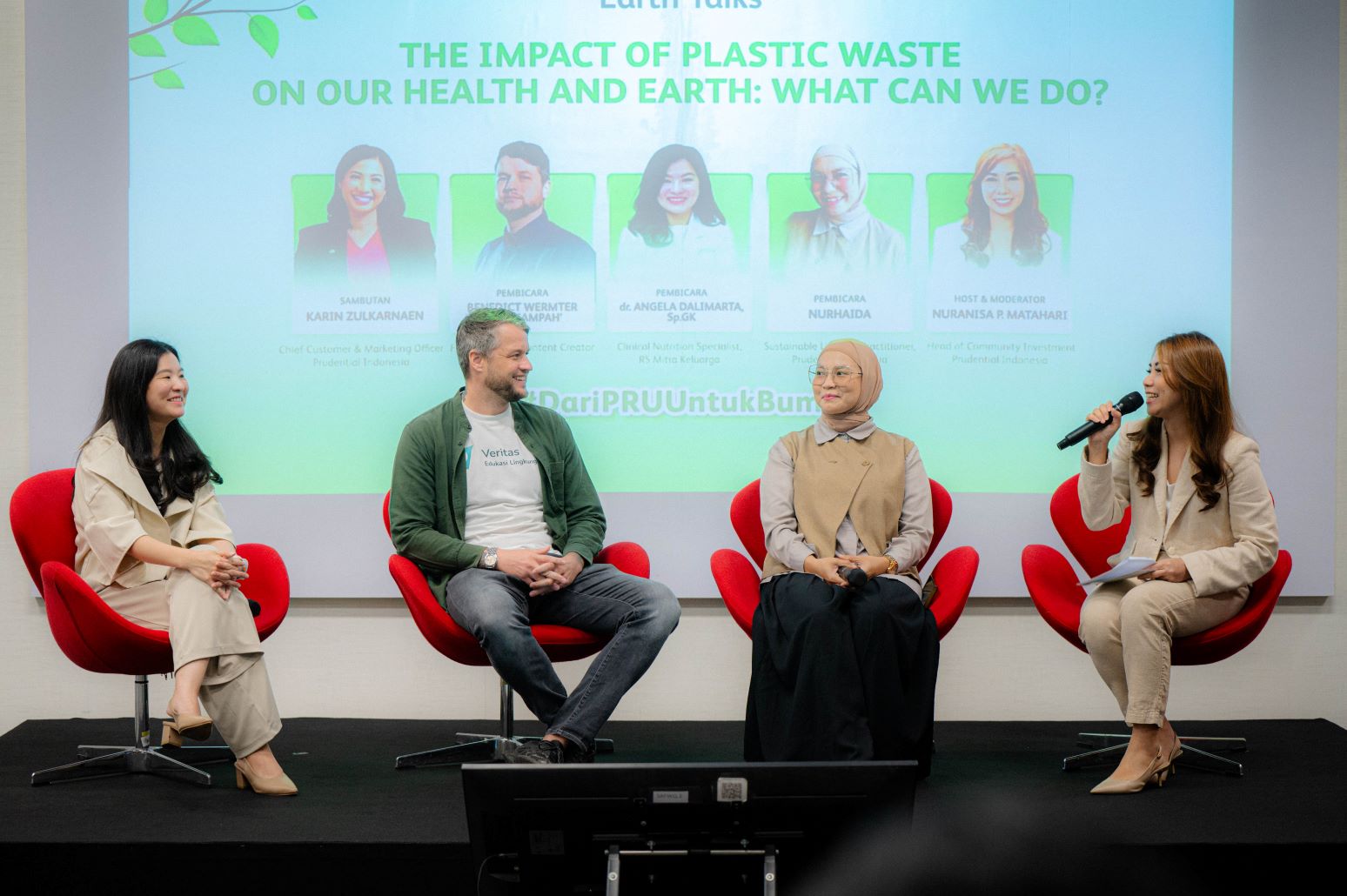
In addition to launching the sustainability report, the company organised an educational discussion titled “The Impact of Plastic Waste On Our Health and Earth: What Can We Do?”, involving employees, marketers, customers, and the general public. The discussion raised the issue of plastic waste and the threat of microplastics, which has become a global concern. The event featured German environmental activist Benedict Wermter, known as ‘Bule Sampah’.
Benedict assessed that the plastic waste problem cannot be solved by the government alone but requires the involvement of the entire community through changes in daily habits. “Tackling the problem of plastic and microplastic waste requires collective collaboration to change simple habits,” said Benedict. He urged the public to begin reducing the use of single-use plastics, sorting waste, and supporting various plastic waste reduction movements at the local level.
Plastic waste remains a serious challenge in Indonesia. Data from the Ministry of Environment and Forestry (KLHK) shows that national waste accumulation reaches over 68 million tonnes per year, of which approximately 17 per cent is plastic waste. This condition is exacerbated by global research findings stating that microplastics have now been found in drinking water, food, and even the air inhaled by humans.
Clinical nutrition specialist at Mitra Keluarga Hospital, Dr Angela Dalimarta, stated that long-term exposure to microplastics can impact human health. “Microplastics entering the human body can trigger inflammation, damage cells, disrupt the immune system, and potentially interfere with the hormonal system,” said Angela. She advised the public to reduce the use of plastic containers, especially for hot food, and to implement clean and healthy lifestyles to minimise the risk of microplastic exposure.
Karin added that the company will continue to promote various initiatives related to health, the environment, and sustainability as part of its corporate social responsibility. “We hope to increase public awareness to protect the environment and health as part of a more responsible lifestyle,” she said. Amidst the increasing threats of climate change and environmental pollution, the issue of sustainability is no longer merely a corporate trend, but a shared necessity that demands collaboration between the government, the business world, and the community.