
Surya Stambha: A Rare Artefact from Sawu Island, NTT
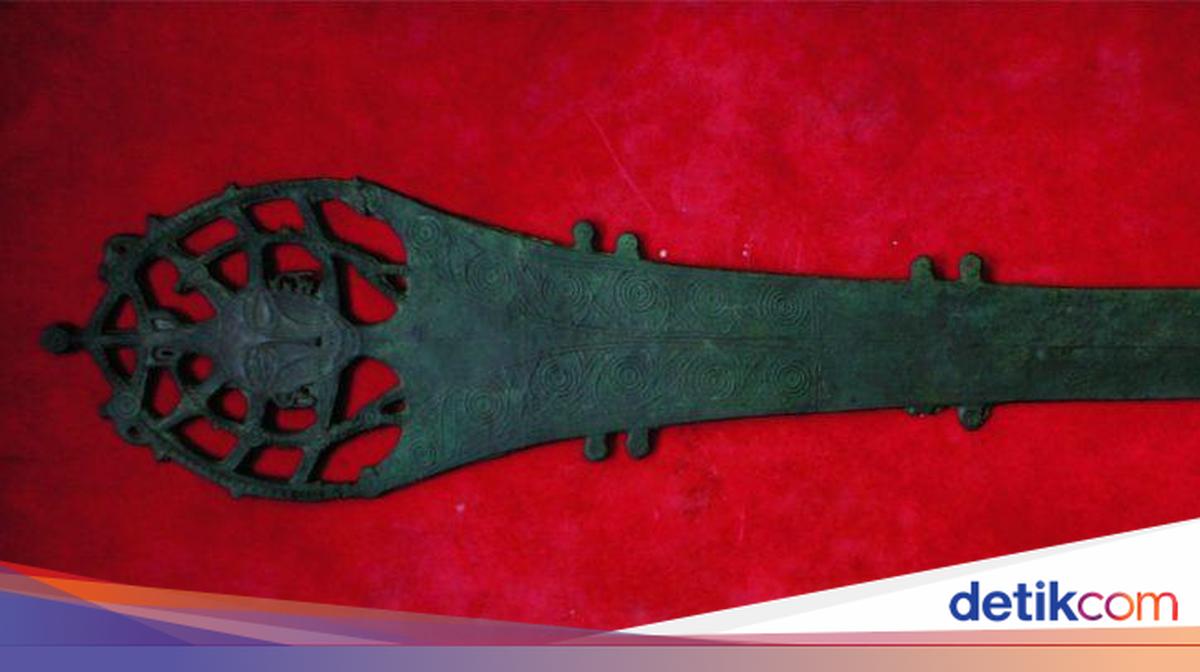
East Nusa Tenggara (NTT) holds a wealth of prehistoric cultural treasures. Stone and metal tools are commonly found in NTT. One particularly intriguing find is a bronze artefact from Sawu Island. This artefact is named Surya Stambha.
This relic from the trading era is stored at the Mpu Tantular Museum in East Java (Jatim). So far, no similar finds have been discovered in Indonesia.
Origin and Current Location
Surya Stambha was discovered accidentally on Sawu Island, Sabu Raijua, NTT. The artefact was found alongside several other discoveries, such as a kabila axe. The material used to create Surya Stambha is estimated to be bronze, indicating a mixture of metals within it.
In terms of size, the artefact measures 150 centimetres (cm) in length and 30 cm in width. Its volume is somewhat flat. The top part has a net-like shape with a carved face in the centre.
Reason for the Name Surya Stambha
Stambha originates from Sanskrit, meaning pillar or column. In the context of Indian architecture, stambha refers to a structure with religious and symbolic functions. Such buildings often feature inscriptions or religious elements.
If stambha is a term for a building or form originating from India, why is the artefact found on Sawu Island, dating from the late prehistoric period, named Surya Stambha? Does this artefact also serve the same function as stambha in India?
So far, there is no definitive explanation regarding the naming and function of the object. However, it is suspected that the object is related to Dongson and Lapita cultures.
Dongson Culture and Lapita Culture
Prehistoric bronze artefacts in Indonesia are closely linked to the Dongson culture. The name Dongson is taken from the Dong Son site in Vietnam, excavated in 1924. This culture spread from Vietnam to Papua. Its characteristics are found in the materials and relatively contemporaneous age. The Dongson culture represents the spread and advancement of technology during that era.
There is also the Lapita culture, which spread across the Asia-Pacific region. A strong feature of this culture is the art on its relics. It usually consists of dots forming geometric patterns or faces. The Lapita culture is easily found among coastal communities. This indicates traces of its spread among Austronesian societies.
Both cultures are believed to have a strong influence on Surya Stambha. For example, contemporaneous artefacts share similar characteristics. The Pejeng Drum in Gianyar is made of prehistoric bronze. Additionally, the face decoration on the Pejeng Drum appears similar to that on Surya Stambha.
Function of Surya Stambha
Societies in the Pacific region apparently possess objects with similar forms. An illustration depicts a person from Marquesas Island in the Pacific holding an object resembling Surya Stambha. That person holds a high position in the social hierarchy. The object he holds serves as evidence of that social status. This suggests that Surya Stambha may have had the same function, even though it was found in NTT. Of course, this hypothesis requires further study and examination.