
Surveying traders' stalls, Regent Jeje ensures health of Eid al-Adha sacrificial animals in Bandung Barat Regency
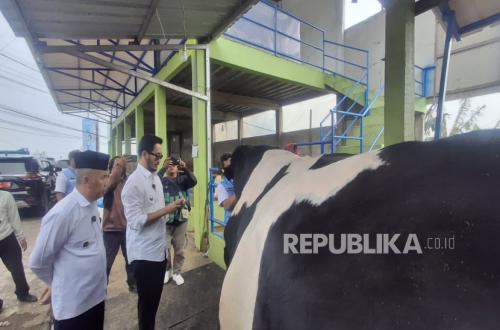
Bandung Barat Regency Regent Jeje Ritchie Ismail personally checked a number of livestock stalls selling sacrificial animals in his area on Wednesday (20 May 2026). He said he wanted to ensure that the animals sold by breeders were healthy and fit for slaughter. ‘We inspected the livestock stalls in Bandung Barat Regency. Of the 47 stalls examined, 2,069 cows and 760 sheep were recorded as healthy,’ Jeje said, flanked by Vice Regent Asep Ismail.
Jeje stated that animal health officers are still patrolling to inspect stalls and farmers across Bandung Barat. The checks confirmed that the animals are healthy and fit for sacrifice. The conditions for sacrificial animals are that they be healthy, not emaciated, and of proper age. In terms of age, sheep or goats must be over 1 year old, while cows or buffaloes must be over 2 years old.
Jeje reminded the public to buy sacrificial animals that are labeled with a health band or sticker from the Bandung Barat Fisheries and Livestock Service. ‘For the public, we urge the purchase of animals that have a health label issued by the Fisheries and Livestock Service. With that label, people can be assured the animal has undergone a health check, so the meat will be safe for consumption,’ he said.
Head of the Bandung Barat Fisheries and Livestock Service, Wiwin Aprianti, forecast that the number of sacrificial animals checked this Eid al-Adha will rise this year. Last year, the number of sacrificial animals health-checked and deemed fit was 11,710, comprising 5,063 cows, 6,269 sheep, 366 goats, and 12 buffalo. The checks prior to slaughter (ante mortem) were conducted at 270 stall sites across Bandung Barat.
‘If the number of animals checked in 2026 is projected to rise by 2 percent from 2025, it will total 11,944 animals. The number of stalls to be checked will be about 270, in line with the 2025 data on sacrificial-animal stalls,’ Wiwin said.
According to Wiwin, the sacrificial animals are sourced from local Bandung Barat stock as well as from outside areas such as East Java, Central Java, Yogyakarta, and other West Java regencies and cities. Wiwin stressed that animals must be accompanied by documents in accordance with regulations, such as the Health Certificate (SKKH), veterinary certificates for inter-regional transport, and animal-quarantine certificates for inter-regional movement. Registration can be done online through the system. She also urged traders and farmers to report any arrival of animals.
‘They must also implement biosecurity, isolating new animals for at least 14 days, maintaining clean housing, and separating sick animals from healthy ones. We hope all checks go smoothly so that the public can choose healthy, safe, and fit-for-consumption sacrificial animals,’ Wiwin concluded.
Source: jawawa.id (https://jawawa.id/newsitem/surveying-traders-stalls-regent-jeje-ensures-health-of-eid-al-adha-sacrificial-animals-in-bandung-barat-1779545612)
Originally published by Republika (https://rejabar.republika.co.id/berita/tfc2a4368/cek-lapak-pedagang-bupati-jeje-jamin-kesehatan-hewan-kurban-di-bandung-barat), translated from Indonesian