
Surprising Remarks from Deputy Industry Minister and Business Owners on Rupiah and Pertamax Price Hike
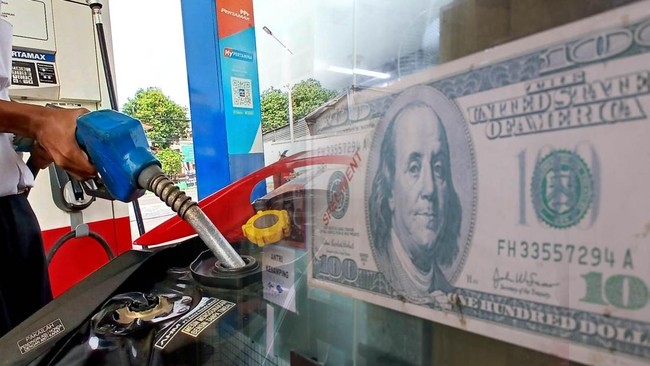
The movement of the Rupiah exchange rate is showing a positive trend. The strengthening of the Rupiah against the US Dollar continues today.
Quoting Refinitiv, the Rupiah exchange rate in today’s trading, Friday (12/06/2026), opened sharply stronger by 0.42%, appreciating to the level of Rp17,900/US$.
The weakening Rupiah, which had previously plummeted against the US Dollar to Rp18,170—its weakest level ever—occurred at the close of trading on Monday, 8 June 2026, causing significant volatility in the country. Panic was even observable among both foreign and domestic investors.
Entrepreneurs have voiced their concerns, calling on the government to act swiftly to address the Rupiah’s depreciation. The government and the House of Representatives (DPR RI) responded by holding marathon meetings aimed at strengthening the currency.
Amidst this trend in the Rupiah’s movement, PT Pertamina officially implemented price adjustments for non-subsidised Fuel (BBM) starting Wednesday, 10 June 2026.
According to the PT Pertamina Patra Niaga website, Pertamina officially raised the price of Pertamax (RON 92) to Rp16,250 per litre starting Wednesday, 10 June 2026, for the DKI Jakarta area and its surroundings. This Pertamax price increase represents a rise of Rp3,950 per litre from the previous rate of Rp12,300 per litre set on 1 June 2026.
As a note, in trading on Wednesday, 10 June 2026, Refinitiv recorded the Rupiah closing at the level of Rp17,950 per US Dollar. This position allowed the Rupiah to successfully exit the psychological level of Rp18,000/US$, after first breaching that level on 4 June 2026.
How are the government and entrepreneurs responding to the dynamics of the Rupiah exchange rate against the US Dollar and the Pertamax price hike?
Deputy Minister Claims ‘Harvesting Opportunities’
Deputy Minister of Industry Faisol Riza stated that several sectors are currently ‘harvesting opportunities’ amidst the turmoil caused by the pressure on the Rupiah exchange rate.
“Lately, there have been many issues suggesting that the rise in foreign currency and the pressure on the Rupiah have a massive impact on industry. However, we know that certain sectors are actually experiencing a harvest of opportunities,” Riza said in a statement on Friday (12/06/2026).
Based on field inspections, he assessed that several industries still possess sufficiently strong business resilience to face external pressures.
“It is evident that they possess good fundamentals and are almost unaffected by the weakness or instability of the Rupiah exchange rate or the capital market. I also see that our national industry has strong resilience in facing unstable global situations,” he said.
Furthermore, the government is said to be tightening supervision of incoming goods to protect domestic industries from unfair trade practices.
“The government is also ensuring that border controls are strictly enforced. The President has ordered that Customs becomes our economic strength by limiting illegal goods, goods that do not meet standards, and goods that damage the domestic market,” said Ruala.
Entrepreneurs Respond
Contacted separately, the Chairman of the Ikatan Pengusaha Konveksi Berkarya (IPKB), Nandi Herdiaman, stated that although the weakening Rupiah has the potential to increase certain raw material costs, the impact remains manageable as long as market demand is maintained.
“(The exchange rate and Pertamax price increase) is not a problem for me and will hold as long as the key factor is the market. If the market is maintained—because I am confident the Indonesian market is still running, including export opportunities—it will be fine,” Nandi told CNBC Indonesia on Friday (12/06/2026).
In fact, if domestic market conditions remain stable and export opportunities continue to improve, the garment industry still has the opportunity to create new jobs. As a labour-intensive sector, any increase in market demand is usually immediately followed by the need for additional workers in production lines, ranging from sewers and fabric cutters to other support staff.
“For those of us in home industries specifically, I have also spoken with colleagues; as long as the market exists, we are not worried. In fact, if the market is consistently good, it could absorb 100,000 new workers in 2027,” said Nandi.
The Finance Director of PT Superior Prima Sukses (BLES), Andrew, expressed similar sentiments.
“Energy and distribution costs are important cost components in the building materials manufacturing industry. However, the impact of the Pertamax price increase on the Company is relatively small, considering that our product distribution activities generally use transport fleets fuelled by subsidised diesel,” he told CNBC Indonesia on Friday (12/06/2026).
He also admitted not to being overly concerned about a scenario where the Rupiah exchange rate remains at the Rp18,000 per US Dollar level. The cost structure, dominated by raw materials, energy, and domestic operational costs, results in relatively low direct exposure to US Dollar fluctuations.
“Overall, the Company assesses that the potential pressure on profit margins due to the weakening Rupiah is relatively small. This is because most of our main raw materials, energy sources, and operational costs are obtained from domestic suppliers and use Rupiah, so the impact of US Dollar fluctuations is not significant,” said Andrew.
“Regarding the comparison between the weakening Rupiah and the fuel price increase, the Company views both as external factors that need to be monitored. However, since most of our raw materials, energy sources, and operational costs come from domestic sources, there is no direct impact of exchange rate fluctuations on the Company’s production costs,” he added.
Potential to Trigger Inflation
Meanwhile, academics assess that the impact of the Pertamax price increase cannot be measured solely by direct logistics costs. The increase in fuel prices has the potential to create a chain effect on economic activities that will ultimately be felt by the industrial sector.
“It may not have a direct impact, but primarily…
Source: jawawa.id (https://jawawa.id/newsitem/surprising-remarks-from-deputy-industry-minister-and-business-owners-on-rupiah-and-pertamax-price-hike-1781254278)
Originally published by CNBC Indonesia (https://www.cnbcindonesia.com/news/20260612130622-4-742320/ucapan-mengejutkan-wamenperin-2-pengusaha-soal-rupiah-pertamax-naik), translated from Indonesian