
Surabaya Wins 2026 TPAKD Award as Best City in Java-Bali with Seven Key Programmes
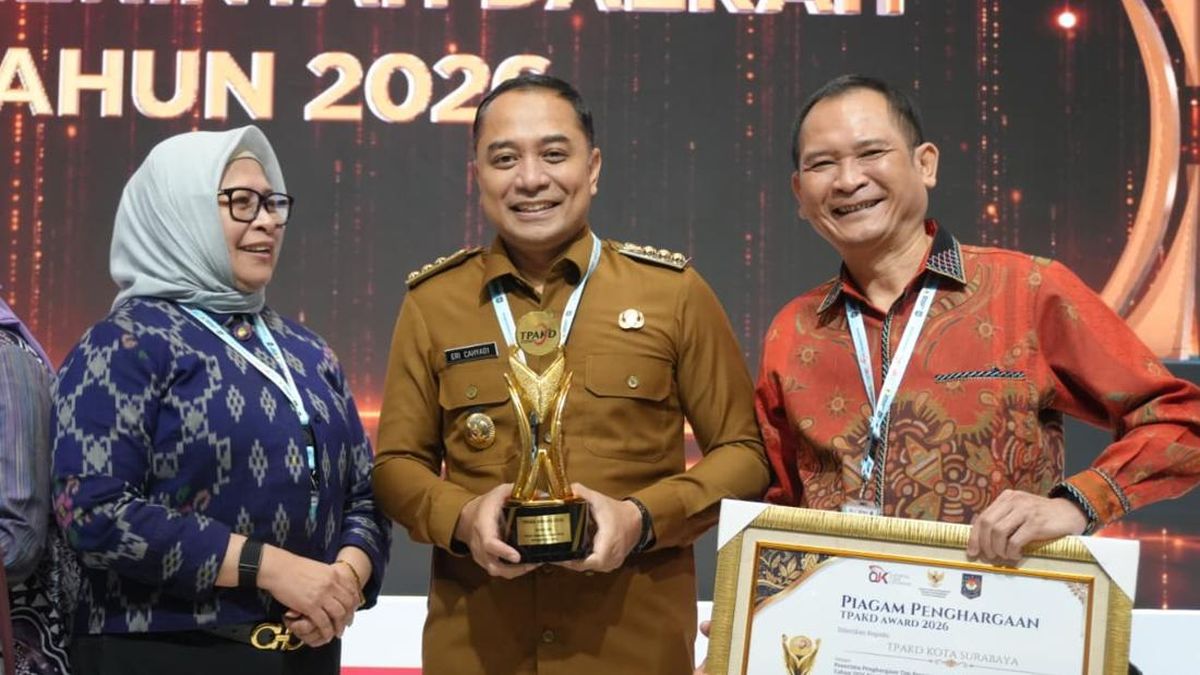
The Surabaya City Government has received the Financial Access Acceleration Regional Team (TPAKD) Award 2026 in the Best City category for the Java-Bali region from the Financial Services Authority (OJK).
The award recognises the city government’s efforts to expand access to financial services, improve public literacy and promote regional economic growth. It was received in Jakarta recently by Surabaya Mayor Eri Cahyadi.
Eri said the award reflected collaboration between the city government and stakeholders in the financial sector to stimulate economic activity and extend the benefits of financial services to the public.
“At the TPAKD Award, thankfully Surabaya was named the best in Java-Bali. It is about working with all stakeholders to drive economic and financial activity,” Eri said at Surabaya City Hall on Wednesday (28 October).
He said wider financial access needed to go hand in hand with developing the public’s economic potential. Engaging Generation Z and providing support to micro, small and medium-sized enterprises (MSMEs) were among the efforts to boost economic activity in Surabaya.
Eri expressed hope that collaboration between the city government, OJK and financial-sector players would continue, allowing more residents to benefit.
“Thank you to OJK and everyone in the financial sector who continues to collaborate with and support the Surabaya City Government,” he said.
Seven flagship programmes
The city’s success in winning the 2026 TPAKD Award was attributed to seven flagship programmes implemented throughout 2025. They focused on widening financial access, empowering the local economy and improving residents’ welfare.
“Officially, the city government has received the Financial Access Acceleration Regional Team Award 2026 at city level for the Java-Bali region. The team’s role is to provide financial literacy and inclusion for Surabaya residents,” said Vykka Anggradevi Kusuma, head of Surabaya’s Economic Affairs and Natural Resources Division.
The Surabaya TPAKD programmes were designed to support the city’s development indicators for 2025. Economic growth stood at 5.87 per cent, above the 5.77 per cent target. The Human Development Index (HDI) reached 85.65, compared with a target of 85.26, while the poverty rate was 3.56 per cent against a target of 3.9 per cent.
The seven programmes cover digital infrastructure, financial-access assistance, worker protection, MSME financing, local economic empowerment, investment education and digital payments.
The first is Satu Data Surabaya, which strengthens digital infrastructure through applications, websites and an integrated data system. The system supports economic policymaking and the distribution of social assistance.
Second, PASTI LAKU provides assistance, guidance, financial literacy and education on access to financial services for residents and businesses.
Third, a worker-protection programme provides employment social security through BPJS Ketenagakerjaan for workers, online motorcycle taxi drivers and public-service workers, covering 99,724 participants.
Fourth, loans under the Kredit Melawan Rentenir (K/PMR) PUSPITA scheme, distributed through PT BPR Surya Artha Utama, have reached 2,138 borrowers.
Fifth, Pemberdayaan dan Ketahanan Ekonomi Nang Suroboyo (PEKEN) is a digital platform that expands market access for local MSME products through peken.surabaya.go.id. By the end of 2025, it involved 5,734 MSMEs and generated turnover of Rp216 billion.
Sixth, the Capital Market Investment Gallery at the Siola Public Service Mall provides investment education and access to legitimate investment products.
Seventh, payments have been digitalised through the Child Identity Card (KATEPAY) and Student Savings (SimPel) schemes in Surabaya. Transactions or savings under the programme currently total around Rp158 billion.
The city government also offers low-interest financing to support MSME development, including PUSPITA at 3 per cent a year and Sikumis at 5 per cent a year.
Low-income groups are supported through employment social security contributions funded by the regional budget. MSMEs, meanwhile, receive help with digital marketing through the PEKEN platform.
“In this regard, the city government, OJK and financial institutions are working together to provide financial literacy and inclusion initiatives in schools, among MSMEs and for women’s groups,” Vykka said.
For 2026, the city government plans to continue existing programmes, including strengthening its data base and financial literacy through the SOMASI PINJOL programme.
“There will also be new initiatives to digitalise parking, tax and levy payments, and to create digital ecosystems for traditional markets and tourism,” Vykka concluded.