
Surabaya Protest Outside Governor's Office: Crowd Delivers 9-Point Protest
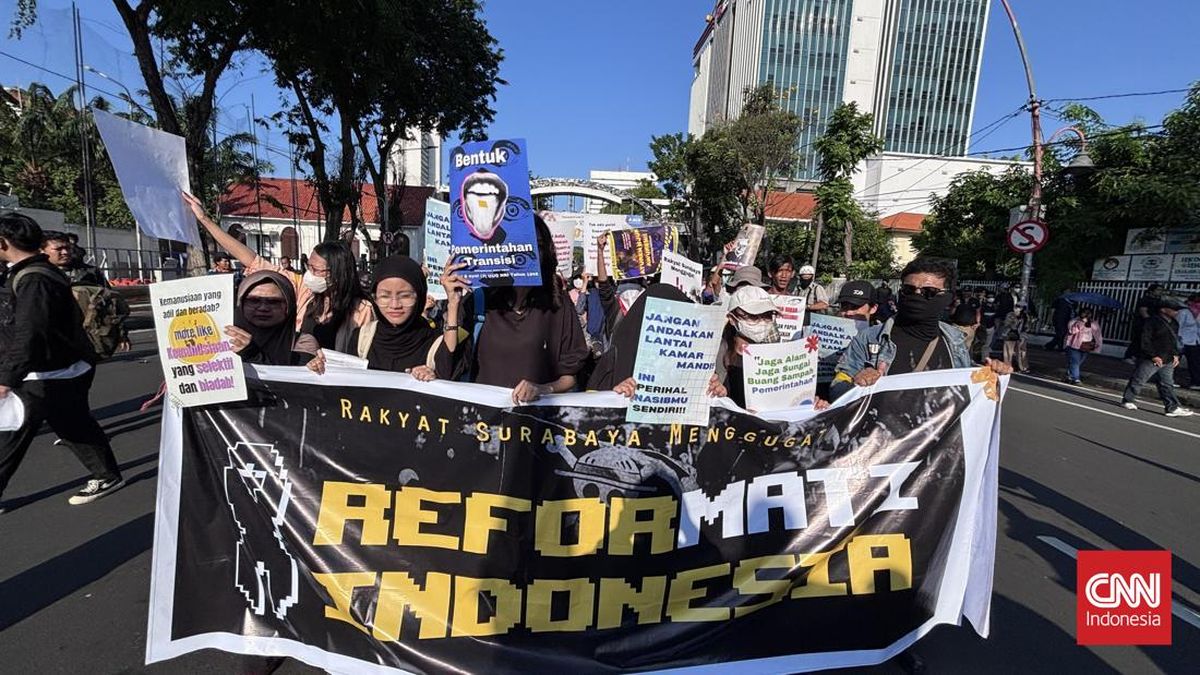
Hundreds of civil society members, comprising students, academics, and workers united under the Surabaya People’s Alliance of Protest, staged a demonstration outside the Grahadi State Building in Surabaya, East Java, on Monday afternoon. The crowd delivered nine points of indictment against the administration of Prabowo Subianto and Gibran Rakabuming Raka, which they labelled the ‘Nawa Nestapa’ (Nine Calamities).
The protest began with a long march from the Bambu Runcing Monument on Jalan Panglima Sudirman Surabaya. Participants walked while banging kitchen utensils they had brought, proceeding to the front of the Grahadi State Building on Jalan Gubernur Suryo. The crowd also carried numerous banners and placards, including one reading ‘Reformati Indonesia’ and another stating ‘Intellectuals without a rebellious passion are merely an extension of the state’. The latter banner was displayed on a pedestrian bridge on Jalan Gubernur Suryo.
Action coordinator Raditya Ananta Widyawardana stated the protest involved a combined force of civil elements, students, and workers united in a single front. This deliberate merging of movements was intended to avoid the fragmentation seen in previous actions. ‘We agreed to unite civil society, students, and workers; we consulted everyone together. We don’t want the movement in Surabaya to be fragmented like before. So today we are trying to merge,’ Raditya said.
The Surabaya People’s Alliance of Protest had formulated nine points of protest against the central government, which the crowd declared as the failures of the Prabowo-Gibran administration. Spokesperson and academic from the Faculty of Law at Airlangga University, Miftakhur Rohmah, detailed the systemic failures underpinning their demands. ‘We have examined the nine Nawa Nestapa, the nine failures of Prabowo-Gibran that brought us here,’ Miftakhur stated.
The nine accusations of failure encompass issues of legitimacy, failure to protect vulnerable groups, oligarchic practices, and the seizure of civil society’s space and land. ‘Prabowo Subianto has failed constitutionally, failed ethically, is ethically flawed, and logically flawed. This cannot be allowed to continue,’ Miftakhur asserted.
Miftakhur also highlighted the weakening of the principle of legal supremacy under the current administration, arguing it only benefits the oligarchy and a select few. ‘The rule of law no longer exists; now there is rule by law. Rules made by law, made by Prabowo-Gibran. Laws made only for their pleasure, only for their power,’ she said.
Regarding the giant banner on the pedestrian bridge, Miftakhur explained the message was a call to intellectuals and academics to dare to take to the streets. ‘Now intellectuals are afraid to speak out. Academics are afraid to take to the streets. Not because they don’t want to, not because they don’t love the country, but because they don’t have time, because there is too much administration to handle,’ she said. According to Miftakhur, the involvement of academics is crucial to strengthen the movement’s legitimacy. ‘These academics can provide concrete studies. These academics can provide concrete legitimacy for those of us on the streets,’ she added.
Miftakhur stated the group was not demanding to meet any officials, insisting the obligation to listen lies with the government, not the other way around. ‘The government must listen. It is the government’s duty to listen. It is not our duty to beg them to be heard. People on the streets are losing time. The government must also lose time to listen to us, the Surabaya People’s Alliance of Protest,’ she stressed.
Beyond Surabaya, a wave of protests against state policies under the Prabowo-Gibran administration has been ongoing in several cities for at least two weeks. On the same day, a similar demonstration was reported in Denpasar, led by a coalition of students in front of the Bali Regional Legislative Council building. Previous waves of protests also occurred in cities across Indonesia, including Jakarta, Bandung, Solo, Medan, and Makassar, with broadly similar demands concerning the deteriorating state of national finances and a call to halt militarisation in civilian spheres.