
Surabaya Journalists Hold Joint Prayer for Five Missing Journalists
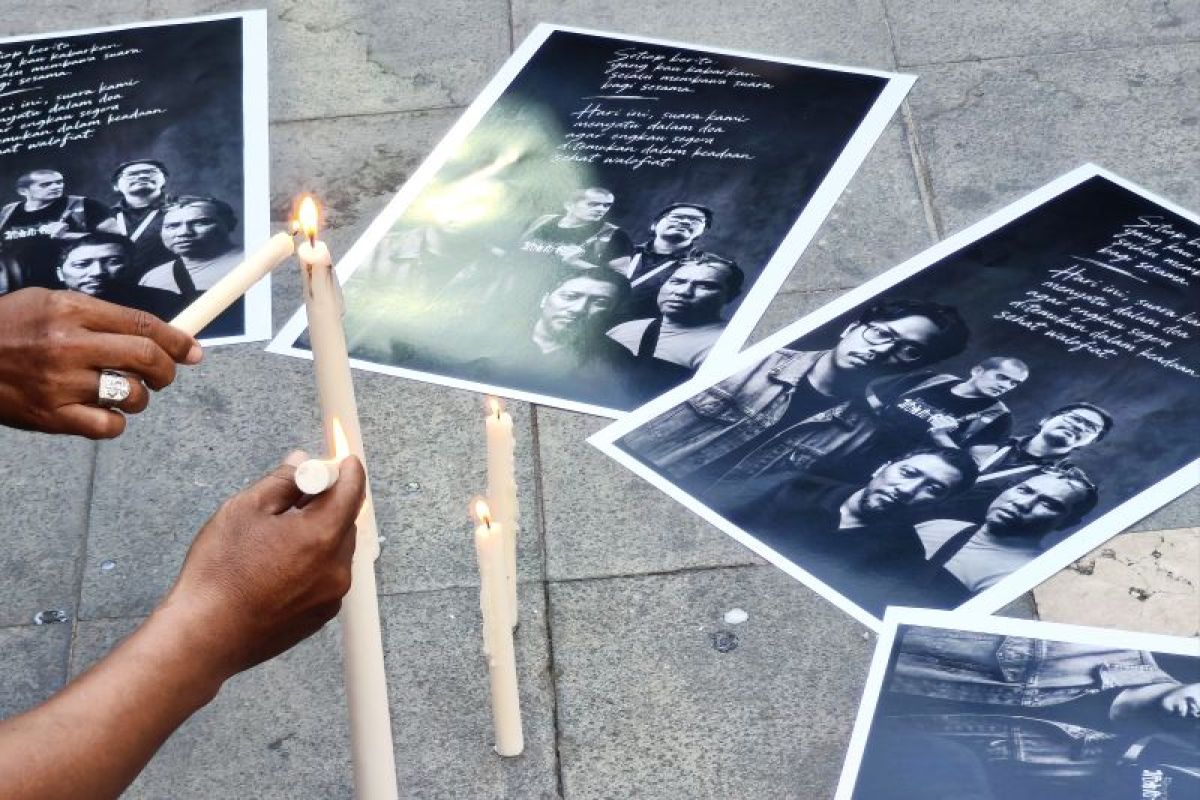
Surabaya (ANTARA) - The Indonesian Photojournalists Association (PFI) Surabaya, alongside the Indonesian Television Journalists Association (IJTI) Surabaya and several other reporters, held a joint prayer session for five journalists and three ship crew members who remain missing after disappearing while covering activities at Mount Anak Krakatau in the Sunda Strait waters.
Suryanto, Chairman of PFI Surabaya, stated that the event was not a protest, but rather a collective prayer expressing hope that all journalists and crew members currently being searched for can be found safe and sound.
“This is not an action, but a joint prayer for five journalists and three crew members who are currently still being searched for,” said Suryorkan during the prayer session held in front of Apsari Park, Surabaya, on Friday.
He explained that the five journalists still being sought are M Bagus Khoirunnas from Perum LKBN ANTARA, Ari Basuki from Merdeka.com, Yudistiro Pranoto from iNews, Firman Daus from Anadolu Agency, and Donal Husni, a freelance journalist.
The prayer session was marked by the lighting of candles, symbolising the hope of fellow journalists that the five journalists and three crew members will be found safely.
“The candle symbol represents our collective hope that our five colleagues and three crew members can be found soon,” he said.
He added that PFI, along with other journalistic organisations, has coordinated with the joint SAR (Search and Rescue) team to support the search process and provide assistance to the families of the missing journalists.
Regarding Firman Daus, who works for Anadolu Agency, Suryanto noted that the media organisation is aware of the disappearance and is communicating directly with the SAR and Basarnas (National Search and Rescue Agency) teams.
“The organisation where Mr Daus works is aware and has approached the SAR and Basarnas teams independently,” he said.
As a precautionary measure, he reminded journalists to always account for risks when performing field assignments, particularly in areas with potential hazards such as volcanoes and the sea.
He noted that while journalists are required to approach their subjects to obtain information and visuals, they must still maintain a safe distance and perform risk mitigation before carrying out their duties.
“We must truly calculate the safe distance; otherwise, it becomes too dangerous,” he explained.
He assessed that while experienced journalists certainly perform various forms of mitigation before their assignments, natural conditions such as sudden weather changes and large waves remain unpredictable factors.
“We cannot fight nature; there might be sudden large waves or similar unpredictable elements,” he concluded.