
Surabaya City Government Wins 2026 Adiwidya Award for Expanding Access to Education
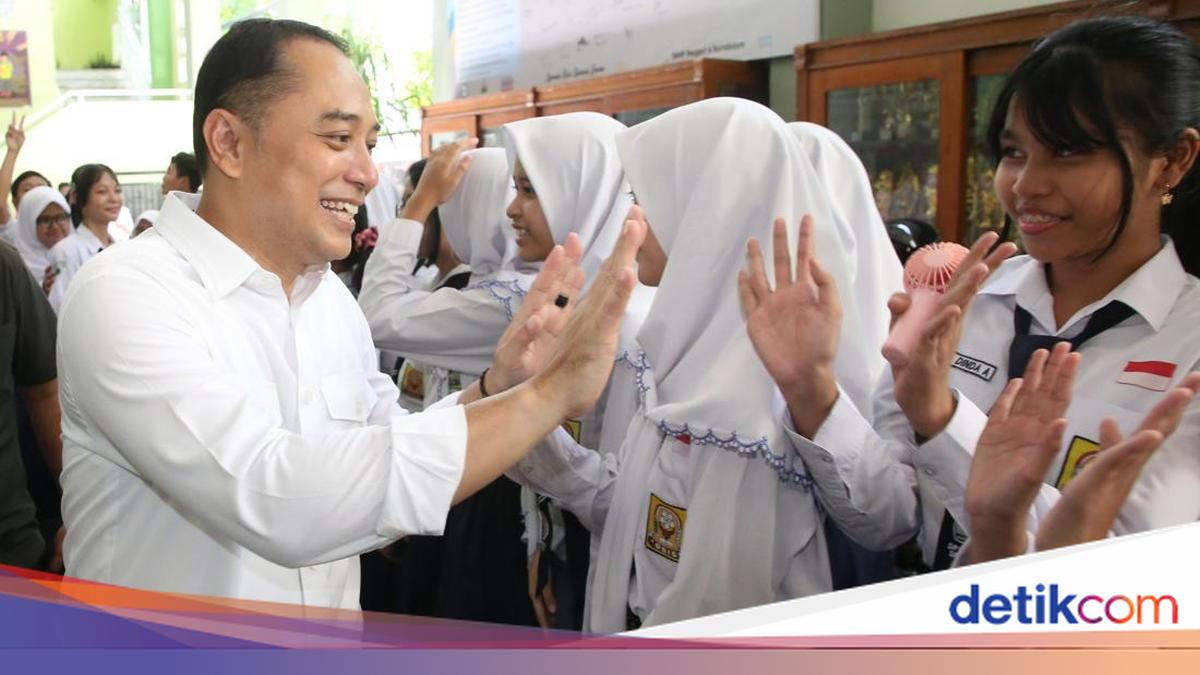
The Surabaya City Government has received the 2026 Adiwidya Award from the Indonesian Forum of Community Learning Centres (FK PKBM Indonesia). The national award recognises the city’s commitment to expanding access to and developing non-formal education through Community Learning Centres (PKBM).
The award was presented during the sixth national seminar and congress of FK PKBM Indonesia at the Sawunggaling Building on the Lidah Wetan campus of Surabaya State University (Unesa) on Friday (6 November). It was presented by Gogot Suharwoyo, Director General for Early Childhood, Primary, Secondary, and Non-Formal and Informal Education (PNFI).
Surabaya Mayor Eri Cahyadi thanked the organisers for the award. He said the recognition was not only for the city government, but also for all members of the public who had contributed to improving residents’ welfare and access to education.
“I am grateful. The award is really for the people of Surabaya. Tackling school dropouts is not something the Surabaya City Government can do alone: it takes the whole community, all the businesses in Surabaya and all the foster parents in the city,” Eri said in a written statement on Wednesday (11 November 2026).
He said community involvement was one of Surabaya’s strengths in sustaining social and education programmes. Foster parents, businesses and residents concerned about school dropouts had helped the government provide education access to those in need.
“Why can Surabaya still stand firm today despite cuts to regional transfers (TKD)? Because heroes have stepped forward in Surabaya: foster parents helping children who have dropped out of school, foster parents helping address stunting, and others,” Eri said.
Eri said mutual assistance and concern for others were essential to improving residents’ welfare. Surabaya’s development, he said, depended not only on the policies of the mayor and government, but also on residents’ willingness to help one another.
“I am proud as mayor that every part of Surabaya’s community is willing to help others and spread kindness. That is the success of Surabaya, the City of Heroes,” he said.
He said this spirit was also reflected in the Kampung Pancasila programme, which encourages different parts of the community to help address social issues, including education.
“As I always say, this is not because of the mayor or the government, but because Surabaya’s residents know they can be heroes and are willing to help others. That is the pinnacle of Surabaya’s prosperity through Kampung Pancasila,” he said.
Febrina Kusumawati, head of the Surabaya Education Office, said the Adiwidya 2026 award recognises local governments that demonstrate concern and commitment to developing non-formal education.
“At this year’s sixth FK PKBM meeting, the Director General recognised regions that are genuinely committed to non-formal education,” Febri said.
She said FK PKBM Indonesia had focused, among other things, on local government policies that give people the opportunity to continue their education through Package A, B and C equivalency programmes. These provide an alternative for residents who face barriers to formal education.
“We are continually encouraging non-formal education for Surabaya residents who have faced difficulties with access to schooling. For example, something may have happened that meant someone could not continue school,” Febri said.
Febri said the city government continued to encourage residents who faced barriers to formal schooling to complete their education up to senior secondary level or its equivalent.
“The mayor has always made room for us to do this through his policies. One example is enabling people to continue their education up to senior secondary level. Even those who have finished senior secondary school are encouraged to go to university,” she said.
These policies form part of the city’s efforts to ensure people can access education, including by encouraging senior secondary school graduates to continue to university.
“PNFI recognised local leaders for their policies and for continuing to encourage people to pursue their education at least up to senior secondary level,” Febri said.
To expand access to equivalency education, the Surabaya City Government has provided 26 learning locations: nine sites under the KRISNA programme (Equivalency Education for the Community) and 17 Community Learning Centres (PKBM).
The nine KRISNA sites use public facilities close to residents, from sub-district halls to neighbourhood association (RW) halls. PKBMs offer an alternative form of community-based non-formal education. Residents can study for Package A, equivalent to primary school; Package B, equivalent to junior secondary school; and Package C, equivalent to senior secondary school.
Residents can also use Learning Activity Centres (SKB) as part of the non-formal education services. The facilities are intended to bring education closer to people who have not completed formal schooling.
Febri added that Kampung Pancasila was another way the city sought to broaden access to non-formal education. Through the programme, residents who had not completed senior secondary school were encouraged to enrol in an equivalency course.
“In Kampung Pancasila, if a resident has not studied up to senior secondary level and is now older, they are encouraged to join an equivalency programme,” she said.
She stressed that the city government was working to ensure people could continue their education despite age-related barriers or limited access to formal schools.
“The state is present, and the Surabaya City Government is providing strong support,” Febri said.
Residents who do not have a senior secondary school certificate or wish to continue their education can seek advice from the Social Welfare Section (Kesra) at their local urban village office or contact the Surabaya Education Office. They can also use information services at RW halls, where civil servants are now available to help answer residents’ questions and needs.
“Surabaya residents who do not yet have a senior secondary certificate or cannot continue school: let us solve that problem together. You can go to the Social Welfare Section at your urban village office or to the Education Office,” Febri said.
Source: jawawa.id (https://jawawa.id/newsitem/surabaya-city-government-wins-2026-adiwidya-award-for-expanding-access-to-education-1794412348)
Originally published by detikcom (https://news.detik.com/berita/d-8748991/perluas-akses-pendidikan-pemkot-surabaya-raih-adiwidya-2026), translated from Indonesian