
Surabaya City Government Strengthens Waste Reduction at Source through Pisang Danor Programme
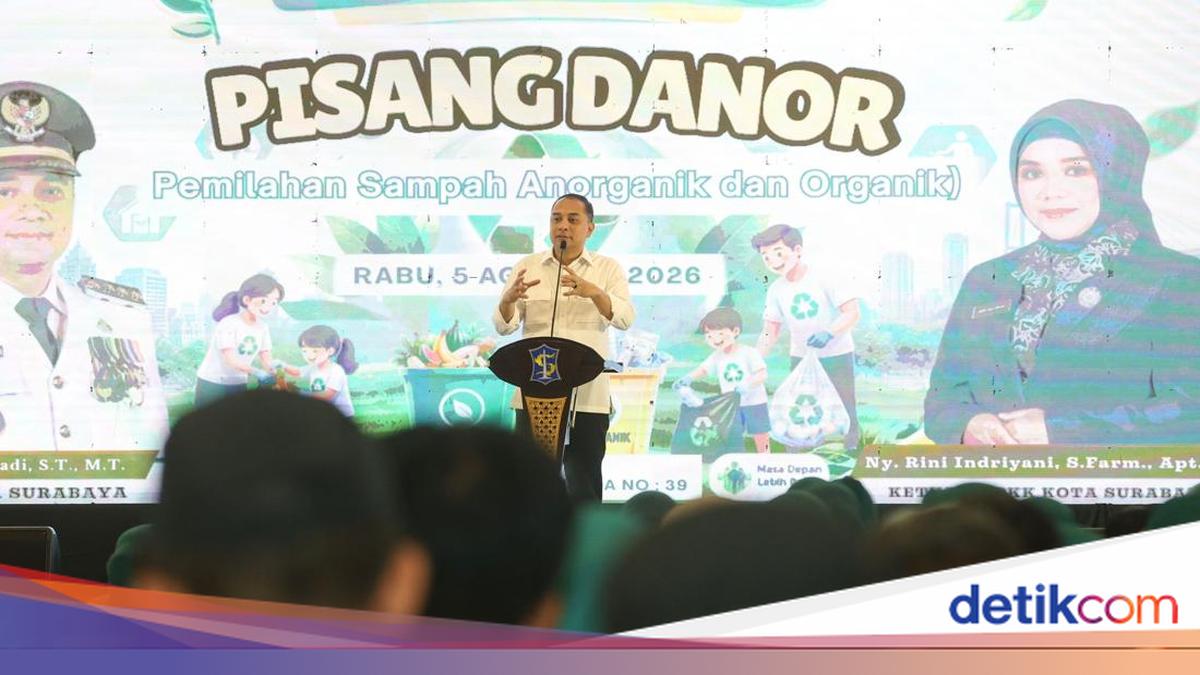
The Surabaya City Government is strengthening efforts to reduce waste at source through the Organic and Inorganic Waste Sorting programme, known as Pisang Danor. The programme aims to encourage the public, particularly at household level, to sort and process waste before it is sent to the final processing site.
Mayor of Surabaya Eri Cahyadi said waste reduction must begin with changing community behaviour in their own neighbourhoods. According to him, organic waste is one of the most commonly produced types of waste and has the potential to be processed from home.
“If we do not love the environment, then the waste problem will never end. And the most abundant waste produced is organic waste,” Eri said in a written statement on Friday (21/8/2026).
He made the remarks at the launch of the Pisang Danor programme at Graha YKP, Medokan Ayu, Rungkut District, Surabaya, on Wednesday (5/8). The programme was initiated by the Surabaya City PKK Driving Team in collaboration with the Environmental Agency and the Office of Women’s Empowerment and Child Protection as well as Population Control and Family Planning.
Eri assessed that processing organic waste from home can reduce transport burdens while lowering waste management costs in the City of Heroes. “If organic waste can be managed at home, then waste costs actually decrease,” he said.
He stressed that this efficiency is important because the Surabaya city government must pay a tipping fee at Benowo landfill of around Rp217,000 per tonne. He therefore urged the public to be more disciplined in sorting waste so that management costs can be reduced and the budget can be diverted to other priority programmes.
“Why do I want to invite the public to process waste? Because rather than our money being used to pay for waste, it is better to use the money for free schools from primary to secondary school up to university. That is better,” said Cak Eri, as he is affectionately known.
Through the Pisang Danor competition, the Surabaya city government wants to build a consistent habit of waste sorting starting from families up to neighbourhood and community unit level. “The waste problem should also be able to start from households,” he said.
Eri revealed that Pisang Danor is part of a series of programmes that will be continued with a broader environmental cleanliness competition. “So after Pisang Danor, it will be continued with the Kampung Pancasila competition,” he said.
He hopes the programme can change public habits while increasing environmental awareness. “Hopefully this competition can change our paradigm and make us love the environment more,” he said.
Meanwhile, Chairwoman of the Surabaya City PKK Driving Team, Rini Indriyani, said the Pisang Danor programme focuses on household organic waste management. Inorganic waste sorting is considered to have developed through the presence of waste banks in various residential areas.
“Surabaya has actually been extraordinary in sorting inorganic waste. Therefore, we are focusing more on organic waste sorting,” said Rini.
According to Rini, households are an important starting point because most food waste management activities begin in the family. “The smallest scope is the family, so we start this habit from home,” she explained.
Rini therefore encouraged collaboration between sub-district heads, village heads, the Environmental Agency, and the Kampung Pancasila task force to expand the organic waste management movement.
“God willing, our goal is the same: how organic waste processing can be carried out massively and certainly be beneficial for all of us,” she said.
Head of the Surabaya Environmental Agency, M Fikser, said Pisang Danor is designed to increase public participation in waste sorting as well as being an initial stage towards the Kampung Pancasila competition.
“This is a competition programme that encourages public participation in sorting. As the Mayor said, this is a warm-up and the peak will be the Kampung Pancasila competition,” said Fikser.
In more detail, Fikser explained that the Pisang Danor competition participants are representatives of the six best community units from each sub-district. Previously, these community units went through a selection process at the village level.
“In each sub-district there are six community unit representatives. They will be selected by the sub-district and village, then the six best are taken to represent the sub-district,” he explained.
Fikser also stressed the importance of ensuring that organic and inorganic waste is not mixed again after sorting. Organic waste can be processed into compost, while inorganic waste that has economic value can be sold.
“Organic waste is processed into compost or other things. Meanwhile, inorganic waste that has economic value is sold directly,” he said.
He hopes that reducing waste at source can lower waste management costs at Benowo landfill. The funds saved can then be used to support government programmes in other sectors.
“Thus the tipping fee value or our payment for management at Benowo landfill can be reduced. And those funds can be diverted to programmes as the Mayor said, namely for education or health,” he said.
Fikser said the Surabaya city government is targeting 40 percent of household waste sorting as part of efforts to support the national waste reduction target.
“That is why the Mayor’s target is that we must sort 40 percent of household waste,” he added.
Fikser explained that waste production in Surabaya currently reaches around 1,800 tonnes per day. Of that amount, around 200 tonnes have been intervened through 3R waste processing sites, waste banks, and sorting carried out by the public.
“From that process, 200 tonnes of waste are sorted. Meanwhile, 1,600 tonnes are sent to Benowo landfill,” he said.
He added that waste sent to Benowo landfill is then processed.