
Surabaya City Government Involves Youth and 12,000 Civil Servants in Pancasila Village Programme
The Surabaya City Government is accelerating the strengthening of mutual cooperation values through the Pancasila Village programme. This programme involves youth and 12,000 Civil Servants (ASN) to assist 1,361 Neighbourhood Units (RW).
This step is taken as an effort to revive social solidarity at the village level, which has long been the foundation of the City of Heroes.
The involvement of thousands of civil servants and youth is part of the city government’s strategy to ensure the implementation of Pancasila values runs concretely at the grassroots level.
However, the city government realises that such efforts cannot run effectively without community support, including other social elements.
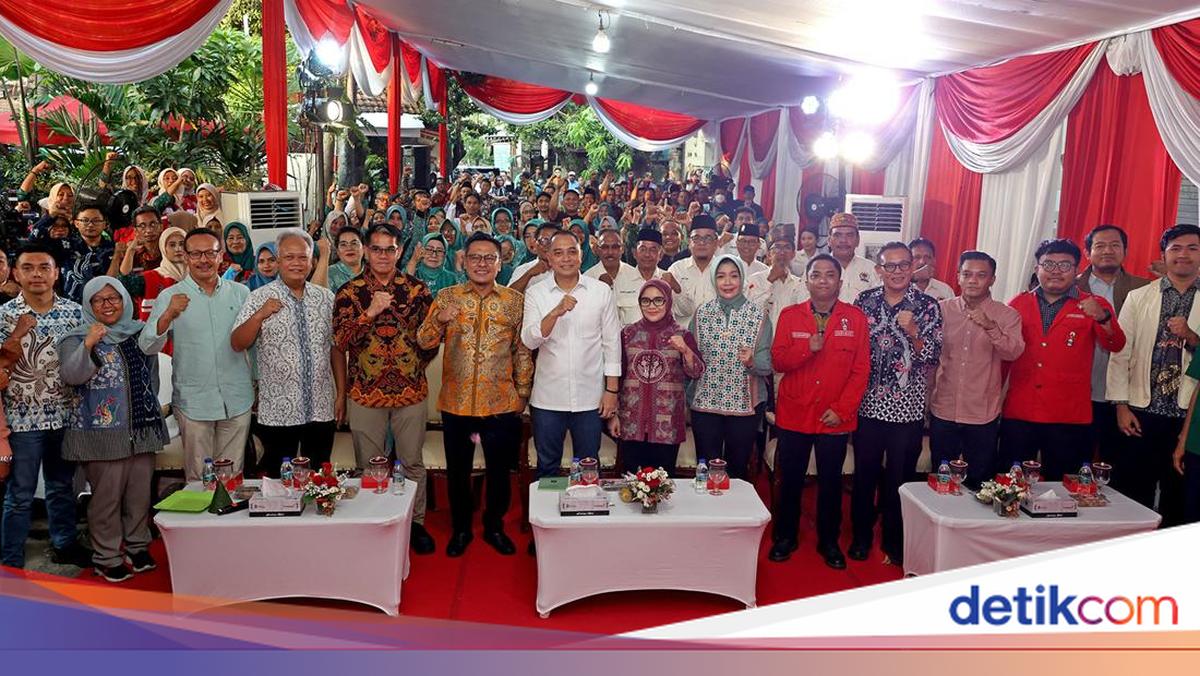
This effort was emphasised by Surabaya Mayor Eri Cahyadi during the launch of Pancasila Village 2026 in RW 2 Krembangan Bhakti, Kemayoran Ward, Krembangan District.
The event was also attended by interfaith leaders, community organisations, youth organisations and students, as well as representatives from 1,361 RW online.
Eri stated that Surabaya’s main strength lies in its long-established culture of mutual cooperation. He reminded that since the 1960s, Surabaya has been built on family values and high tolerance.
“Since 1960, Surabaya has had high tolerance. This is what we must hold on to and continue,” said Eri in a written statement on Monday (20/4/2026).
“Therefore, Pancasila Village must not stop, and Surabaya must stand firm with mutual cooperation,” he added.
To that end, Eri emphasised that the spirit of Pancasila Village must not stop as a slogan, but must be realised in daily practice through mutual cooperation.
Because Eri acknowledges that building Surabaya is impossible by relying solely on the government without active community support, especially from the younger generation.
“If you say Surabaya must prosper without youth movement, that’s impossible. Because it’s impossible for the local government to solve those problems alone,” said Eri.
Eri exemplified the concept of collective welfare through the practice of distributing zakat, infak, and sedekah (ZIS) during the leadership of Sayyidina Utsman bin Affan. According to Eri, that good practice is still very relevant if applied in the current era.
“Why was the country prosperous in the time of Sayyidina Utsman? Because the capable people, who have the obligation to pay zakat, pool their infak, and then give it to those in the village who need it,” said Eri.
Therefore, through Pancasila Village, the Surabaya City Government encourages strengthening in various fields, including environment, social culture, community, and economy.
In the environmental field, Eri invited residents to start sorting waste from home because it has economic value that can be used for social activities.
“Imagine if (plastic bottles) are separated in each RW, then the bottles are sold, it can generate money, go into the RW’s cash, used for social movements. That’s extraordinary,” said Eri.
Meanwhile, in the social and cultural field, the programme is also directed to strengthen solidarity among residents, especially helping underprivileged communities through mutual cooperation mechanisms.
Eri underlined the importance of targeted aid distribution by prioritising the needs of residents in the local RW.
“Because sometimes we don’t want to give our sedekah to the RW, but through other institutions. In the end, those other institutions don’t distribute the infak we help to our RW, but to other places,” explained Eri.
“Even though in our RW there are still those who can’t go to school, there are still those who are poor,” he added.
Eri emphasised that every problem should be solvable at the RW level with government support. However, that requires active reporting from the community, from Surabaya Hebat Cadres (KSH), PKK, to RT/RW administrators.
“So if there are problems with public facilities or children who can’t go to school, it should be resolved at the RW with the city government stepping in. But can the city government do it alone?” said Eri.
“Of course not if there is no report, no movement from the RW. That’s why I hope every RW will be assisted by civil servants,” he continued.
In addition, Eri also invited all community elements, including students, youth organisations, and religious groups, to actively participate in supporting Pancasila Village.
For Eri, Surabaya’s success in resolving various problems is not determined only by the government but by community mutual cooperation.
“Insyaallah we will move together, we will join hands to make Surabaya prosperous. Not because of the mayor, but because of the RT/RW, PKK, KSH, and community leaders in Surabaya,” Eri stressed.
Meanwhile, the Head of the Pancasila Village Task Force of Surabaya City, Irvan Widyanto, added that the programme is directed at strengthening community empowerment at the RW level by emphasising mutual cooperation values.
“The Pancasila Village programme itself is about how to empower all community elements at the RW level to collaborate together,” said Irvan.
Irvan also explained that the Pancasila Village idea is inseparable from Surabaya’s experience in facing the COVID-19 pandemic. At that time, mutual cooperation values grew spontaneously in the community without waiting for government intervention.
“It happened in all (villages), and it was without orders. So the spontaneity of mutual cooperation (by residents) was done to overcome problems in the village itself,” said the Head of the Surabaya City Regional Disaster Mitigation Agency (BPBD).
That experience was then formulated by Eri into the Pancasila Village philosophy, strengthening social solidarity at the RW level to help residents in need.
Therefore, the programme targets various problems, from preventing stunting and malnutrition, access to education for children, to economic empowerment of residents.
As a form of strengthening Pancasila Village, the Surabaya City Government is deploying around 12.
Source: jawawa.id (https://jawawa.id/newsitem/surabaya-city-government-involves-youth-and-12-000-civil-servants-in-pancasila-village-programme-1776664253)
Originally published by detikcom (https://news.detik.com/berita/d-8452263/pemkot-surabaya-libatkan-pemuda-12-000-asn-di-program-kampung-pancasila), translated from Indonesian