
Surabaya Becomes National Pilot for Programme to Prevent Plastic Waste Entering the Sea
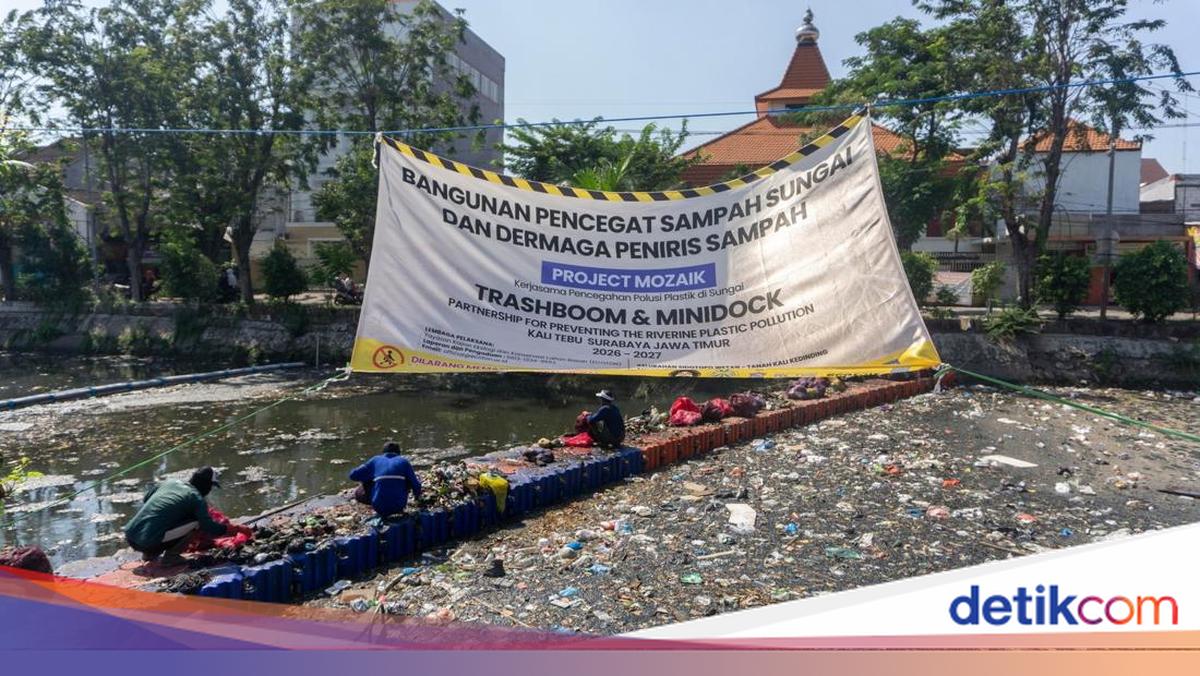
The city of Surabaya has become the first location in Indonesia for the ‘Partnership for Preventing Riverine Plastic Pollution’ programme. This initiative is a bilateral collaboration between the Indonesian Government, through the Coordinating Ministry for Food Affairs, the Government of the United Arab Emirates (UAE), and the United Nations Development Programme (UNDP) Indonesia, aimed at reducing plastic pollution in rivers before it reaches the sea.
The programme’s introduction was held during a soft launch coinciding with World Environment Day on Friday (5/6). The city was chosen as the primary site due to its strong commitment to waste management and environmental pollution control. Moving forward, the programme will focus on controlling river flows to prevent plastic from entering the ocean, waste cleaning, strengthening the circular economy, and driving changes in community behaviour.
The Acting Head of Surabaya’s Environmental Agency (DLH), M. Fineser, expressed gratitude to the central government for selecting the city as the initial implementation site. “Thank you to the Ministry of Environment, the Coordinating Ministry for Food Affairs, and all other ministries. Surabaya was appointed as a soft-launch location regarding plastic waste management, alongside the commemoration of World Environment Day,” Fineser stated in a written release on Thursday (11/6/2026).
He noted that implementation is already underway in Kali Tebu and Kali Mrutu, where waste trap systems have been installed to prevent plastic from being carried downstream to the sea. “The project currently running in Kali Tebu and Kali Mrutu is having a significant impact,” he said.
He explained that the programme is yielding tangible results. Every day, approximately one tonne of plastic waste is removed from the river flows through a collaboration between the Surabaya Environmental Agency and involved Non-Governmental Organisations (NGOs). “Every day, 1 tonne of plastic waste is collected by our partners from Ecoton and Lohjinawi. We provide facilities for these two NGOs,” he explained.
Fineser added that the Surabaya City Government is providing full support through the provision of facilities and the strengthening of education for residents living near the activity sites. “Mayor Eri Cahyadi has instructed us to provide full support for all the needs of these NGOs. Our goal is not just to clean the waste, but to educate residents near the area to protect the environment,” he said.
The programme also emphasises a circular economy approach. Collected waste is not immediately discarded but is instead sorted and repurposed. This process, he continued, creates economic opportunities for local communities, who are involved in sorting, packaging, and selling economically valuable waste.
He noted that the benefits of the programme are felt both environmentally and economically. Sorted waste is processed and sold, bringing financial benefits to the participating residents. Environmental improvements are already visible, particularly in the Kali Tebu area, which was previously heavily polluted. The river now appears cleaner, encouraging community awareness.
Fineser revealed that while the average amount of waste trapped in Kali Tebu still reaches about one tonne per day, the volume is beginning to decrease as community awareness grows. “As of today, it remains around 1 tonne, but there is a decrease. Because after seeing the condition of the river, people are more hesitant to litter as it has started to improve. Furthermore, we use trash booms to intercept the waste upfront,” he said.
However, he emphasised that the programme’s success is measured by the amount of waste successfully removed and the reduction of waste being disposed of at the source. “We hope the waste will decrease further to declare success. To achieve this, we must strengthen efforts upstream; we must reduce waste at the household level,” he asserted.
As part of these efforts, the Surabaya City Government is implementing various community-based waste reduction programmes, such as the ‘Zero Waste Village’ and the ‘Climate Village Programme’ (ProKlim). The government aims to reduce waste generation by up to 40 per cent. “The Mayor’s target for the Environmental Agency is a 40% reduction in waste. Surabaya currently produces about 1,800 tonnes of waste per day,” he explained.
Of this amount, approximately 200 tonnes have economic value through processing at 3R (Reduce, Reuse, Recycle) facilities, while about 1,000 tonnes are processed into energy via the Benowo Waste-to-Energy Power Plant (PLTSa). The remaining 600 tonnes still end up in landfills. As a solution, the central government has designated Surabaya as a development site for a Waste-to-Energy (PSEL) facility, with 5.8 hectares of land in Sumber Rejo, Pakal District, ready for use.
“Consequently, that 600 tonnes can eventually be incinerated alongside waste from the Greater Surabaya area, including Sidoarjo, Gresik, and Lamongan,” said Fineser.
On the other hand, the Coordinator of the Community Behaviour Change Working Group of the Directorate of Waste Reduction and Circular Economy at the Ministry of Environment, Sri Murwani Nurfadilastuti, emphasised that changing community behaviour is the key to reducing waste pollution. “One of the ways is to encourage the community to limit waste and sort waste at the source,” she said.