
Supreme Court Overturns Rule Raising Retirement Age to 65; Workers Demand Legal Certainty
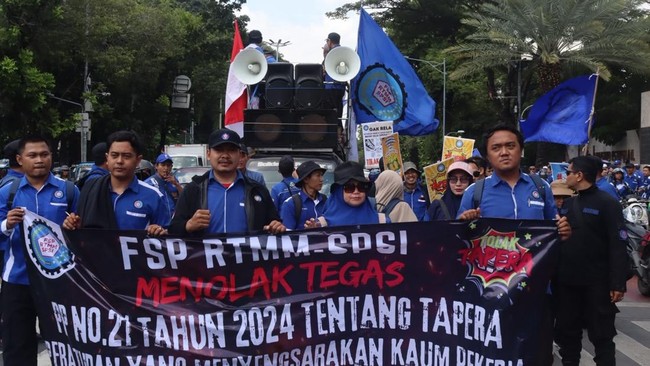
Semarang Regency, CNBC Indonesia – The Supreme Court’s decision to overturn the provision gradually raising the pension age to 65 has become an important moment for reform of the National Pension Insurance programme.
The Federation of Tobacco, Food and Beverage Workers’ Unions (FSP RTMM-SPSI) has urged the government to follow up the ruling promptly so workers have legal certainty and protection after entering retirement.
FSP RTMM-SPSI chairman Henry Wardana said the government must not allow the issue of the age limit for receiving pension benefits to drag on. The Supreme Court has issued Decision No. 18 P/HUM/2026, declaring Article 15 of Government Regulation No. 45/2015 invalid and without general legal force because it conflicts with Law No. 40/2004 on the National Social Security System.
“The ruling is an entry point for reform of the retirement-age insurance system in Indonesia,” Henry said at the Grand Panorama Hotel in Bandungan, Semarang Regency, Central Java, on Saturday (31 October 2026), according to a press release cited on Monday (3 November 2026).
Henry said the government has a maximum of 90 days to implement the Supreme Court’s ruling. He called on it to prepare replacement regulations promptly so workers do not face uncertainty when accessing their pension rights.
Supreme Court overturns scheme to raise retirement age to 65
Supreme Court Decision No. 18 P/HUM/2026 has drawn workers’ attention because it concerns the age at which people can receive pension benefits from BPJS Ketenagakerjaan. Previously, Article 15 of Government Regulation No. 45/2015 set the initial retirement age at 56. The government raised it to 57 from 1 January 2019, after which the age was to increase by one year every three years until reaching 65 in 2043.
In its judicial review ruling, the Supreme Court declared Article 15 of Government Regulation No. 45/2015 invalid and lacking generally binding legal force because it conflicts with Law No. 40/2004 on the National Social Security System.
The government must now formulate new rules on the age limit for accessing pension benefits, including transitional arrangements for workers who have retired or are approaching retirement.
“The implication is that the government must introduce new rules on the age limit for accessing pension benefits,” Henry said.
Workers retire at 55 but have to wait for benefits
Henry said the previous rules had created tangible problems for workers. Many companies in Indonesia set employees’ retirement ages at between 55 and 58, while the age for accessing pension benefits continued to rise under Government Regulation No. 45/2015.
This created a gap between when workers stopped working and when they could receive pension benefits. As a result, people who had stopped earning an income after retiring from their company could still have to wait years before accessing their pension benefits.
“Under the old rules, following the scheme, people had to wait as long as 10 years to claim pension benefits. That is why the government must act quickly,” he said.
Henry said the issue concerns not only workers’ economic rights but also the certainty of social protection for people who have devoted decades to their companies.
BPJS Ketenagakerjaan could face a surge in claims
Uncertainty over the eligibility age could also create administrative problems for BPJS Ketenagakerjaan, in addition to its impact on workers.
Henry warned that, without clear replacement regulations, workers could interpret differently when they are entitled to file a claim after leaving work. This could lead to a surge in claims and make it harder for BPJS Ketenagakerjaan to serve its members.
“If there is no legal certainty, everyone could file a claim when they stop working, potentially causing a surge in claims,” he said.
Henry therefore urged the government not to focus solely on changing the retirement-age limit. It should also prepare administrative, funding and service mechanisms capable of meeting members’ needs.
FSP RTMM-SPSI proposes five pension reform priorities
In response to the Supreme Court ruling, FSP RTMM-SPSI has put forward five priorities for reform of the National Pension Insurance programme. The proposals are intended to inform discussions among the government, employers and workers’ representatives.
The five priorities are:
Legal certainty on the age for accessing benefits and transitional arrangements. The government should set a clear eligibility age and provide protection for workers in the transition period.
Adequate benefits and minimum protection. The programme should provide sufficient benefits to ensure workers retain economic protection after leaving work.
Fair financing and contribution compliance. The government should ensure balanced financing and encourage all parties to meet their contribution obligations.
A measured fiscal role for the state. The state’s support for the programme’s sustainability should be defined through clear and measurable fiscal policy.
Transparency, accountability and services for members. Programme management should prioritise open information, accountability and accessible services for members.
Henry said the five priorities should be discussed comprehensively so that regulatory changes address not only the age limit but also strengthen protection for workers in retirement.
Calls for government forum within 30 days
To speed up discussions, FSP RTMM-SPSI has invited the Ministry of Manpower, BPJS Ketenagakerjaan, the Ministry of Finance, employers, trade unions, the House of Representatives and academics to meet.
Henry proposed that the government open a discussion forum within 30 days. He said the government should then present a follow-up plan and reform road map within 60 days of the press conference. He stressed that these proposed timeframes are advocacy targets set by FSP RTMM-SPSI, not deadlines imposed by the court.
“We propose opening a forum within 30 days and presenting a follow-up plan and road map within 60 days of the press conference. These are advocacy targets we have put forward, not deadlines set by the court,” he said.
Henry hopes the government will respond to the Supreme Court ruling by drafting new policy that provides legal certainty, ensures the programme’s sustainability and protects workers’ rights as they retire. He said reform of the National Pension Insurance programme must ensure workers do not lose economic protection after ending their working lives.
Source: jawawa.id (https://jawawa.id/newsitem/supreme-court-overturns-rule-raising-retirement-age-to-65-workers-demand-legal-certainty-1793681508)
Originally published by CNBC Indonesia (https://www.cnbcindonesia.com/news/20261103105840-4-781817/ma-batalkan-aturan-usia-pensiun-65-tahun-buruh-tuntut-kepastian-hukum), translated from Indonesian