
Supporting Food and Energy Security, PTPN III Develops Cassava Downstreaming
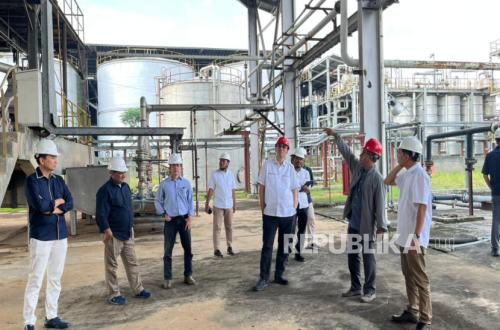
REPUBLIKA.CO.ID, JAKARTA – Cassava is being encouraged to enter the industrial chain to support national food and energy security. The strengthening is no longer limited to cultivation but is directed towards downstream processing up to bioethanol production.
PT Perkebunan Nusantara III (Persero) is preparing integrated development from upstream to downstream for this commodity. PTPN III’s President Director Denaldy Mulino Mauna stated that the model being prepared includes increasing productivity in plantations to strengthening processing industries.
“This programme is designed as an integrated development model from upstream to downstream,” said Denaldy in a written statement on Monday (20/4/2026).
On the upstream side, the company focuses on land optimisation, productivity enhancement, and the development of adaptive superior varieties. Meanwhile, on the downstream side, strengthening is directed towards the bioethanol industry through operational collaborations at factory facilities in Lampung.
“This programme is a strategic step for the company in building a future integrated, productive, and sustainable agro-industrial ecosystem,” said Denaldy.
He assessed that cassava has a dual role, not only as a food commodity but also as an energy raw material. Therefore, its development needs to be comprehensive to form an efficient value chain.
PTPN III is also exploring collaborations with local governments, farmers, and industry players to ensure raw material supply and production sustainability. In Lampung, the company has coordinated with the provincial government, farmers’ associations, and processing industry partners.
“That meeting involved local government, farmers, to operational partners to ensure readiness for implementation,” said Denaldy.
In addition, research strengthening is being conducted with universities and research institutions to improve productivity, including through variety development and cultivation techniques.
The development of the bioethanol industry is seen as having the potential to create economic impacts, from job absorption to increasing the added value of agricultural commodities.
PTPN III views upstream-downstream integration as the key so that commodities like cassava do not only become raw materials but enter a broader and value-added industrial chain.