
Supply at Risk as Crude Oil Prices Surge Again
Jakarta, CNBC Indonesia — Global crude oil prices strengthened again in Friday’s (9 October 2026) trading. Hurricane Isaias, approaching the US coast, disrupted oil production in the Gulf of Mexico and fuelled concerns about global energy supplies.
According to Refinitiv, Brent crude rose 2.42% over the week, reversing a 1.98% decline the previous week. Brent closed at US$104.72 a barrel on Friday (9 October 2026).
West Texas Intermediate (WTI) crude gained 0.81% over the week, after falling 1.41% the previous week, and closed at US$91.85 a barrel.
On the day, Brent rose US$0.44, or about 0.42%, while WTI gained US$0.36, or 0.39%.
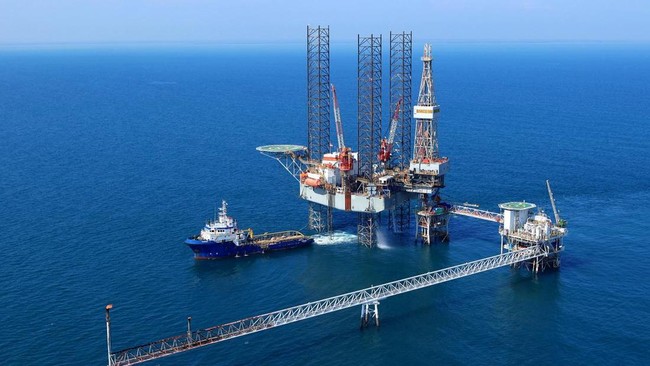
The gains came as US energy producers suspended most offshore operations as a precaution against Hurricane Isaias, which was moving towards the Florida coast.
Hurricane Isaias disrupts US oil production
Reuters reported that energy producers in the Gulf of Mexico had temporarily halted around 1.5 million barrels of oil production a day by Friday (9 October 2026), equivalent to nearly 72% of the region’s total US oil output.
Natural gas production was also affected, with about 1.3 billion cubic feet a day shut in, or 59% of the region’s output.
The shutdowns were implemented ahead of Hurricane Isaias, which was expected to reach the Florida Panhandle coast on Friday evening local time.
According to the National Hurricane Center (NHC), the storm was about 90 kilometres from Pensacola, Florida, with maximum sustained winds of 185 kilometres per hour. Extreme wind warnings were issued for parts of the Florida Panhandle.
The disruption could put pressure on US energy supplies, particularly if the storm damages production facilities and delays the resumption of operations. The impact on markets will depend on how long production remains halted and how quickly operations recover after the storm passes.
Storm threatens US refineries and energy infrastructure
Hurricane-related disruption is not limited to crude oil production; it could also affect refining along the US coast.
Reuters reported that 129 production platforms, or around 35% of the 371 manned platforms in the Gulf of Mexico, had been evacuated. Eight additional drilling facilities were also cleared as a precaution.
Major energy companies, including Shell and Chevron, had reduced or suspended operations at offshore facilities. The shutdowns were intended to protect workers and infrastructure ahead of the storm.
The US Energy Information Administration (EIA) says offshore production in the Gulf of Mexico is about 2 million barrels a day, equivalent to 15% of total US crude oil output.
Refineries on the Gulf Coast also face risks. Power outages, flooding or infrastructure damage could disrupt the processing of crude oil into fuels, including petrol and diesel.
However, facilities that escape damage are expected to resume operations after the storm passes and safety inspections are completed.
Trump and Putin agree to increase diesel supplies
Amid the storm-related production disruption, plans to increase Russian diesel supplies have added a new factor to the energy market.
US President Donald Trump announced on Friday (9 October 2026) that Russia had agreed to supply more than 300,000 tonnes of diesel to the US and global markets following his talks with Russian President Vladimir Putin.
Reuters reported that the agreement also includes plans to ship an additional 500,000 tonnes in November and 1 million tonnes thereafter. Trump also described plans for a further 3 million tonnes to be supplied within a relatively short period, depending on the condition of Russian refineries.
The agreement is intended to ease pressure on fuel prices, which remain high because of disruptions to global energy supplies.
The move could help curb rising energy prices. Additional diesel supplies could ease tightness in refined-product markets, although delivery and production capacity in Russia will determine whether the plan is realised.
Middle East conflict remains a risk
Developments in the Middle East conflict remain another important factor affecting global oil prices.
Oil prices had earlier weakened in Friday’s trading after Trump said talks with Iran to end the war were productive.
His remarks briefly eased market concerns about possible disruptions to oil supplies from the Middle East. However, the Gulf of Mexico production shutdowns subsequently pushed prices higher by the close of trading.
Meanwhile, China’s plan to resume fuel-product exports after a temporary suspension during the Golden Week holiday could add to global supplies.
Oil prices therefore face opposing forces. Production disruptions caused by Hurricane Isaias and the Middle East conflict are supporting prices, while planned additional Russian diesel supplies and the prospect of easing US-Iran tensions could limit further gains.
Oil price movements in the coming week will depend heavily on the storm’s impact on US energy facilities, the pace of production recovery, and developments in supplies from Russia and the Middle East.
Source: jawawa.id (https://jawawa.id/newsitem/supply-at-risk-as-crude-oil-prices-surge-again-1791607854)
Originally published by CNBC Indonesia (https://www.cnbcindonesia.com/research/20261010055238-128-774898/pasokan-terancam-harga-minyak-mentah-kembali-melonjak), translated from Indonesian