
Sunan Candlenut: A Biodiesel Source That Can Outperform Palm Oil with Solar Power
When a flash flood swept through dozens of homes in the Batang Toru region, South Tapanuli, at the end of 2025, the public was quick to blame the sky: a tropical cyclone, extreme rainfall, or nature’s fury. However, a forensic environmental audit revealed a different story. Deforestation was the primary cause, with the heavy rain serving merely as a trigger.
As the debate subsided, a more fundamental question emerged, one that is rarely asked: when the land is already wounded, what should we plant on it?
In Indonesia, the answer to the energy crisis has almost always pointed to a single commodity: palm oil. The national biodiesel mandate is among the most ambitious in the world, starting with B35 in 2023, increasing to B40 in January 2025, and targeting B50 by 2026 as part of the national energy self-sufficiency agenda. Consequently, diesel consumption fell to around 40 million kilolitres in 2024.
Yet, behind this achievement lies a paradox. Efforts to provide a climate solution can create new challenges if feedstock development is not accompanied by sustainable land governance. Risks such as forest conversion, soil degradation, and high water demand must be anticipated. In several areas, including the upstream region of Batang Toru, landscape changes due to land clearing have increased vulnerability to disasters.
Thus, the critical question is no longer simply how to produce biofuels, but whether there is a biofuel that does not trigger deforestation.
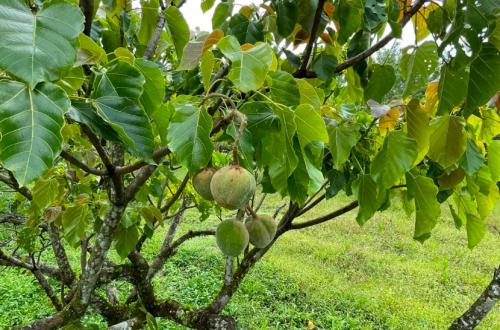
To answer this, I calculated the carbon footprint using a Life Cycle Assessment (LCA) approach for a plant that has received little attention: the Sunan candlenut (Reutealis trisperma), developed at the Center for Assembly and Testing of Industrial and Refreshing Crops (BRMP TRI) in Sukabumi.
The arithmetic of carbon reveals compelling data. Sunan candlenut is not a food crop; its seeds are toxic, so it does not compete with edible oil needs. The tree thrives on dry, marginal land unsuitable for oil palm. With only about 130 trees per hectare, plantations are far less dense than oil palm and can even support intercropping with coffee. But its agronomic advantages are not the deciding factor; its carbon footprint is.
Data shows that one litre of B100 biodiesel from Sunan candlenut, calculated from cultivation to the factory gate, produces 2.04 kilogrammes of CO2-equivalent emissions. This figure is nearly half of the 3.99 kg CO2-eq per litre recorded in previous studies, a reduction achieved through updated field data in 2026 and a simplified production process that eliminated the esterification stage.
However, a fair assessment requires an equivalent comparison. Using electricity from the national grid, which is still dominated by coal-fired power plants, Sunan candlenut biodiesel emissions reach approximately 1,802 kg CO2-eq per tonne. This is slightly higher than palm oil biodiesel, which ranges around 1,659 kg CO2-eq per tonne, though both are significantly lower than fossil diesel at roughly 3,400 kg CO2-eq per tonne.
At first glance, this result appears disappointing. The alternative candidate seems to fall short against palm oil.
But the key lies in one factor: the source of electricity. A hotspot analysis shows that the largest emissions contributor is not the plant itself, but the processing stage, particularly the drying and transesterification of kernels, which are heavily dependent on grid electricity. This stage alone accounts for about 56 per cent of total emissions.
When the electricity source is replaced with solar photovoltaic (solar PV), the results change dramatically. Emissions drop from around 2.02 kg to just 0.74 kg CO2-eq per litre, a reduction of approximately 63 per cent. Calculated per tonne of biodiesel, emissions fall to around 660 kg CO2-eq.
At this point, Sunan candlenut not only rivals palm oil but surpasses it. Compared to fossil diesel, the difference is even more striking. Once the electricity source is cleaned up, the remaining challenge is simply improving the efficiency of fertiliser and chemical use—a far more manageable task than overhauling an entire energy system.