
Sumatra Power Outage Caused by Technical Faults and Extreme Weather, Not Sabotage
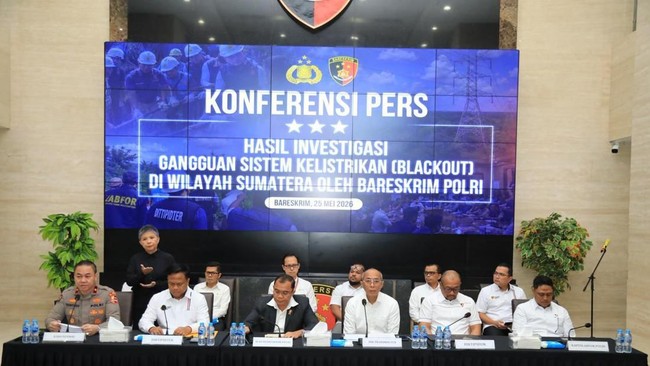
The Indonesian National Police’s Criminal Investigation Agency (Bareskrim) and state electricity company PT PLN (Persero) have released preliminary findings on the power disruption that affected several Sumatran regions on Friday, 22 May 2026. Initial results indicate the outage was caused by technical issues and extreme weather, with no evidence of sabotage or intentional interference.
Bareskrim Deputy Chief Inspector General Nunung Syaifudin explained that a joint team from the Special Crimes Directorate, General Crimes Directorate, Bareskrim Forensic Laboratory, Jambi Provincial Police Criminal Investigation Unit, and PT PLN conducted on-site investigations at a transmission tower in Tempino Village, Mestong District, Muaro Jambi Regency, Jambi Province.
Initial identification showed that at around 6:44 pm WIB on Friday, a disruption occurred in the 275 kV transmission line between Muara Bungo and Sungai Rumbai in Jambi, allegedly triggered by severe weather. This caused the transmission system to disconnect from Sumatra’s power grid, leading to instability in frequency and voltage.
As a result, multiple power plants tripped in a cascading failure, causing widespread blackouts across Aceh, North Sumatra, West Sumatra, Riau, Jambi, and parts of South Sumatra.
“The preliminary identification shows that the disruption in the 275 kV Muara Bungo-Sungai Rumbai transmission line was likely caused by severe weather, leading to the transmission system disconnecting from Sumatra’s interconnected power grid,” said Inspector General Nunung during a press conference on Monday, 25 May 2026.
The joint team also found a broken transmission cable near the transmission tower, though the tower structure remained intact with no significant damage.
Nunung stated that the suspected cause of the cable break is still under investigation, with possible factors including mechanical issues from friction and wind, heat from loose connections causing electrical arcing, or strain from extreme weather.
“We can confirm there is no indication of sabotage or intentional involvement in the blackout incident. The preliminary suspicion points to technical and extreme weather factors,” he added.
Initial examination revealed the cable damage had a frayed pattern rather than a clean cut, which would suggest sabotage. The damaged section has been secured and is undergoing forensic laboratory analysis by Bareskrim to determine the exact cause scientifically.
Meanwhile, PT PLN’s Director of Transmission and System Planning, Edwin Nugraha Putra, explained that Sumatra’s power system has two main transmission corridors: the 500 kV eastern corridor and the 275 kV western corridor, both transporting power from south to north.
During the incident, the transmission lines tripped due to heavy rain and strong winds, causing power flow reversal and triggering a high-amplitude power swing – significant voltage and frequency oscillations.
This split Sumatra’s power system into two parts: the southern region with excess generation capacity and the northern region with a shortage. The northern area experienced cascading generator trips, leading to blackouts in affected regions.
PLN restored power through a staged recovery process using diesel and gas generators for black start, followed by the restart of gas-fired and coal-fired plants until the entire system returned to normal.
“All of Sumatra’s power systems have returned to 100% normal operation and are currently stable and safe,” Edwin stated.
PLN confirmed that as of Monday, 25 May 2026, major power plants had resumed operations, ensuring stable and secure electricity supply across Sumatra.