
Sukarno and the Imagination of a Post-Colonial New World Order
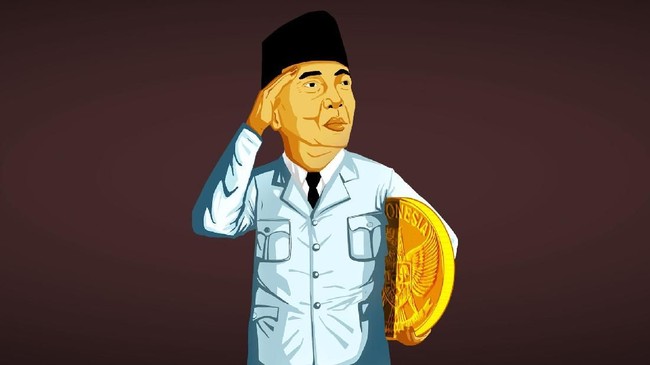
On 30 September 1960, the Proclamator and first President of the Republic of Indonesia, Sukarno, stood at the podium of the United Nations in New York, USA, at a time when the world was still divided by the Cold War, colonialism had not yet fully ended, and newly independent nations were searching for their place in an international order shaped by great powers.
From that forum, Sukarno did not arrive to accept the world as it was, but to bring more fundamental questions regarding who possesses the right to determine the world’s direction and what values should serve as the foundation for relations between nations.
The speech, which later became known as ‘To Build the World Anew’, demonstrated how Sukarno linked Indonesia’s colonial experience to much broader issues, ranging from peace, disarmament, and global inequality to national sovereignty and the future of humanity.
When Sukarno stated that ‘Pancasila has universal significance and can be and used internationally’, he was positioning Pancasila as an idea that could contribute to the search for a more peaceful, just, and equitable world order.
More than six decades later, the world has undergone massive changes, yet the questions Sukarno brought from the UN podium remain relevant for study as matters of international politics. Who determines global rules, how post-colonial nations can gain equal space in the world order, and how peace can be built amidst power imbalances are questions that make ‘To Build the World Anew’ essential reading—not merely as a historical speech, but as part of the evolving political thought of the Global South.
Questioning the Old World
Sukarno’s speech must be placed within the historical context of 1960, when the process of decolonisation was altering the political composition of the world and Asia-Africa nations were becoming increasingly active in demanding recognition as subjects in international relations.
The 15th UN General Assembly took place in an atmosphere where issues of colonialism, the arms race, the rivalry between the United States and the Soviet Union, and the emergence of new nations were central to debates regarding the future of the international system.
For Suklam, political independence could not be separated from the issue of international structures that allowed dominance to persist in new forms after formal colonialism ended. Independence, therefore, had to be understood as a political process encompassing sovereignty, equality between nations, the freedom to determine development orientations, and the ability of new nations to participate in the formation of international norms.
This position has deeper roots in Sukarno’s intellectual journey since Indonesia’s struggle for independence. On 1 June 1945, while explaining the state’s foundation during the BPUPKI session, Sukarno linked nationalism with internationalism or humanity, followed by democracy, social welfare, and divinity—a series of principles that would later be known as Pancasila.
Thus, there is an intellectual continuity between the ideas formulated by Sukarno in the context of Indonesia’s state formation and the ideas he brought to the UN fifteen years later. Pancasila was not presented as a construct limited to Indonesia’s territorial boundaries, but as a reflection of the experience of a colonised nation offered to universal issues regarding international relations.
ANRI archives record that the speech text consists of 28 pages within the ‘Memory of the World’ documentation, accompanied by photo archives, voice recordings, and film of the event. In the text, Pancasila is mentioned 23 times, a frequency indicating that Pancasila was not merely a rhetorical ornament, but a foundation of Sukarno’s argument on how the world should be built.
Interestingly, Sukarno did not offer Pancasila as an export of Indonesia’s political system to other nations. Instead, he sought to show that these principles could be read as universal values addressing human, national, and state relations, as well as democracy and social justice on an international scale.
This is where the significance of the ‘To Build the World Anew’ speech lies, as Sukarno was dissatisfied with the idea that new nations should merely receive recognition as members of the existing international system. He questioned the basic structure of that system and opened the possibility that nations born from colonial experiences possess the intellectual and political right to help define the principles of the world order.
This idea represents an early form of thought that, in contemporary studies, can be placed within the discourse of the Global South. While the term ‘Global South’ developed much later as an analytical category, the political experiences that form its foundation were evident in the struggle of Asia-Africa nations to build solidarity, equality, sovereignty, and political space amidst hierarchical international structures.
Pancasila and the Project of Building a New World
The primary strength of ‘To Build the World Anew’ lies in Sukarno’s courage to transform Pancasila from the philosophical foundation of the Indonesian state into a political language used to interpret international issues. Within this framework, Divinity, humanity, nationalism, democracy, and social justice were not treated as five independent principles, but as a series of values capable of shaping the relationship between the state and the international community. When Sukarno stated that Pancasila possesses ‘universal significance’, he was proposing…
Source: jawawa.id (https://jawawa.id/newsitem/sukarno-and-the-imagination-of-a-post-colonial-new-world-order-1790157530)
Originally published by CNBC Indonesia (https://www.cnbcindonesia.com/opini/20260923160516-14-770294/sukarno-dan-imajinasi-tatanan-dunia-baru-pascakolonial), translated from Indonesian