
Sukabumi and Bogor on Alert After Shallow Earthquakes Damage Hundreds of Homes
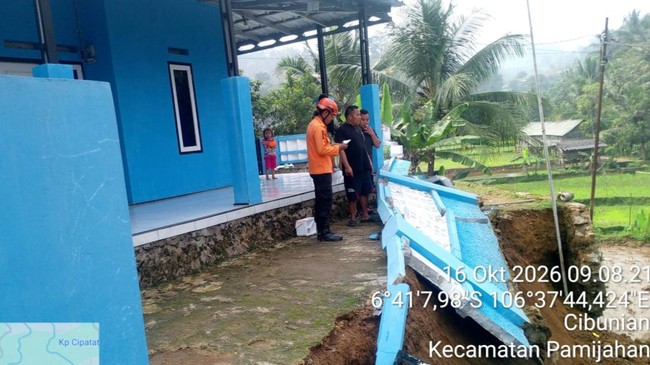
Two earthquakes struck the Bogor area of West Java within minutes of each other on Thursday, 15 October 2026. The Meteorology, Climatology and Geophysics Agency (BMKG) confirmed that they damaged hundreds of homes and several places of worship in Bogor and Sukabumi regencies.
BMKG Director of Engineering Seismology, Potential Geophysics and Time Signs Teguh Rahayu said the first earthquake occurred at 17:49:43 local time, with a magnitude of 3.5. It was followed at 17:58:23 by a magnitude 4.1 earthquake. Both were shallow, at depths of 9km and 5km respectively.
Based on the epicentres and hypocentre depths, the two earthquakes were shallow events that are thought to have been triggered by activity on an active fault, she said.
In an official statement, Ayu said BMKG monitoring recorded at least 11 aftershocks following the two main earthquakes. They ranged in magnitude from 1.6 to 2.6, and two were reported felt by residents.
What happened when the two main earthquakes and their aftershocks struck Bogor on Thursday, and why did they damage hundreds of homes?
Beware of damaging small earthquakes in Sukabumi and Bogor
Daryono, a member of the Indonesian Disaster Experts Association (IABI), warned that a destructive earthquake does not have to be powerful. Small earthquakes, he said, can also cause significant damage.
“The earthquake in Kabandungan, Sukabumi, and Pamijahan, Bogor, on Thursday afternoon, 15 October 2026, is an important reminder that small, shallow earthquakes close to residential areas can damage hundreds of homes and force residents to leave their houses,” he said.
“Although their magnitude was relatively low, the impact of the earthquakes was significant,” he added.
From a seismological perspective, the two events were shallow crustal earthquakes: tectonic earthquakes originating in the upper part of the Earth’s crust, he explained.
“The activity is strongly suspected to be linked to movement on an active fault near Kabandungan. However, definitively identifying the responsible fault requires further analysis of the hypocentre locations, source mechanisms and local tectonic conditions,” he said.
Daryono said three factors could explain the damage caused by the relatively low-magnitude earthquakes.
First, the earthquake sources were very shallow. The hypocentres were only 5–9km deep, so seismic waves travelled a relatively short distance to the surface. Close to the source, shaking can be strong even when an earthquake’s magnitude is low.
Second, buildings may be structurally vulnerable. Homes that do not meet earthquake-resistant construction principles — for example, those with weak connections between structural elements, inadequate structural bracing or low-quality materials — are more likely to be damaged by shaking.
Third, local site effects may have played a part. Certain soft soil layers or loose deposits can amplify seismic shaking.
“In some circumstances, a match between the dominant frequency of ground motion and a building’s natural frequency can increase its vibrational response through resonance,” he said.
“This effect needs to be verified through studies of local soil conditions and seismic response. The level of damage is therefore the result of interaction between the earthquake source, wave propagation, ground conditions and structural vulnerability,” Daryono said.
Daryono urged Sukabumi and Bogor to remain alert to shallow earthquakes because the area lies within West Java’s complex tectonic setting, which includes several active faults.
“The earthquake threat comes not only from the megathrust zone south of Java, but also from inland active faults, which can generate shallow earthquakes close to residential areas,” he said.
“The experience of damaging earthquakes in this area is a lesson that even small earthquakes must not be underestimated, particularly when their sources are shallow and close to homes, and buildings are highly vulnerable,” Daryono said.
He stressed, however, that a small earthquake cannot be used as a basis for predicting that a larger one will follow.
“The timing, location and magnitude of the next earthquake cannot yet be predicted accurately,” he said.
History of damaging earthquakes in Sukabumi and Bogor
Sukabumi and Bogor have a long history of damaging earthquakes, Daryono said.
“Historical records show that from 1780 to 2026, the area has repeatedly experienced earthquakes that damaged buildings and, in some cases, caused injuries,” he said, according to a report dated Monday, 19 October 2026.
“Several relatively small to moderate earthquakes have also caused considerable damage,” he added.
This shows that earthquake risk is determined not only by magnitude, but also by the depth and distance of the source, local geological conditions and building quality, he explained.
“This history of seismic activity is an important reminder that Sukabumi and Bogor require serious attention in earthquake mitigation,” he said, particularly through strengthening earthquake-resistant buildings, mapping hazard zones and improving public preparedness.
Daryono listed the following damaging earthquakes in Sukabumi and Bogor:
22 January 1780: damaged many homes.
11 October 1834: damaged many homes in Sukabumi, Bogor and Cianjur.
1879: damaged hundreds of homes.
14 June 1900: many homes damaged.
23 February 1903: damaged homes in Sukabumi and Bogor.
21 January 1912: many homes damaged.
2 November 1969 (magnitude 5.4): many homes collapsed.
26 November 1973: many homes damaged.
26 December 1973: damaged several homes.
10 February 1982 (magnitude 5.5): many homes damaged and 17 people injured.
12 July 2000 (magnitudes 5.4 and 5.1): 1,900 homes damaged.
12 June 2011 (magnitude 4.9): 136 homes damaged.
4 June 2012 (magnitude 6.1): 104 homes damaged.
8 September 2012 (magnitude 5.1): 560 homes damaged.
11 March 2020 (magnitude 5.1): 760 homes damaged.
15 October 2026 (magnitude 4.1): hundreds of homes damaged.
Mitigation measures
Daryono said the most important mitigation measure is to improve the earthquake resistance of buildings.
“Houses should be built with strong structures, quality materials, foundations suited to the ground conditions, and sound connections between structural elements. Construction and reinforcement should comply with the applicable technical standards for earthquake-resistant buildings,” he said.
“Buildings that have been damaged should be inspected before people return to them, particularly if there are cracks in structural elements, shifted walls, or damage to columns and beams. People should also understand how to protect themselves during an earthquake, identify safe places, secure furniture that could topple, and follow official information from BMKG and instructions from local authorities,” Daryono said.
He also stressed that earthquakes cannot be prevented, but the risk of deaths and damage can be reduced.
“The experience of Sukabumi and Bogor reminds us that the threat comes not only from major earthquakes, but also from small ones whose sources are very shallow and close to residential areas,” Daryono said.
Source: jawawa.id (https://jawawa.id/newsitem/sukabumi-and-bogor-on-alert-after-shallow-earthquakes-damage-hundreds-of-homes-1792392633)
Originally published by CNBC Indonesia (https://www.cnbcindonesia.com/news/20261019121715-4-777437/sukabumi-bogor-waspada-gempa-kecil-dangkal-udah-rusak-ratusan-rumah), translated from Indonesian