
Suitcase-Sized Satellite to Hunt Signals from the Early Universe
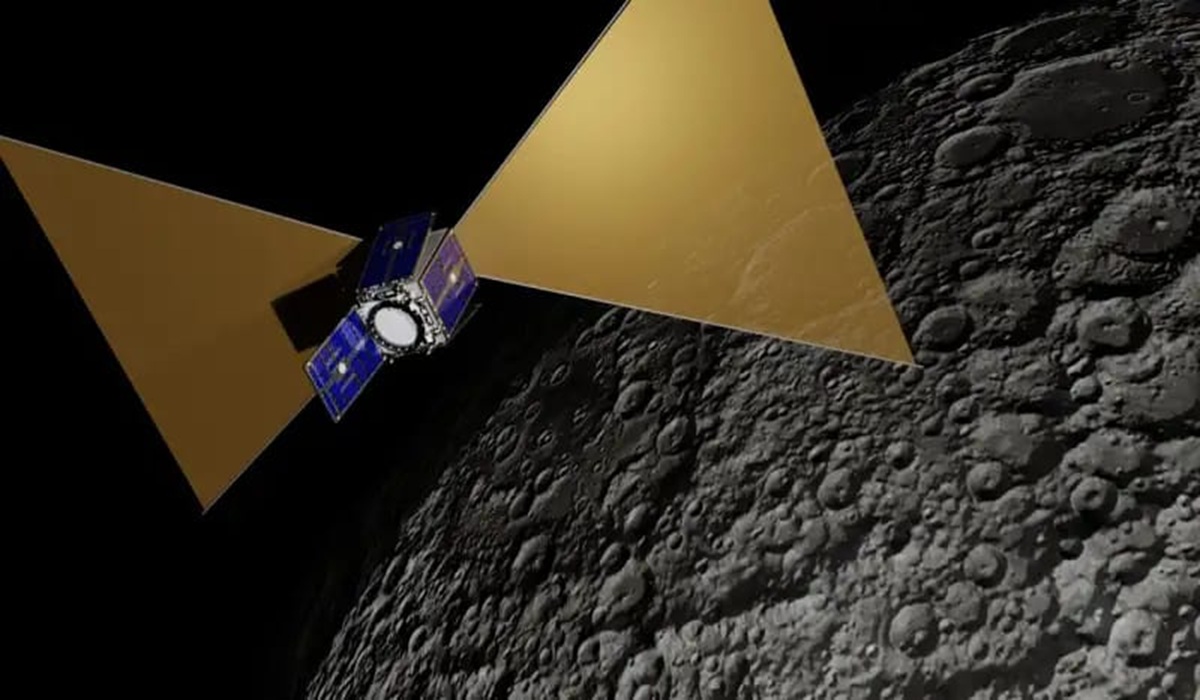
Scientists are preparing a new way to uncover traces from the early universe by utilising the far side of the Moon. A research team plans to place a satellite roughly the size of a suitcase into lunar orbit. The satellite, named CosmoCube, will take advantage of the far side of the Moon, which is shielded from various radio interference from Earth, to search for signals originating from the early universe.
CosmoCube will search for a radio signal known as the 21-centimetre line, or 21cm. This signal originates from neutral hydrogen atoms that filled the universe in its early period.
The 21cm signal is important because its wavelength changes due to the expansion of the universe. The older the observed signal, the greater the redshift it has undergone, causing its wavelength to become longer.
By tracking this signal, researchers hope to learn how conditions in the universe evolved over time after the Big Bang.
“The main thing we track by looking at this signal is the physical temperature of the gas during the early universe,” said Professor Eloy de Lera Acedo, lead author of the study from the Cavendish Laboratory at the University of Cambridge.
Researchers describe the 21cm signal as a cosmic thermometer. Its measurement is expected to provide a picture of gas conditions during a very early period in the history of the universe.
The observations cover a period known as the cosmic dark ages, which began around 380,000 years after the Big Bang. The research can then follow the development of the universe up to the emergence of the first stars and galaxies in a period called the cosmic dawn.
The observations are also expected to provide information up to the end of the epoch of reionisation, around one billion years after the Big Bang.
“The gas temperature is influenced by things happening in the universe at that time,” said de Lera Acedo.
Not only temperature, but the shape and strength of the 21cm signal are also expected to provide clues about dark matter. This mysterious component, which cannot be seen directly, is thought to make up most of the matter in the universe.
Therefore, measuring the 21cm signal could be one way for scientists to study the properties of dark matter while understanding the processes that shaped the structure of the universe.
Previous efforts to detect the 21cm line have been carried out using ground-based instruments. However, the signal being sought is extremely weak and easily obscured by man-made radio interference.
Signals from FM radio, aircraft communications, satellites, and various electronic devices can produce interference that disrupts observations. In addition, the Earth’s ionosphere is also a source of disturbance that makes it difficult for scientists to obtain signals from the early universe.
The far side of the Moon offers a quieter environment. When the satellite is behind the Moon, the celestial body can act as a natural shield against most radio interference originating from Earth.
This condition makes the far side of the Moon one of the locations considered ideal for low-frequency radio astronomy.
Nevertheless, observing the 21cm line is not an easy task. The EDGES (Experiment to Detect the Global EoR Signature) telescope team in Australia previously claimed to have found a signal related to that period, but the results remain a subject of debate among scientists.
The CosmoCube team estimates the mission will last about two years. The project is projected to cost just under £50 million.
De Lera Acedo estimates that CosmoCube could be launched around five years from now. The project has received more than £2 million in funding from the UK Space Agency.
Professor Phil Bull from the Jodrell Bank Centre for Astrophysics, who was not involved in the project, welcomed the CosmoCube mission plan. According to him, the measurements made by CosmoCube could help scientists understand important processes that occurred after the cosmic dark ages, including processes that eventually triggered the formation of the first stars and galaxies.
However, CosmoCube is not the only project hunting for this signal. Bull warned that a number of other lunar missions are also being planned and may reach the location first. His concern is that these missions could bring equipment that produces man-made radio interference.
This condition could potentially disrupt the radio environment that CosmoCube intended to exploit from the outset.
“More worryingly, other planned lunar missions may bring with them the kind of human-generated radio interference that this mission is trying to avoid,” said Bull.