
Sugar Production in 2026 Projected to be in Surplus, but Industry Still Faces Deficit
KOMPAS.com — National sugar production in 2026 is projected to increase and has the potential to create a surplus for household consumption needs, amid significant challenges in meeting the industrial sector’s requirements.
Based on the results of the initial estimation meeting for the 2026 White Crystal Sugar (GKP) milling season with all sugar mills across Indonesia in Surabaya, national sugar production is estimated to reach 3.04 million tonnes, supported by an existing sugarcane harvest area of 576,538 hectares.
“From a productivity perspective, the average GKP yield is estimated at 5.28 tonnes per hectare. Meanwhile, sugarcane productivity stands at 70.87 tonnes per hectare,” said Dr Abdul Roni Angkat, Director of Annual and Perennial Crops at the Ministry of Agriculture, to Kompas.com on Tuesday (21/4/2026).
The national average recovery rate is also projected to reach 7.45 percent, indicating improved efficiency in the sugarcane processing into sugar.
“With total production of 3.04 million tonnes, this achievement is estimated to meet the public’s sugar consumption needs, which are around 2.8 million tonnes,” he added.
“Thus, there is potential for a surplus of about 0.2 million tonnes for household consumption needs.”
This situation is seen as a positive signal for the stability of sugar supply and prices domestically, in line with the visible results from programmes to increase sugarcane productivity and improve industry performance.
In 2026, industrial sugar needs are estimated to reach 3.4 million tonnes, far exceeding the GKP supply that has so far been more focused on public consumption.
The gap between production and industrial needs becomes homework for the government and business players to find solutions, whether through increased production, efficiency, or measured import strategies.
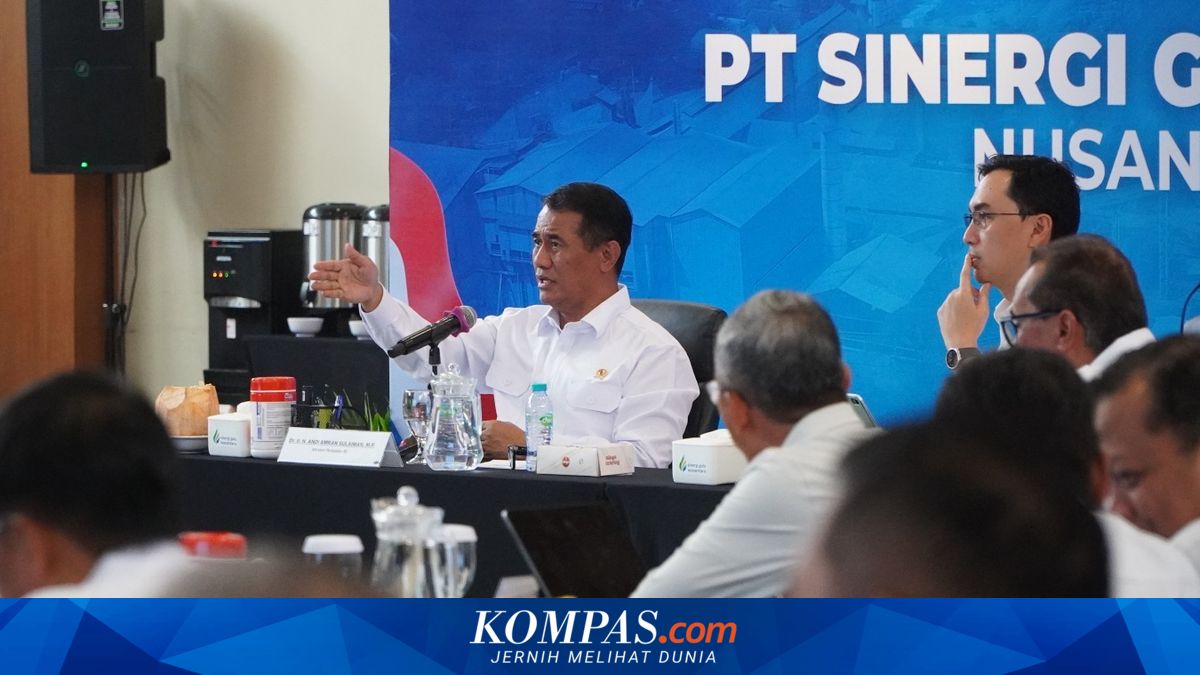
This is reflected in the working visit of the Minister of Agriculture of the Republic of Indonesia, Andi Amran Sulaiman, to PT Sinergi Gula Nusantara as part of the Coordination Meeting to Accelerate Food Self-Sufficiency.
“Ladies and gentlemen, why do we feel that self-sufficiency has been achieved? It is thanks to the food SOEs, PTPN. We were given targets by the President and asked to report routinely to the President for food SOEs, because food SOEs are the driving force,” he said.
The visit served as a momentum to evaluate various strategic programmes, from increasing productivity to optimising the role of the plantation holding in supporting food security.
As part of the PTPN plantation holding, PT Sinergi Gula Nusantara continues to be encouraged to increase its contribution to the national sugar sector.
The President Director of PT Sinergi Gula Nusantara, Mahmudi, emphasised the company’s commitment to strengthening the national sugar industry.
“We are committed to continuously increasing productivity, efficiency, and competitiveness of the national sugar industry as a real contribution from food SOEs in realising Indonesia’s food self-reliance,” he concluded.