
Sudirman Said Urges Student Activists to Cultivate Intrinsic Leadership
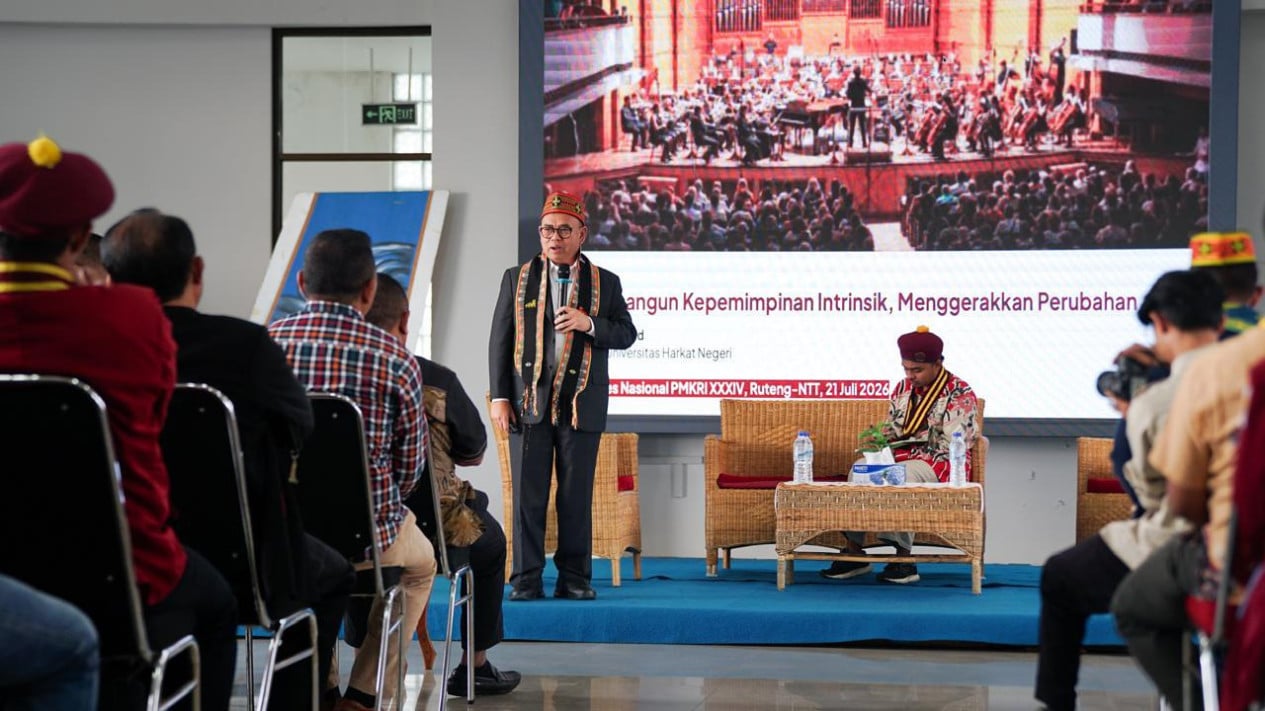
Rector of Universitas Harkat Negeri (UHN) Sudirman Said has urged student activists to build intrinsic leadership, a form of leadership whose source of strength is not formal authority, but rather values and character cultivated by an individual over time. He made the remarks at the 34th National Congress of the Union of Catholic University Students of the Republic of Indonesia (PMKRI) at Unika Indonesia St Paulus Ruteng, Flores. “We should be grateful for all the progress we have achieved as a nation. But we must realise that our current situation is not in good shape,” Sudirman said on Wednesday, 22 July 2026. Sudirman highlighted figures that contradict the Golden Indonesia 2045 vision. Over the past decade, alongside average economic growth of 5 per cent per year, the Corruption Perception Index ranking has plummeted from 88 to 109. “The richest one per cent control more than half of the national economy, the number of poor people has increased by more than 10 million, and around 19 million high school graduates are not in employment, education, or training,” he said. However, Sudirman remains convinced there are reasons for optimism, drawn from Indonesia’s history. Every major leap forward, from the National Awakening of 1908, the Youth Pledge of 1928, the Proclamation of 1945, to the Reformasi, has always been driven by the youth and the educated class. He noted that the current generation’s capital is far greater than in 1908, when almost the entire population was illiterate and there were only 178 native university students nationwide. Today, Indonesia has around 25 million students and nearly 3,000 higher education institutions. “Overall, we have the will to break through, fight the status quo, and make improvements,” he stated. Unfortunately, Sudirman said, the democratic achievements of the Reformasi have not been well maintained over the last decade. He claimed the Corruption Eradication Commission (KPK) has been weakened, law enforcement has become toothless, parliament has lost its oversight function, and political parties have turned into arenas for elite transactions. He described this condition as a black hole that must be immediately lifted out, and from there offered three leadership models that must grow simultaneously: institutional leadership, to fix damaged institutions; collective leadership, because no single figure can resolve problems of this magnitude alone; and, what he emphasised most that evening, intrinsic leadership.