
Suddenly, the Ministry of Agriculture Asks to Recalculate Reference Beef Prices, Why?
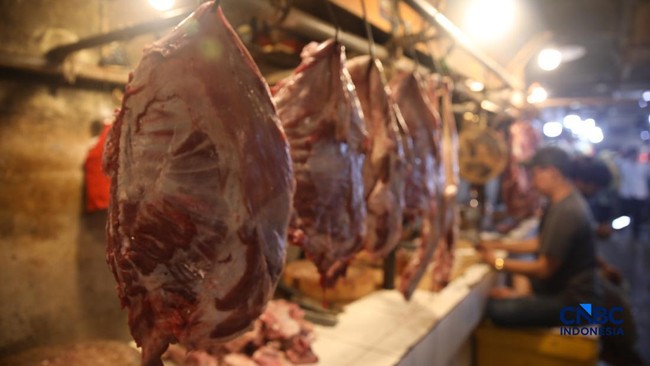
Jakarta, CNBC Indonesia - The Ministry of Agriculture (Kementan) has issued a warning regarding the surge in prices of imported feeder cattle from Australia, which is deemed to have exceeded normal assumptions. This situation is assessed as potentially pressuring business actors and impacting beef prices, particularly in regions reliant on imports such as Jabodetabek.
The Director of Livestock Product Downstreaming at Kementan, Makmun, revealed that the price increase for cattle in the source country has been significant in recent times.
“This is also a warning for all of us. Because cattle prices in Australia have risen. So feeder heifer (female fattening cattle) as of 20 April is already at US$4,” stated Makmun during the Regional Inflation Control Coordination Meeting broadcast via the Ministry of Home Affairs (Kemendagri) YouTube, on Monday (20/4/2026).
According to him, this figure is far above historical trends. “From our experience in previous years, it has never exceeded US$3.5,” he added.
Meanwhile, for male feeder cattle, prices have also risen sharply.
“Whereas for male feeder cattle, it’s already at US$4.56, and if averaged, US$4.32,” he explained.
Based on Kementan’s calculations, this price increase directly affects the CIF (Cost, Insurance and Freight) value up to the landed price in Indonesia. After accounting for shipping costs, insurance, exchange rates, as well as handling and loss fees, the price of imported feeder cattle is recorded as far exceeding the Reference Purchase Price (HAP).
“Plus travel insurance and then quarantine measures in Indonesia, the price per kilogram of live female feeder cattle is at Rp77,177. For male feeder cattle, it’s already Rp86,139. Meanwhile, our maximum HAP is Rp58,000 per kg live weight,” said Makmun.
He assessed this situation as a dilemma for business actors due to the wide price disparity.
“This looks like a somewhat complicated position. Because our HAP is a maximum of Rp58,000 per kg live weight, while the purchase price for our friends (importers) is already very high like this,” he remarked.
Therefore, Kementan is encouraging the National Food Agency (Bapanas) to promptly take policy adjustment measures.
“This is a warning, hopefully our friends from the Food Agency are taking this opportunity, perhaps later on what steps we can take to bridge the price increase at the source,” he said.
Furthermore, Makmun assessed that this rise in imported cattle prices is also expected to directly impact domestic beef prices in the market, especially in regions heavily dependent on import supplies.
“This will impact beef prices in Jabodetabek. Outside Java, it seems still quite safe, but for those relying on imported cattle, particularly Jabodetabek, this will definitely experience a surge, from the purchasing portrait of our friends there,” he explained.
Makmun stated that his side, together with Bapanas, had previously discussed revising the HAP to make it more realistic with current market conditions.
“Yesterday we also conveyed it, and also together with the Food Agency to revise the HAP with the existing conditions,” said Makmun.
According to him, this adjustment is important to maintain balance between purchase and selling prices, while avoiding pressure on business actors.
“So that later the Food Task Force doesn’t question it, while indeed the purchase is already high,” he said.
Makmun also reminded of the greater risk if policies are not adjusted soon, namely the potential disruption to supplies.
“If we pressure them, we’re worried they won’t buy, then we’ll be short on stock. This is even more dangerous if the stock runs out, because they are pressured to sell at the current HAP price,” he concluded.