
Sudden Emergence of New Mountain in Java, Geology Expert Reveals Its Origins
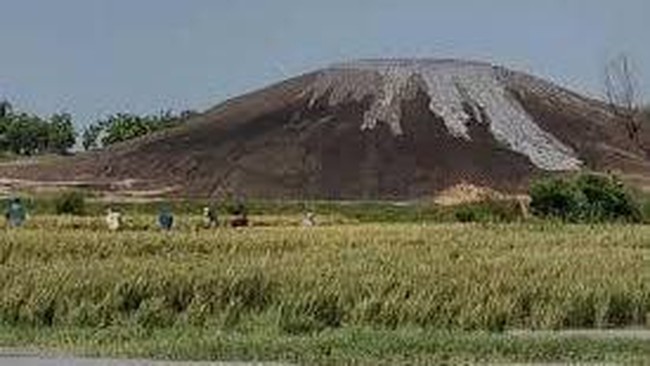
The phenomenon of a ‘new mountain’ emerging suddenly once stirred excitement among the people of Central Java, specifically in Grobogan. This event gained significant public attention in March 2024.
At that time, the mound, initially suspected to be a new mountain, emitted bursts of soil. From a distance, its appearance resembled a volcano.
The phenomenon became widely discussed on social media. Many speculated about the mound’s emergence and linked it to the 6.5 magnitude earthquake on 22 March 2024.
In response, Muhammad Wafid A.N, Head of the Geological Agency of the Ministry of Energy and Mineral Resources, affirmed that the mud mound in Grobogan was a mud volcano, termed ‘mud volcano’.
The mound reaches a height of 25 metres above the ground surface. Its formation is caused by natural gas rising to the surface upon encountering a vertical fault (conduit) and carrying mud with a density lighter than the surrounding sediments, as quoted from the official EGSA UGM website on Monday (20/4/2026).
“Various materials, such as mud, gas, rocks, sulphur, salt, and water, are erupted to the surface, forming a cone resembling a mountain,” states the article on the EGSA UGM website, citing Sabdaningsih, 2020.
Furthermore, the earthquake caused more active migration of hydrocarbons and mud due to cracks or faults from the shallow quake. This propelled hot mud to emerge with great force, resembling a volcano.
EGSA UGM notes that the mud volcano phenomenon in Grobogan is not an extraordinary incident. Mud volcanoes frequently occur in that area.
The mud volcano anomaly in Grobogan is said to originate from rocks experiencing an elongated fault from southwest to northeast. The fault then results in gas flows emerging to the Earth’s surface through permeable rocks.
Risks of Mud Volcano Emergence
In the EGSA UGM article, it is mentioned that mud volcanoes are not as explosive as volcanic eruptions. However, their eruptions still impact the surrounding areas.
One impact is damage to residents’ agricultural lands near the site. Additionally, periodic bursts of hot mud that shift locations can destroy rice fields and plantations of nearby residents.
Moreover, toxic gases such as hydrogen sulphide and carbon dioxide emitted by the hot mud bursts can endanger safety if inhaled in high concentrations.
“Hydrogen sulphide gas, with its pungent odour like rotten eggs, can cause irritation to the eyes, nose, and throat if inhaled in large amounts. Meanwhile, carbon dioxide gas in high concentrations can cause shortness of breath, dizziness, and even death if inhaled for a prolonged period,” states the EGSA UGM report.
Therefore, the government is urged to provide alternative solutions for residents who lose jobs due to damaged agricultural lands.
Potential of Mud Volcano Emergence
Nevertheless, this phenomenon can also bring significant opportunities for local residents. For example, in the tourism and creative industries sectors by leveraging the natural potential of the mud volcano.
“Through the integration of valuable mineral contents such as lithium, kaolinite, and calcite with unique microorganisms like halophilic bacteria, the mud from mud volcanoes becomes a promising material for various applications from industry to environmental conservation. This potential can be optimised through further research and sustainable technology development to provide maximum benefits for society and the environment,” the report states.
Mud volcanoes can also serve as an interesting research object for geologists, biologists, and environmental scientists. Scientists can study the chemical composition and materials contained in the hot mud eruptions.
From there, valuable information can be derived regarding Earth’s crustal processes, natural resource potentials, and impacts on the surrounding environment. Several components in the hot mud also have potential benefits in industry or other applications, such as in agriculture, energy, or even health.
Thus, the explanation from geology experts regarding the mud volcano emergence that went viral on social media. Hopefully, this information adds to our knowledge!