
Sudden Desil Changes Won't Immediately Cut Social Assistance, Government Says
Jakarta, CNBC Indonesia - The government has confirmed that changes to welfare rankings (desil) following the inclusion of 12 million new records from the Ministry of Population and Family Development/BKKBN will not immediately affect the social assistance (bansos) entitlements of recipients.
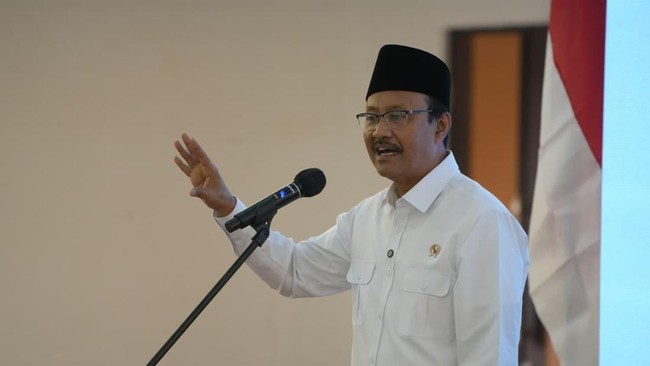
Social Affairs Minister Saifullah Yusuf said the data sourced from the Ministry of Population and Family Development/BKKBN is part of the national data consolidation process, which is subsequently verified, validated, and ranked by the Central Statistics Agency (BPS).
“There is nothing wrong with the data from BKKBN or the Ministry of Population and Family Development. There is absolutely nothing wrong with it. The data is part of the national data consolidation,” said the minister, who is familiarly known as Gus Ipul, in a written statement quoted on Monday (7/9/2026).
According to Gus Ipul, in line with Presidential Instruction Number 4 of 2025, BPS is the sole manager of the National Single Social and Economic Data (DTSEN). Meanwhile, ministries, agencies, and regional governments play a role in assisting the updating process.
Various data sources from ministries and agencies are then verified, validated, and standardised by BPS before being presented in rankings from desil 1 to desil 10.
“This data is very dynamic. Every day there are births, deaths, people moving residence, marriages, economic conditions improving, and some declining. Therefore, the updating process must be carried out continuously,” he said.
In addition to data from the Ministry of Social Affairs and BKKBN, the consolidation process also utilises data from various other agencies, including motor vehicle data and land data from the Ministry of Agrarian Affairs and Spatial Planning/National Land Agency (ATR/BPN). This integration is needed so that the socio-economic conditions of the public can be depicted more accurately.
Gus Ipul said that if spikes or changes in desil rankings are found during the consolidation process, the data will continue to be corrected and updated.
“If there are spikes now, they are being corrected and updated. Hopefully, within a not-too-long period, the rankings will better match the established measures,” he said.
Desil Changes Do Not Automatically Stop Social Assistance
Gus Ipul also emphasised that the assumption that people found to be in a high desil during data updating will automatically be removed from social assistance recipients is incorrect.
According to him, the determination of social assistance recipients is carried out every three months based on the results of updates from various parties, including regional governments, which are then processed and re-measured by BPS.
“If a desil is found to be inaccurate, it does not mean the social assistance will be immediately cut. There is still an objection period and an updating period for the next distribution,” said Gus Ipul.
He stressed that information suggesting someone temporarily recorded in desil 10 will automatically lose social assistance is inaccurate.
The Ministry of Social Affairs, Gus Ipul continued, has provided a number of channels for the public to correct data. Through the Cek Bansos application, the public can submit proposals or objections and see their desil position in DTSEN.
Meanwhile, a government channel is available through SIKS-NG, which can be accessed by data operators in villages, sub-districts, and social services offices across Indonesia. The public can also go directly to their village or sub-district office to get assistance with the data updating process.
“Every village and sub-district has a data operator. It is through these operators that updating proposals are forwarded for processing,” he said.
In addition to updating DTSEN, the government is also expanding the digitalisation of social protection. The programme is designed so that the public can apply for themselves or propose others to receive social assistance through a digital system by including the required supporting data.
The digitalisation of social assistance was previously piloted in Banyuwangi and is now being expanded to 42 regencies/cities. The government aims to expand its implementation nationally if the pilot areas perform well.
One of the updates being developed is a system that allows the eligibility of aid recipients to be tested using data from across government agencies.
“Later, the public can submit proposals, and then the system will provide an answer on whether they meet the requirements or not. If they do not yet meet the requirements, the reasons can also be known because the data is connected to various government agencies,” said Gus Ipul.
According to him, this integration is expected to reduce targeting errors in aid due to data inaccuracies, which have been a problem in the distribution of subsidies and social assistance.
Therefore, Gus Ipul invited the public to actively participate in monitoring and correcting data. Members of the public who know of affluent families still receiving social assistance can submit objections. Conversely, residents deemed eligible but not yet registered as recipients can also be proposed.
“The government is as open as possible. Nothing is being hidden. We want the public to be involved because the more parties participate, the more accurate our data will be,” he said.
Gus Ipul assured that the Ministry of Social Affairs also continues to monitor public complaints, including those conveyed through social media.
“On social media, there is information that is true, some that is half true, and some that is not true. We respond to all of it, we investigate, and we follow up because we truly want to obtain accurate data,” he said.