
Sucofindo Promotes Carbon Market Development and Food Supply Chain Resilience
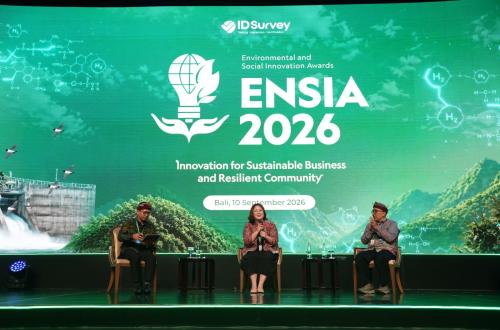
Sucofindo has highlighted the development of the carbon market and food supply chain resilience during the 2026 Environmental and Social Innovation Awards (ENSIA). These two issues were discussed as part of a knowledge exchange regarding innovations designed to address economic, environmental, and social challenges.
Senior Researcher at the Korea Research Institute on Climate Change (KRIC), Bonn Choi, stated that the implementation of Article 6 of the Paris Agreement opens opportunities to develop carbon market mechanisms as an effective instrument for emission reduction.
Bonn explained that investment in innovative technologies and low-emission facilities can generate economically valuable greenhouse gas emission reductions through carbon market mechanisms in accordance with applicable regulations.
“Emission reduction can provide two main benefits: supporting the achievement of Nationally Determined Contribution (NDC) targets and simultaneously opening new revenue opportunities through carbon trading transactions,” Bonn said in a written statement in Jakarta on Monday (2_September_2026).
According to Bonn, Indonesia possesses potential for emission reduction projects across various sectors, ranging from energy, household energy efficiency, waste management, and sustainable agriculture to forestry and Carbon Capture and Storage/Carbon Capture, Utilisation and Storage (CCS/CCUS) technologies. He noted that carbon market development requires support through the identification of priority sectors, regulatory strengthening, and the integration of various emission reduction sources into the Emissions Trading System (ETS).
“By identifying priority sectors, Indonesia can direct carbon investments in a measurable manner towards projects that have real environmental impacts, tangible economic benefits, and a greater contribution to development,” Bonn added.
In addition to the carbon market, ENSIA 2026 addressed food supply chain resilience. The Assistant Deputy for Food Logistics at the Coordinating Ministry for Food, Ridky Irfan Wirautama, stated that the agricultural and food sectors face challenges ranging from climate change, global economic dynamics, and food price volatility to natural disasters, logistics infrastructure readiness, and the depletion of productive land.
“Amidst these various challenges, innovation serves as a key solution. The transformation of waste management, including converting waste into electricity, demonstrates how environmental issues can be repurposed into sources of economic value and part of the energy solution,” said Ridky.
Ridky noted that the government is also expanding the application of a circular food economy and mitigating the impacts of extreme climate phenomena. In terms of maritime logistics, the development of green and smart ports is being undertaken by integrating digitalisation, modern governance, the ‘ASRI’ (Clean, Healthy, Neat, and Beautiful) culture, and the 3R principles (reduce, reuse, recycle).
Ridky mentioned that the blue economy also serves as a pillar of food security, opening new sources of economic growth in coastal areas through the provision of protein-based food, job creation, and investment opportunities.
He stated that the ‘Kampung Nelayan Merah Putih’ (KNMP) has also been launched as a new economic growth centre in coastal areas, integrating the value chain from upstream to downstream, including fishing production, processing, cooling and storage facilities, and market distribution networks.
“Through collaboration and the alignment of cross-sectoral food policy directions, we can ensure smoothness and strengthen the supply chain and logistics of food commodities so they can reach all regions of Indonesia,” said Ridky.