
Success story of sustainable aquaculture without sacrificing ecosystems
A story from Berau provides a valuable lesson that nature is not an adversary in the pursuit of a livelihood; instead, nature is a partner that must be preserved.
In the coastal areas of Berau Regency, East Kalimantan, there is a story proving that economic development does not have to sacrifice environmental sustainability. Both can proceed hand in hand without damaging the ecosystems that support community life.
In Kampung Pegat Batumbuk and Kampung Suaran, fish farmers are enjoying abundant harvests. Their happiness no longer stems from old practices that often sacrificed mangrove forests, but from a more environmentally friendly cultivation approach.
They are implementing a method known as Shrimp Carbon Aquaculture (SECURE), a system for shrimp and other fishery cultivation that combines increased productivity with environmental restoration.
This harvest is a tangible manifestation of the collaboration between the Nusantara Conservation Foundation (YKAN), the Berau Regency Fisheries Office, and the local community under the Solutions for Marine and Coastal Resilience in the Coral Triangle (SOMACORE) programme.
More than just a harvesting activity, this moment marks a new chapter for Berau’s coastal fisheries. This success demonstrates that protecting nature is actually the key to ensuring sustainable livelihoods for future generations.
Towards a wiser system
For decades, traditional pond aquaculture often relied on land expansion, even at the expense of mangrove forests that serve as natural barriers for coastal areas. The impact was declining water quality, deteriorating soil conditions, and increasingly unstable harvests. The loss of mangrove ecosystems also led to a reduction in the natural feed that has long supported pond productivity.
SECURE exists to change this paradigm through a simple yet revolutionary principle: better results do not have to be obtained by clearing more land. In this system, land use is managed more intelligently. Only about 20 per cent of the total area is used for cultivation, while the remaining 80 per cent is returned to its function as a conservation area and for mangrove restoration.
To some, this approach might sound like a reduction in business capacity. However, facts on the ground show otherwise; productivity has actually increased.
One example can be seen in the pond owned by Abdul Rahman in Kampung Pegat Batumbuk. Before implementing SECURE, his entire pond area was used for cultivation, but the harvest of black tiger shrimp was only about 100 kilograms per planting season. Now, even though the cultivation area has shrunk to just one-fifth of its original size, the yields have actually increased.
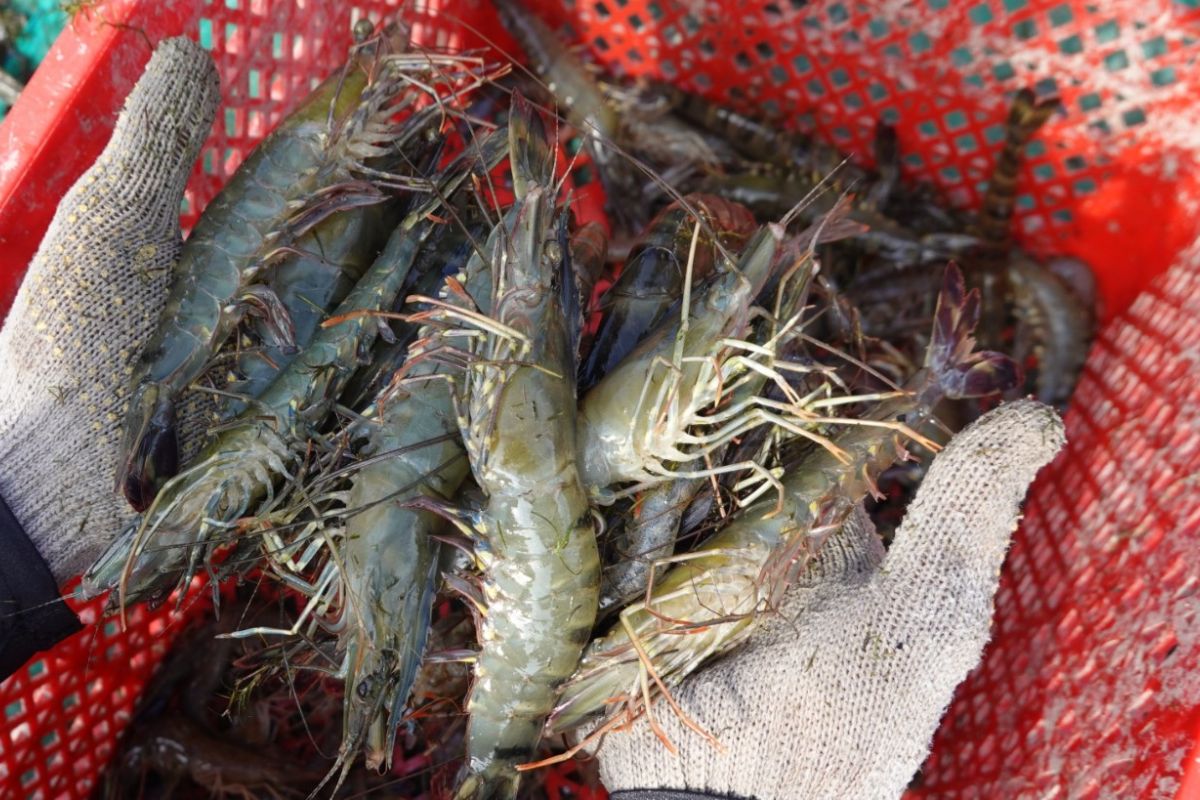
During the harvest conducted on Tuesday, 3 June this year, his pond produced 115 kilograms of black tiger shrimp, 141 kilograms of tiger prawns, 1.9 tonnes of milkfish, and 50 kilograms of mud crabs.
This achievement shows that pond management that considers environmental conditions can produce better productivity. The increase in black tiger shrimp production of approximately 15 per cent serves as proof that the quality of management is far more decisive than mere land area.
Source: jawawa.id (https://jawawa.id/newsitem/success-story-of-sustainable-aquaculture-without-sacrificing-ecosystems-1781661134)
Originally published by Antara (Indonesian) (https://www.antaranews.com/berita/5610727/kisah-sukses-tambak-berkelanjutan-tanpa-korbankan-ekosistem), translated from Indonesian