
Success in Food and Energy Self-Sufficiency: Pertamina Commissioners Applaud Uma Palak Lestari CSR Programme
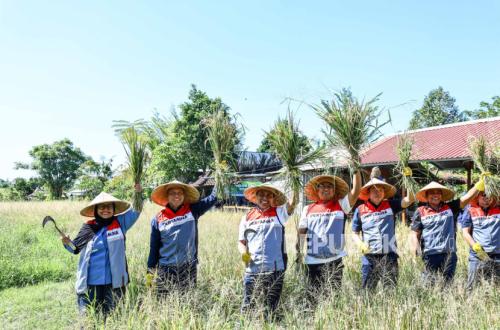
Pertamina continues to drive community self-reliance through the Independent Energy Village (DEB) programme, a Corporate Social Responsibility (CSR) initiative that integrates the use of renewable energy with community economic empowerment. One such programme is ‘Uma Palak Lestari’, managed by Pertamina Patra Niaga Aviation Fuel Terminal (AFT) Ngurah Rai, located in the Peguyangan area, North Denpasar, Bali.
To personally observe the success of this CSR initiative, Pertamina Commissioner Nanik S. Deyang and Independent Commissioner Condro Kirono visited the site recently. They were accompanied by Pertamina Patra Niage’s Director of Institutional and Compliance, Kadek Ambara Jaya, Pertamina Corporate Secretary Arya Dwi Paramita, and members of Pertamina’s management team. During the visit, the commissioners inspected various facilities and participated in a symbolic rice planting ceremony to support sustainable agriculture based on clean energy.
Previously, local farmers faced limited water supplies for agriculture, particularly during long dry seasons, which led to reduced harvests and impacted farmer welfare. The DEB programme was introduced to address these challenges by developing sustainable food agriculture supported by renewable energy, alongside the development of eco-tourism and educational tourism areas.
In the agricultural sector, Pertamina has implemented an irrigation system powered by Renewable Battery Technology (RBT) and micro-hydro plants with a capacity of 21 kWp. The use of clean energy has been able to reduce carbon emissions by up to 27.3 tonnes of CO2eq per year. The system currently irrigates 103 hectares of farmland, equipped with digital irrigation technology and electric agricultural tools, such as tractors and rice milling machines.
Additionally, Pertamina has built the ‘Bale Melajang’ facility as an agricultural education centre, promoting the use of organic fertilisers and providing training on irrigation management based on the traditional Subak system. The programme has benefited approximately 408 people, including 24 female farmers. Economic impacts include electricity cost savings of up to Rp 44 million per year and an increase in rice productivity from 5.5 tonnes to 7.5 tonnes per hectare. Furthermore, 5 hectares of land have been developed for organic ‘Mentik Susu’ rice cultivation, generating an annual turnover of Rp 476 million.
Beyond agriculture, the programme has developed eco-tourism and educational tourism zones, including green open spaces, jogging tracks, a cafe rest area, and a camping ground, attracting approximately 72,000 local and international tourists. The community earns an annual income of Rp 64 million from these activities.
Pertamina Commissioner Nanik S. Deyang noted that the Uma Palak Lestari CSR programme is an exemplary model of empowerment that successfully integrates the agricultural sector, energy independence, and community-based tourism. “In 2023, these farmers suffered crop failures, but after receiving assistance from Pertamina, they are harvesting again and their income has potentially doubled,” said Nanik. She expressed hope that this model could be replicated across other Pertamina operational areas to benefit farmers, small entrepreneurs, and tourism operators.
Similarly, Independent Commissioner Condro Kirono emphasised that CSR programmes must create sustainable benefits for communities surrounding company operations. He stated that Pertamina strives to empower and prosper the community so they can feel the tangible benefits of the company’s presence. “Through these tangible benefits, we hope to foster a sense of responsibility to protect Pertamina’s presence as a state-owned company and a national vital object,” he said.
I Wayan Sukadana, Chairman of the Uma Palak Lestari Joint Business Group (KUB), also expressed his appreciation for Pertamina’s support. “Since the arrival of Pertamina’s CSR programme from 2021 to 2026, through various coaching and facilities provided, it has been able to increase agricultural yields and improve the economic welfare of both the farming group members and the wider community. I thank Pertamina,” he concluded.