
Suahasil Nazara and the Test of Strengthening Fiscal Policy Credibility
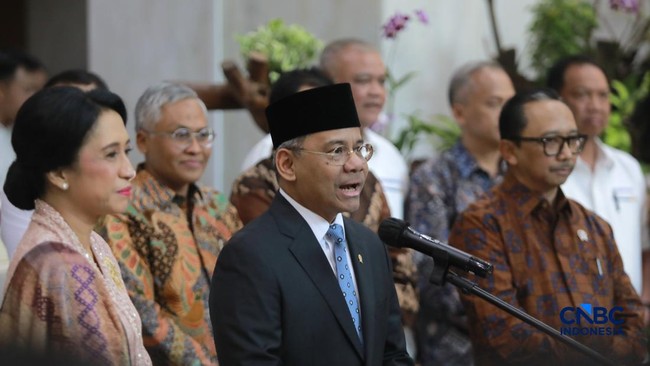
The market gave a fairly promising initial welcome to the appointment of Suahasil Nazara as Finance Minister. In trading on 14 September 2026, the Composite Stock Price Index (IHSG) briefly slumped around 2.5 per cent before recovering nearly all of its losses and closing slightly lower, down 0.10 per cent at 6,534.69.
The indices comprising large-capitalisation stocks actually moved positive: LQ45 rose 1.43 per cent and IDX30 strengthened 1.40 per cent. The recovery was mainly underpinned by banking shares. BBRI gained 3.98 per cent, BBTN 3.40 per cent, BBNI 3.20 per cent, BBCA 2.77 per cent, and BMRI 1.84 per cent.
This dynamic is relevant because banking is a sector sensitive to expectations regarding growth, liquidity, interest rates, government fund management, and fiscal-monetary policy coordination.
These movements cannot be entirely attributed to the change of Finance Minister. When the Indonesia Stock Exchange opened, investors also carried positive sentiment from Wall Street’s close at the end of the previous week.
The S&P 500, Dow Jones, and Nasdaq each strengthened by around one per cent. Asian markets on 14 September themselves moved more mixed: the Hang Seng strengthened, whilst the Nikkei and KOSPI weakened. The more relevant indication, therefore, is not merely the change in the IHSG from the previous close, but the intraday reversal and selective strengthening of large-cap shares after the announcement.
These patterns are consistent with initial relief over the new Finance Minister figure, but they do not yet prove lasting confidence. The market has extended reputational credit, not a blank cheque.
Initial capital, not the final outcome
Positive expectations of Suahasil are not without basis. He is no newcomer to fiscal management. His experience as Head of the Fiscal Policy Agency and Deputy Finance Minister gives him an understanding of the state budget (APBN) formulation process, fiscal administration, financing management, and inter-institutional coordination.
His academic background and research further reinforce the perception that policy will be formulated on the basis of data and analysis. However, personal credibility is different from policy credibility. A minister’s track record helps the market form initial estimates when new decisions are not yet available. After that, the weight of reputation diminishes and is replaced by information on policy direction, consistency of communication, quality of implementation, and results achieved.
Suahasil’s test, therefore, is not choosing between fiscal discipline and economic growth. He must demonstrate that the APBN can remain active in driving the economy without sacrificing confidence in the continuity of state finances. This task must be carried out across several horizons at once: completing the 2026 APBN, ensuring the consistency of the 2027 APBN, and building policy coordination within the new constellation of macro-financial authorities.
Two budgets in one period of transition
Suahasil takes office as Finance Minister as the 2026 fiscal year approaches its final quarter. In the time remaining, the room to adjust the implementation of the 2026 APBN is relatively limited. In its initial posture, the 2026 APBN set state revenue at Rp3,153.6 trillion, state spending at Rp3,842.7 trillion, and a deficit of Rp689.1 trillion, or 2.68 per cent of GDP.
In the latest outlook, revenue is estimated to rise to Rp3,208.1 trillion. However, spending is projected to increase further, to Rp3,942.4 trillion. As a result, the deficit is estimated to widen to Rp734.3 trillion, or 2.85 per cent of GDP. Compared with the initial budget, additional spending reaches around Rp99.7 trillion, nearly twice the additional revenue estimated at Rp54.5 trillion.
With fiscal space towards the legal 3 per cent deficit ceiling growing thinner, optimisation of the APBN cannot be interpreted merely as accelerating disbursement. Suahasil needs to ensure that spending with high leverage continues to run, while expenditure with low benefit can be controlled.
Pressure on subsidies and compensation, interest costs, financing needs, the use of unspent budget balances, and contingency obligations must also be managed without reducing the APBN’s capacity to face shocks.
At the same time, Suahasil inherits the 2027 draft budget (RAPBN), which has been prepared and is entering the budgetary political process. State revenue is targeted at Rp3,426 trillion and spending at Rp4,097.2 trillion. The deficit is planned to fall to Rp671.2 trillion, or 2.40 per cent of GDP, whilst economic growth is targeted to rise to 6 per cent.
This combination presents no light challenge. Compared with the 2026 outlook, revenue must grow 6.8 per cent, whilst spending increases by around 3.9 per cent. The government wants to accelerate growth whilst simultaneously carrying out fiscal consolidation. Suahasil needs to explain the mechanism that brings these two objectives together.
The impetus for economic growth comes from a combination of improved spending quality, higher productivity, stronger private investment, and better financial intermediation. However, this relationship does not occur automatically.
The government must show which spending has a high economic multiplier, how the APBN leverages investment without taking on excessive risk, and how realistic its revenue improvement is. Without a clear transmission mechanism, the targeted 6 per cent economic growth and 2.40 per cent deficit will merely look like two optimistic targets placed side by side.
From reputational credibility towards a series of proving tests
Confidence in fiscal policy is not formed on inauguration day. Suahasil’s track record can foster optimism, but the market and the public will continuously assess the decisions taken afterwards. There are at least five tests that will determine whether that initial confidence can develop into stronger credibility.
The first test is the market response around the inauguration. At this stage, the market has no new policy to evaluate. Investors use experience, academic portfolio, initial statements, and perceptions of the mandate given by the president.
Credibility at this stage is still borrowed from past reputation. The next test comes during deliberation and ratification of the 2027 APBN. In this phase, what is tested is no longer biography but policy choices. Macroeconomic assumptions, revenue targets, spending priorities, financing strategy, and risk disclosure will show whether the commitment to maintaining a healthy APBN is translated into a realistic posture.
The closing of the 2026 APBN becomes the first execution test. The market and public can compare the outlook with the realisation of revenue, spending, deficit, subsidies, and financing. Deviation from target does not always mean failure, because changes in oil prices, exchange rates, and global conditions can affect the APBN.
However, every deviation needs to be explained openly, including the reasons for the change and the source of its financing. Entering the first quarter and semester of 2027, assessment shifts towards implementation. Revenue realisation, spending composition, results of state securities auctions, and consistency of programme execution will show whether the budget posture can truly be carried out.
At this stage, credibility can weaken if revenue falls behind, productive spending becomes the target of cuts, or policy changes without adequate explanation.
Over a longer horizon, personal reputation loses weight and is replaced by a track record of performance. Fiscal credibility should be understood as confidence that the government is able to carry out its revenue and spending plans and fulfil its debt obligations.
This credibility can be observed through the distance between official targets and market expectations, and between budget plans and their realisation. A deficit below 3 per cent is therefore necessary, but not sufficient.
A low deficit can still be questioned if it is built on overly optimistic revenue assumptions, the postponement of productive spending, non-recurring revenue, or the shifting of obligations outside the APBN. Credibility also depends on the completeness of information, timeliness of reporting, openness about risks, and consistency of data conveyed to the public.
A new constellation of macro-financial policy
Suahasil’s test does not stop at fiscal policy alone. As coordinator of the Financial System Stability Committee, he must work with the relatively new leadership of Bank Indonesia, the Financial Services Authority (OJK), and the Deposit Insurance Corporation (LPS).
This constellation opens opportunities to build a more coherent policy mix, but at the same time requires adjustments in ways of working and a shared diagnosis of economic problems. Coordination does not mean all institutions must take the same policy direction.
When the government uses the APBN and liquidity management to accelerate growth, Bank Indonesia may still need to hold interest rates to contain pressure on the rupiah and inflation. The OJK must ensure that accelerated lending does not degrade asset quality, whilst the LPS safeguards depositor confidence and readiness to handle troubled banks.
Credible coordination requires a clear division of mandates. Fiscal, monetary, macroprudential, supervisory, and guarantee policies must complement one another without blurring the independence of each institution. The test is not how often the authorities hold meetings, but whether the policy mix can maintain stability whilst channelling financing towards productive activity.
The market has given Suahasil a reasonably strong initial footing. However, strengthening fiscal credibility will be determined by the distance between statements and decisions, between targets and realisation, and between the size of spending and the benefits it produces.
His success will be reflected not only in the IHSG’s response or the rupiah’s movement, but in the government’s ability to maintain financing costs, the quality of the APBN, the stability of the financial system, and fiscal support for sustainable growth.
Source: jawawa.id (https://jawawa.id/newsitem/suahasil-nazara-and-the-test-of-strengthening-fiscal-policy-credibility-1789444355)
Originally published by CNBC Indonesia (https://www.cnbcindonesia.com/opini/20260915091748-14-767940/suahasil-nazara-dan-ujian-penguatan-kredibilitas-kebijakan-fiskal), translated from Indonesian